


When you think about blockchain, you imagine coders in hoodies, not engineers in hard hats. But the more you look at how decentralized systems actually work, the clearer it becomes: blockchain’s future depends less on speed and hype, and more on discipline and structure; hence, blockchain needs engineers
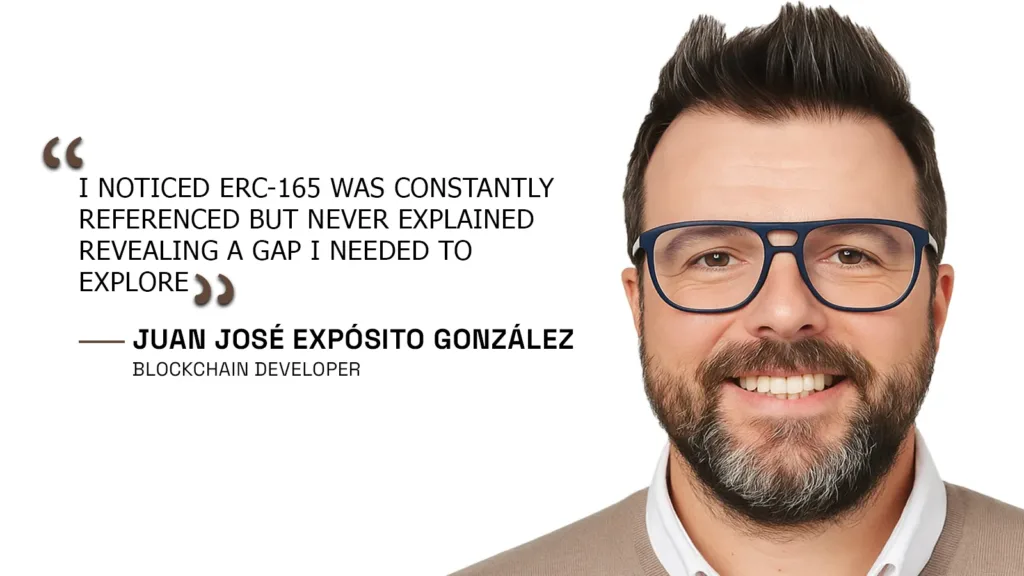
Juan José Expósito González, an engineer turned blockchain developer with over two decades in drilling and operations, puts it simply: “The most critical components of any system are usually the ones nobody sees or talks about.”
And that’s the story of blockchain’s hidden backbone: standards like ERC-165, the quiet frameworks that make everything else run smoothly.
The invisible architecture of Web3 and reasons blockchain needs engineers
When you hear Ethereum, most people know about ERC-20 and ERC-721, the standards that power tokens and NFTs. They’re the visible layer, the showpieces. But beneath them are architectural standards like ERC-165, which defines how smart contracts recognize and interact with each other.
Juan was drawn to this invisible layer for a reason. “Everyone talks about ERC-20 and ERC-721 because they’re the visible layer, tokens and NFTs people interact with daily,” he explains. “But as an engineer with 22 years in drilling and planning, I’ve learned that the most critical components of any system are the ones nobody talks about.”
He describes it as a case of “invisible infrastructure syndrome.” Just as people don’t think about the electrical grid until the power goes out, blockchain users rarely think about the standards that keep the ecosystem stable until something breaks.
ERC-165: The language of contracts
Juan offers an elegant analogy for ERC-165:
“Before it existed, when one smart contract wanted to interact with another, it was like calling someone without knowing if they spoke your language. You’d just have to try and hope for the best, which in blockchain means wasted gas or catastrophic errors.”
ERC-165 changed that by introducing a universal question system, a way for contracts to ask, “Do you understand this interface?” It’s a simple handshake protocol that prevents chaos. By using mathematical signatures, it checks compatibility efficiently and keeps interactions predictable.
That’s not glamorous, but it’s revolutionary, the kind of foundational reliability that turns blockchain from a risky playground into a stable digital economy.
From oil wells to smart contracts
Juan’s journey from drilling rigs to decentralized finance reveals why blockchain needs engineers.
“In drilling, we deal with high-stakes environments where failures are expensive and dangerous,” he says. “You learn to think in terms of redundancy, safety, testing, and documentation. I apply these same principles to blockchain.”
He treats code like a critical system, one that must be auditable, tested, and resilient. His engineering mindset pushes him to ask uncomfortable but essential questions: What happens if this fails? How do we recover? What are the edge cases?
That mindset, he argues, is missing from much of today’s blockchain development culture.
Move deliberately and build things that last
“Right now, blockchain development often feels like the wild west,” Juan says. “Smart contracts are deployed without proper testing, systems are built without redundancy, and protocols launch without thinking about failure modes.”
He believes the solution is simple: borrow from traditional engineering.
- Standardized testing frameworks for reliability
- Formal verification methods to mathematically prove safety
- Incident response protocols for when things go wrong
- Peer review cultures before any mainnet deployment
- Continuous monitoring to ensure long-term stability
“The stakes are real,” he adds. “We’re building financial infrastructure that people trust with their assets. That deserves the same rigor we’d apply to a bridge, an aircraft, or a drilling operation.”
The bottom line
Blockchain doesn’t need to slow down. It just needs to grow up. As Juan puts it, “We can learn from a century of traditional engineering mistakes without repeating them.”
The future of blockchain won’t just belong to those who write code fastest; it’ll belong to those who build with structure, redundancy, and purpose. In the end, the next revolution in Web3 might not come from a new token or protocol but from something far more old-fashioned: an engineering discipline. All being said, blockchain needs engineers, and that’s a fact.