
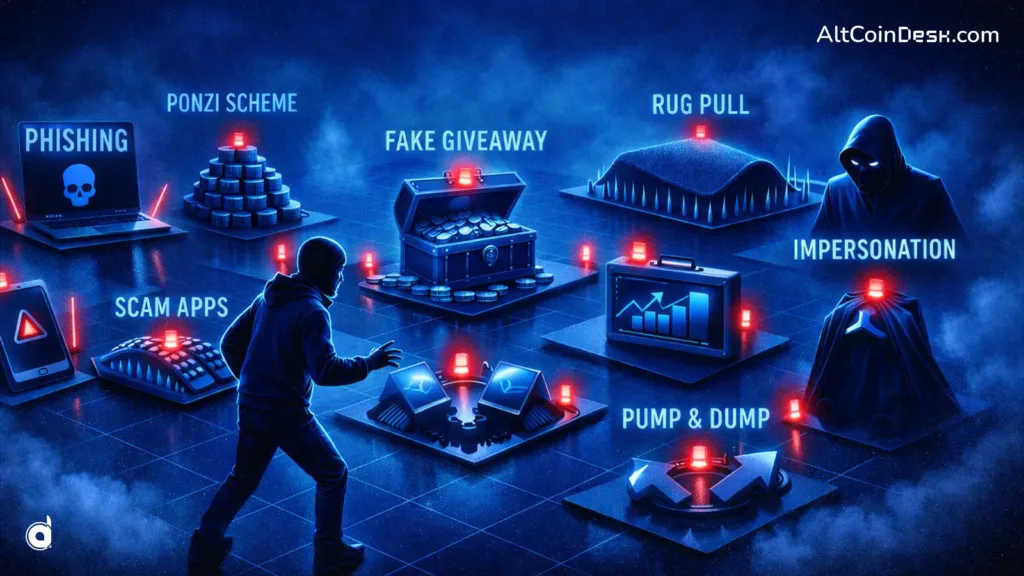

Crypto is real, the profits people talk about are real, and the scams are just as real. Every year, billions of dollars are lost to fraudsters who target people who are still finding their footing in the crypto world. The worst part? These scams rarely look like scams. They look like opportunities, friendly advice, or a lucky break.
The good news is that crypto scams follow patterns. Once someone understands how each one works, they become very hard to fall for.
1. Pig butchering: The slow burn crypto scam
This one starts with a friendly message. Sometimes a wrong-number text, sometimes a follow request on Instagram or WhatsApp. The person on the other end is warm, attentive, and in no rush. Over weeks, they build what feels like a genuine connection, and then casually mention how well they’ve been doing in crypto. They offer to show the way.
By the time the victim realizes what’s happening, they’ve transferred real money to a fake platform the scammer controls. The name comes from the idea of fattening livestock before slaughter. It’s a cruel setup, and it works because it feels completely human.
In April 2025, a woman in Maryland lost $3 million this way. After the initial loss, she was then targeted by fake “recovery” companies asking for upfront fees to get her money back. The scam didn’t stop after it ended.
Watch out for:
- A stranger online who’s unusually eager to connect
- Conversations that quickly shift toward crypto investing
- Platforms you’ve never heard of being recommended by someone you’ve never met in person
2. Phishing: The fake email or text scam
An email arrives that looks exactly like it’s from Coinbase or MetaMask. It says something urgent, like an account being compromised, or a need to verify identity before losing access. There’s a link. The website looks identical to the real thing. A password or seed phrase gets entered. That’s it, it’s gone.
This is one of the most common cryptocurrency scams because it doesn’t require a long setup. It just needs one moment of panic and one click.
The trick scammers use is subtle misspellings in the URL. Something like “coinbase-secure-login.com” instead of “coinbase.com.” It’s easy to miss when there’s urgency involved.
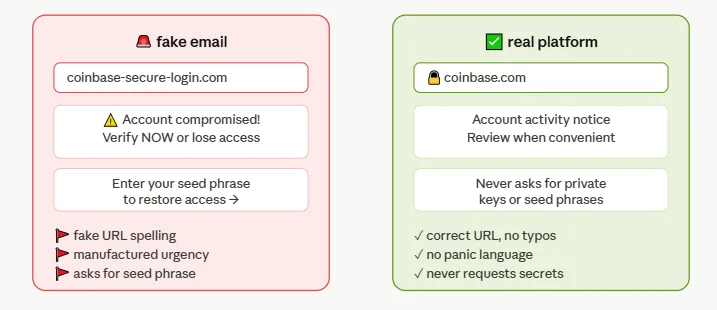
The rule: Never click links in emails or texts about crypto. Open a browser and type the website address directly every single time.
3. Fake giveaways: The “double your crypto” trick
A video shows up on YouTube or X of a well-known figure, sometimes Elon Musk, sometimes a popular CEO, saying they’re giving back to the community. Send one Bitcoin, get two back. It’s always fake. Always.
In recent years, scammers have started using deepfake videos to make them look completely convincing. One scam using a deepfake of a popular crypto YouTuber collected over half a million dollars in fake “entry fees” before it was caught.
No legitimate person or company will ever ask someone to send crypto in exchange for getting more back. That’s the one rule that never changes.
4. Rug pulls: The vanishing act
A new coin launches with a slick website, a detailed roadmap, and a buzzing Discord community. People invest. The price climbs. Then one day, the developers disappear, taking all the funds with them. The coin drops to zero overnight.
Rug pulls show up a lot in DeFi and NFT projects, and the scary part is they’re built to look completely credible – until the money’s gone.
Signs to watch for:
- No real names or verifiable backgrounds behind the project
- The token can be bought but not sold, a technical trick scammers build in
- Big promises with no working product to show
5. Pump and dump: The artificial hype machine
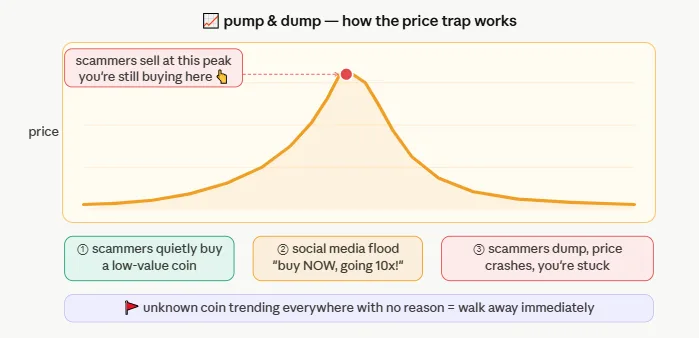
A group quietly buys a large amount of a low-value coin. Then social media gets flooded with posts. “This coin is about to explode.” “Insiders are buying now.” People pile in, the price jumps, and then the group sells everything at the peak. The price collapses, and everyone else is left holding worthless tokens.
Pump and dump scams live and die on FOMO. When a coin nobody’s heard of is suddenly all over social media, and influencers are pushing it hard without saying what it actually does. That’s not opportunity, that’s bait.
6. Fake exchanges and wallets: The counterfeit platform
Some scammers build entire crypto exchanges or wallet apps just to collect deposits. The app might even show fake profits for a while to keep users engaged. Then one day it’s gone, pulled from the app store, with customer support going silent and the money nowhere to be found.
How to stay safe:
- Only use well-known exchanges like Coinbase, Kraken, or Gemini
- Always go directly to the official website, never through a link someone sent
- If withdrawals keep getting blocked with excuses like “pay a tax fee first,” leave immediately
7. Ponzi schemes: Robbing Peter to pay Paul
A platform promises returns that sound unbelievable, like five percent per day or guaranteed monthly profits. Early investors actually do get paid, but only because newer investors’ money is being used to cover it. The moment new money slows down, the whole thing collapses.
The key giveaway with these crypto scams is the word “guaranteed.” No legitimate investment, whether it’s stocks, real estate, or crypto, can guarantee returns. Anyone who says otherwise is lying.
8. SIM swap and Bitcoin ATM scams: The phone hijack
A SIM swap happens when a scammer convinces a mobile carrier to transfer someone’s phone number to a SIM card they control. Once they have the number, they can intercept two-factor authentication codes and break into crypto accounts.
Bitcoin ATM scams work differently. Someone gets a call from a person claiming to be from the IRS, the FBI, or a bank, telling them to go to a Bitcoin ATM and send payment immediately. No real government agency or bank will ever ask for payment this way. Ever.
If someone calls and says to go buy Bitcoin at an ATM, hang up.
How to avoid crypto scams: the short version
Knowing how to avoid crypto scams starts with a few habits that never change.
- Never share a seed phrase or private key with anyone, not support teams, not exchanges, not anyone
- If something sounds too good to be true, it is
- Urgency is a manipulation tactic, real opportunities don’t expire in ten minutes
- Always verify by going directly to official websites, never through links in messages
- If something feels off, it probably is
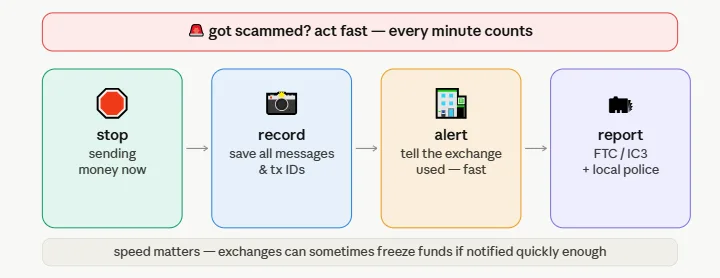
If a scam does happen, act fast. Stop sending money, save every message and transaction record, and report it to the exchange used. Speed matters because exchanges can sometimes freeze funds if they’re notified quickly enough.
Crypto scams aren’t going away, but they’re also not impossible to spot. A little skepticism and a few solid habits go a long way.