



The ability to earn money in crypto without the necessity to trade has encouraged more investors to think about staking their assets. As a result, many investors are looking for the best crypto staking platforms that provide stable returns.
This guide will cover some of the best crypto staking platforms that offer profitable staking returns in 2026. The picks are determined on the basis of reliability, assets supported, lock-up conditions, and realistic staking APY.
What is a crypto staking platform?
A crypto staking platform is a service that allows investors to lock their tokens to be used by validators to authenticate transactions across a particular blockchain network based on a Proof-of-Stake (PoS) mechanism. These platforms handle the operational side of staking, including validator participation, reward calculation, and distribution.
Rather than acting as a validator, which requires technical knowledge and capital, investors can use a crypto staking platform that stakes the tokens on their behalf through a few clicks. Upon lapse of the staking period, these investors get rewards in turn, depending on the tokens accumulated and the efficiency of the validators.
Some crypto staking platforms require full custody of the staked assets. However, this predisposes investors to counterparty risks since the platform requires investors to entrust management of their private keys to the staking platform. In contrast, others allow investors to deposit and store their own keys, which limits counterparty risks.
How does crypto staking work?
Staking means committing or delegating your tokens so a blockchain network can process and confirm transactions properly. Validators rely on these staked assets as backing when verifying activity and maintaining the integrity of the network. In return, the blockchain rewards the validators and stakers for their activities.
Once staked, investors’ assets are either combined with those of other users or assigned to a chosen group of validators. The platform then distributes part of the rewards to the stakers once the staking period lapses or investors unstake their assets. Such payouts are typically issued in the form of the assets staked.
The returns from crypto staking are typically computed as Annual Percentage Yield (APY). Platforms that offer this service often have varying staking APYs based on factors such as validator performance and overall network participation.
Additionally, the returns are affected by the number of people who have staked their tokens. A surge in the number of users who have staked the same asset leads to a reduction in the reward per user.
Staking crypto platforms also differ in terms of flexibility on when to withdraw the staked assets. Certain crypto staking platforms allow investors to withdraw deposited assets immediately, whereas some compel investors to stake their assets over a fixed time. For the latter, the assets can only be withdrawn upon lapse of the staking duration.
5 best crypto staking platforms in 2026
The following are five of the best crypto staking platforms offering high yields in 2026:
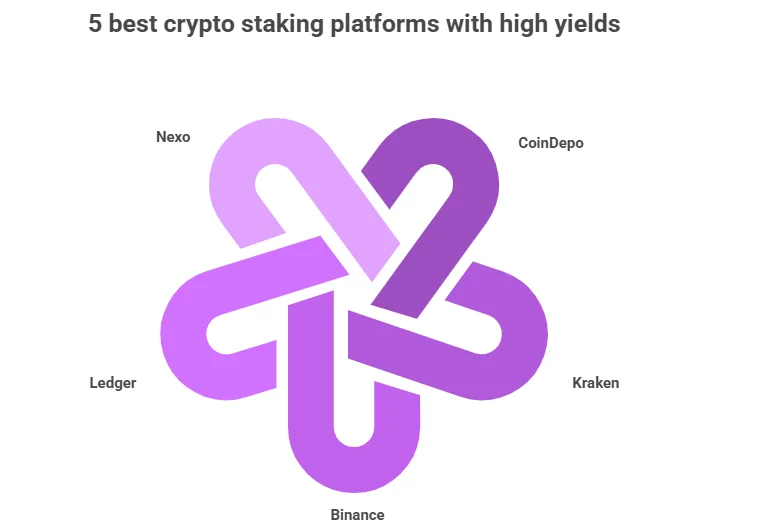
1. CoinDepo
CoinDepo is dedicated to a savings model that emphasizes stable returns and insured deposits. It has a comparatively high Annual Percentage Yield (APY) for most of the popular cryptocurrencies and stablecoins. The platform also offers higher rates depending on the commitment (staking) period.
The site is designed for users who prefer less complicated decentralized finance (DeFi) tools. Staking on CoinDepo is quite straightforward; you only need to deposit assets, select a staking plan, and start to earn passive rewards per the underlying conditions.
Pros
- Higher yields compared to most centralized sites.
- Insurance structure boosts investor confidence.
- User-friendly interface and minimum setup.
Cons
- The third-party custody is required in the fixed staking plans.
- Inflexible when compared to alternative DeFi.
2. Kraken
Kraken is a crypto staking platform that is oriented to users who care more about transparency and reliability rather than high returns. This platform offers supports staking of various digital assets, including flexible or bonded options, based on the token.
The platform clearly defines reward expectations, making it easy for investors to have a rough estimate of how much they could receive as staking returns. This renders Kraken appropriate for those users who desire predictable results.
Pros
- Transparent staking reward system.
- Impressive reputation in terms of security.
- Features several staking plans.
Cons
- Investors must grant the platform full custody of assets.
- Offers lower returns
3. Binance
Binance is a multi-faceted staking platform that provides investors with a wide range of different staking services through its earn products. The platform allows investors to choose between flexible staking options and fixed-term options.
Rewards can be earned regularly, and the platform combines staking with trading, so the user can do it all in a single account. Binance’s limited campaigns give some of the best yields, although swift action is required.
Pros
- Wide selection of supported tokens.
- Various revenue streams other than simple staking.
- Rewards are shared regularly.
Cons
- Unreliable rewards due to limited promotions
- Needs full custody of assets.
4. Ledger
Ledger is a uniquely designed crypto staking platform that enables staking via a hardware wallet environment. Because of this design, this platform allows investors to stake without moving assets to a centralized platform.
This method is more appropriate for users looking for control of their assets while seeking passive returns through staking. Although the returns on Ledger vary based on the validator and the network, the key advantage is the minimization of the third-party custody risk.
Pros
- Investors have full control over private keys.
- Hardware integration with powerful security.
- Supports various networks of staking.
Cons
- The process of setting up is complex.
- There is no standardization of returns.
5. Nexo
Nexo structures its staking earnings system more like a fixed-income setup than a typical crypto staking model. Users can choose to keep funds available for withdrawal or commit them for a defined period in exchange for higher returns, depending on their strategy.
The layout keeps everything in one place, so checking earnings and managing balances does not involve jumping through complicated steps.
Pros
- Straightforward layout with easy-to-understand earning options
- Supports flexible and fixed-term staking.
- Platform users enjoy additional benefits.
Cons
- Prices are based on account level.
- Requires full custody of staked assets
How to choose the best platform for crypto staking
Some of the major steps to follow include the following:
Step 1: Choose the right platform type
Begin by deciding how you want your assets handled. Centralized platforms handle all the staking operations without requiring investor input. However, this forces full control of assets by the platform. Decentralized options, on the other hand, leave control in your hands, though they require you to manage wallets and understand how staking works.
Step 2: Evaluate security and validator performance
Before committing funds, take time to check how the platform operates. Look at validator uptime, past consistency in payouts, and how user funds are stored. Opt for platforms that have well explained staking process and underlying risks.
Step 3: Compare rewards besides the APY
Some platforms advertise high APYs for staked tokens. However, the returns are often impacted by changes in token value and price changes, which may slash the rewards significantly. Investors must thus opt for stable rewards by considering other factors besides the highest reward advertised.
Step 4: Comprehend the lock-up conditions
The staking terms vary according to the product. Flexible plans enable you to withdraw at your own will, but in the fixed plans, the assets are locked for a specific period. The trade-off is normally between access and higher returns.
Step 5: Analyze assets and added benefits
Make sure that the platform supports the assets that you wish to be staked. Others as well provide functionality of added value, like the availability of governance, reward systems, or compatibility with a hardware wallet, which can improve control and security.
Conclusion
Different platforms suit different individuals, and therefore, investors should concentrate on crypto staking platforms that provide consistent and stable returns in the long run. However, our list shows that CoinDepo, Kraken, Binance, Ledger, and Nexo are some of the best five picks to consider.
Before committing, it is crucial for investors to check returns against the risks involved in order to mitigate them. Opting for multiple crypto staking platforms can also help in diversifying risks as opposed to depending on a single crypto staking provider.