


Crypto trading sounds like the easiest thing in the world until you actually do it. Buy low, sell high, repeat. But the moment real money is involved, emotions kick in, markets move unpredictably, and that clean, simple plan starts falling apart fast. Most new traders don’t lose because they’re bad at analysis.
They lose because nobody told them that knowing when to enter a trade is only half the job, and knowing how to protect yourself when it goes wrong is the other half.
That’s the whole point of risk management for spot vs futures crypto trading. Let’s understand how both markets work, why the risks they carry are fundamentally different, and the practical techniques that stop one bad trade from becoming an account-ending mistake.
What is spot trading and futures trading?
Spot trading is buying or selling a cryptocurrency at its current market price, with immediate ownership. You buy Solana at today’s price, you own Solana. If the price drops 40%, you’re sitting on a paper loss, but you still hold the asset. Nobody forces you out of the position. The maximum you can lose is exactly what you put in, no borrowed money, no liquidation risk, no countdown clock.
Futures trading works completely differently. You’re not buying the actual asset. When you trade Ethereum futures, you hold no actual Ethereum. You’re entering a contract that speculates on where the price will go.
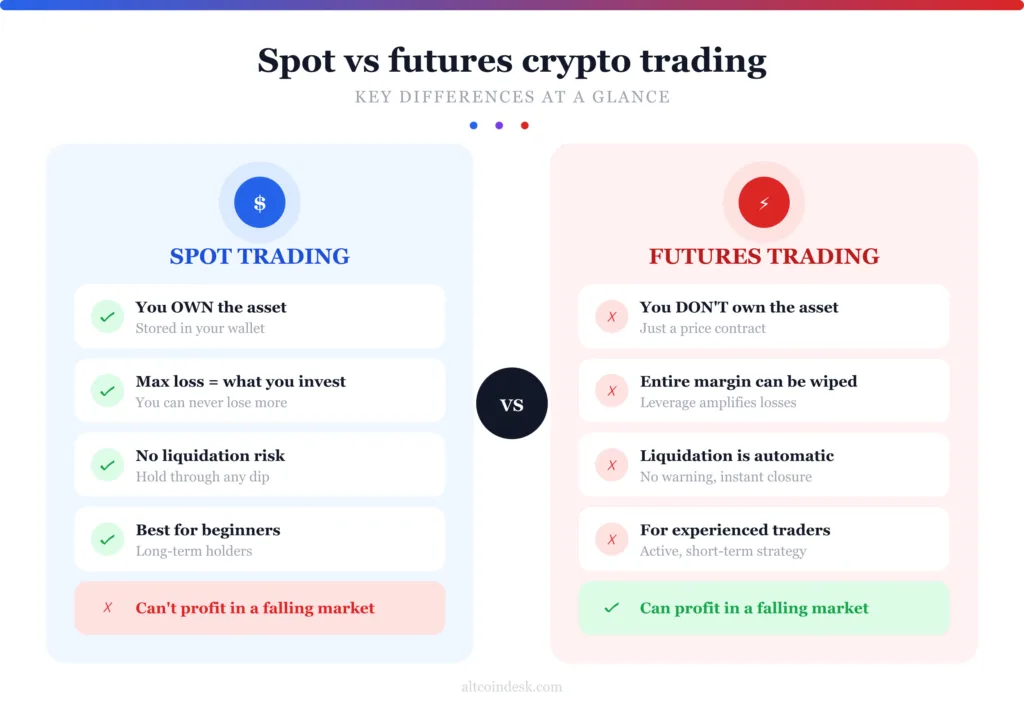
What makes futures genuinely dangerous for beginners is leverage. With $500 and 10x leverage on a futures trade, you’re controlling a $5,000 position. A 10% move in your favor doubles your money. A 10% move against you triggers liquidation, the exchange automatically closes your trade, and your $500 is gone, instantly, with no warning.
Most crypto futures today are perpetual contracts with no expiry date. You can hold as long as you aren’t liquidated. There’s also a funding rate charged every eight hours between long and short traders. In a trending market, that fee quietly stacks up and chips away at your margin faster than most beginners notice.
Crypto spot trading vs futures trading risk
Spot and futures trading don’t just carry different levels of risk, they carry entirely different kinds of risk.
In spot trading, time works in your favor. Solana crashed roughly 97% from its 2021 peak of around $260 down to under $10 by late 2022. Spot holders who stayed patient saw it recover to a new all-time high of around $294 in January 2025. The losses were real, but the asset remained, and so did the chance to recover.
In futures, leverage compresses everything. Avalanche can move 8-10% in a single session without any major catalyst. At 10x leverage, that move wipes your entire margin before you’ve had time to think. The psychological pressure of watching a leveraged position approach its liquidation price is a completely different experience from watching a spot holding dip. That pressure is where poor decisions happen, and accounts get destroyed.
Funding fees make it worse – being on the wrong side of a funding rate means paying a fee every eight hours just to keep a losing position open.
Spot vs futures crypto trading risk management
The most important principle across both markets, before anything else: treat them as completely separate activities with separate capital and separate rules. Never let a bad futures trade push you into selling spot holdings ahead of schedule, and never dip into your spot budget to top up a losing futures position.
That separation is the foundation on which everything else is built.
How to manage risk
Some risk management rules apply to both spot and futures trading. Others are specific to each market. Both matter.
Rules that apply to both markets
Set a stop-loss on every trade. A stop-loss closes your position automatically when the price hits a level you define before entering. Say you buy Solana and you’re comfortable losing a maximum of 8% on the trade. You set your stop-loss 8% below your entry. If the price hits that level, the trade closes, and you still have most of your capital intact. Without one, traders hold losing positions far longer than they should, waiting for a reversal that often never comes.
Never risk more than 1-2% of your account per trade. With a $2,000 account, your maximum loss on any single trade should be $20 to $40. Your position size and stop-loss placement should work together to stay within that range. Four consecutive losses at 2% risk each means you’re down 8% total, recoverable. Four losses where you sized recklessly can wipe out 50% in a week, and that kind of hole takes months to climb out of.
Define your take-profit target before you enter. Decide where you’re exiting with a profit before the trade is live, not after it’s running in your favor. Altcoins can reverse sharply and give back days of gains within hours. If you’re targeting a 15% move on Chainlink, get out there. Holding on because momentum looks strong is a different trade from the one you planned, and it doesn’t always end well.
Managing risk in spot trading
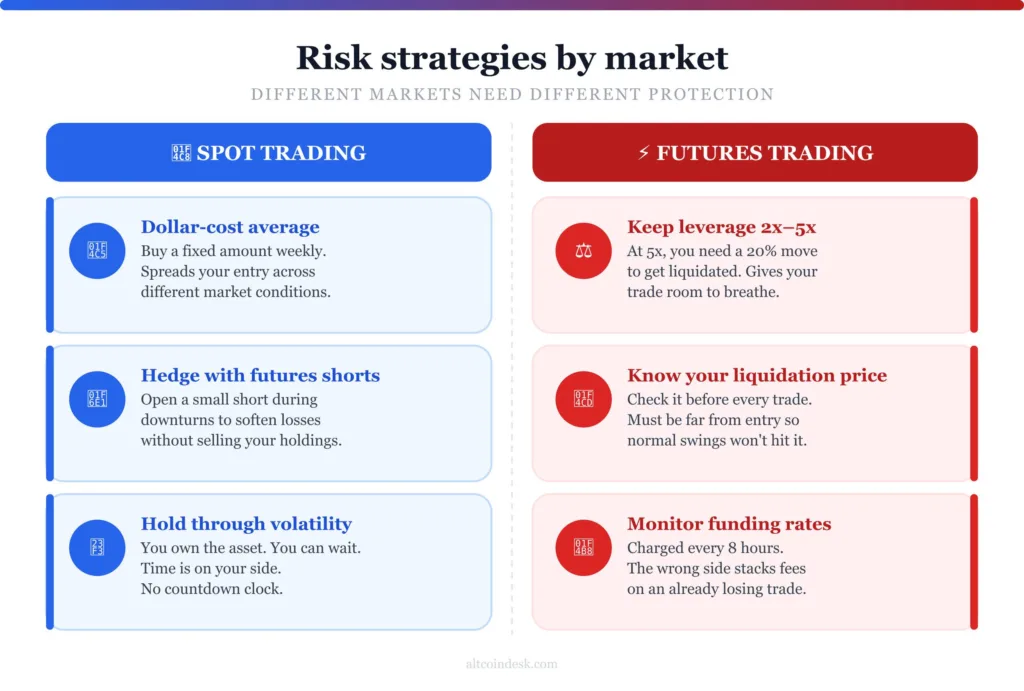
Dollar-cost average into positions. Trying to nail the perfect entry is unreliable for almost everyone. Buying a fixed amount of Solana or Chainlink on a regular weekly or bi-weekly schedule means your average entry price spreads across different market conditions. One overpriced week gets balanced by a cheaper entry the next. Over months, your cost basis reflects a reasonable range rather than one unlucky timing call.
Hedge with small futures shorts during uncertainty. Holding a spot position through a downturn is fine in theory until you’re watching it bleed 20% in real time. One way to soften that without selling is to open a small short futures position on the same altcoin. If the price falls, your short gains while your spot holding absorbs the dip. Keep the short small though, this is protection, not a second directional bet.
Managing risk in futures trading
Keep leverage between 2x and 5x. At 5x leverage, the price needs to move 20% against you before liquidation. At 15x, that drops to around 6-7%. Altcoins like Avalanche can easily swing 8-12% during volatile sessions. High leverage doesn’t improve your analysis or make your timing more accurate. It simply removes the margin for error that normal market volatility requires.
Always know your liquidation price before entering. Check exactly where your liquidation price sits before opening any futures trade. It should be far enough from your entry that normal intraday volatility won’t touch it. If it’s too close, either reduce your leverage or reduce your position size. Getting liquidated on a temporary move, only to watch the market reverse in your favor minutes later, is one of the most avoidable losses in futures trading.
Monitor funding rates. Funding rates are charged every eight hours in perpetual futures. When market sentiment is heavily skewed in one direction, the rate can work strongly against you. Check the funding rate before entering and factor it into how long you’re willing to hold the position open.
Final thoughts
Losing trades are part of crypto, and there’s no way around that. What separates traders who last from those who don’t is rarely talent or timing. It’s whether they had rules in place that kept a losing trade from becoming a catastrophic one.
Build the framework, follow the rules even when it’s tempting not to, and the rest of it starts to fall into place a lot more naturally than you’d expect.