


Leverage trading allows investors and traders to control positions much larger than their actual capital. While trading with leverage can amplify an investor’s potential gains, it can be a double-edged sword, as it can also quickly diminish their capital. In fact, trading with leverage is one of the most common ways that altcoin investors end up losing their money.
The crypto derivatives market is notoriously volatile, making trading with leverage an even more dangerous prospect. However, the intriguing part about trading altcoins with leverage is that traders are usually right about the direction of the underlying digital asset. Rather, it is poor risk management that makes them part ways with their capital.
Avoiding getting liquidated is rarely about perfectly timing the market. Instead, most often it involves structuring trade in such a way that normal crypto market volatility doesn’t knock you out of your trade position.
What is liquidation, and how does it work?
Before trying to understand how to avoid getting liquidated or losing your capital while trading altcoins, let us first understand what exactly liquidation is. In simple terms, liquidation is an event that occurs when a trader’s capital or equity falls below the minimum amount of money that must be maintained as a maintenance margin in a crypto exchange.
As the price of a digital asset moves against a leveraged position or trade, the unrealized losses reduce available margin. If the margin level is breached, the crypto trading exchange automatically closes the trader’s position to prevent further losses. Let’s understand this concept with the help of a simple example.
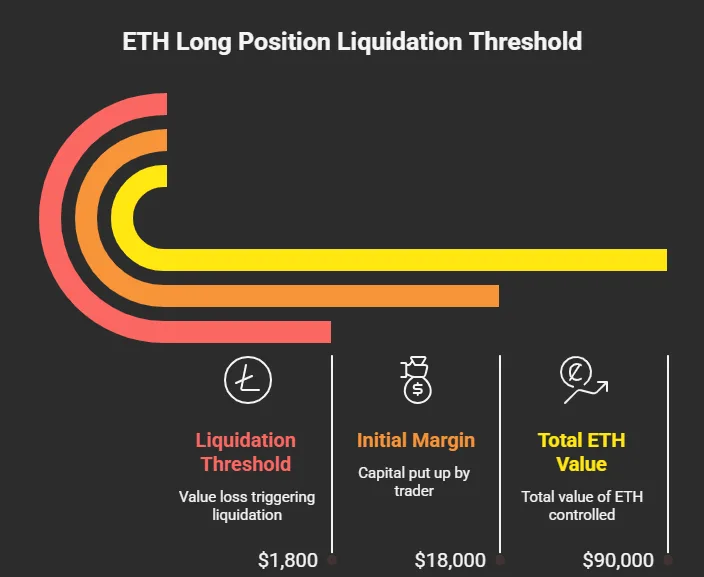
A trader opens a 10 ETH long at $1,800 using 5x leverage, meaning they put up $18,000 of their capital (margin) to control $90,000 worth of ETH. Their maintenance margin requirement is 10%, so if their position loses $18,000 × 10% = $1,800 in value, the exchange will start liquidating to protect itself.
If ETH drops to $1,620, the position hits the liquidation price, the exchange sells the 10 ETH, and the trader loses their full $18,000 margin. This sudden liquidation can also push ETH’s price down further, affecting other leveraged traders.
Since liquidation is forced, traders essentially lose control over their exit. As a result, liquidation almost always leads to poor execution prices, especially during sharp market movements that the crypto industry is so used to. Compared to manually closing a trade or triggering a stop-loss, liquidation is almost always the most expensive outcome.
Leverage trading risk management
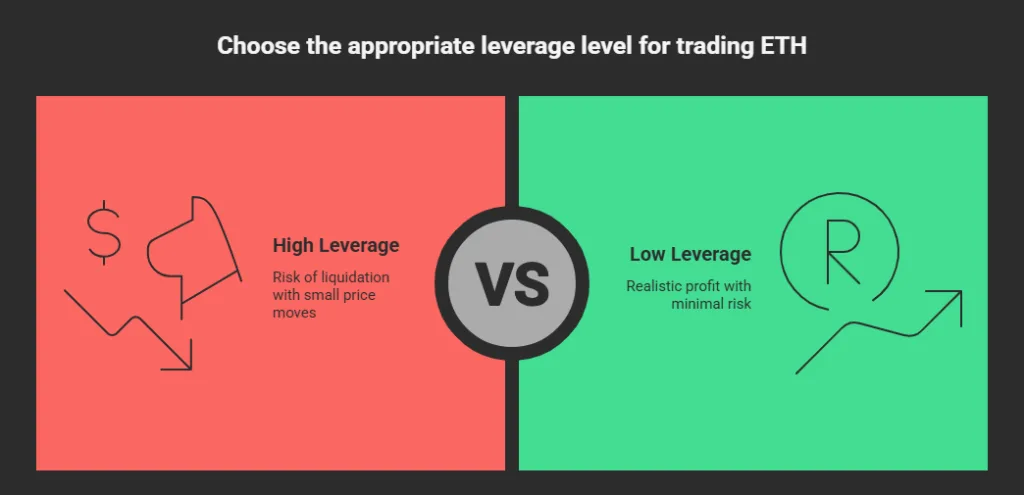
Using low leverage is one of the most useful and simplest ways to avoid getting unnecessarily liquidated. Most crypto exchanges offer obscene levels of leverage, sometimes ranging as high as 50x or even 100x. Trading at 100x leverage is essentially gambling, as even the slightest movements in the opposite direction in the underlying asset’s price can liquidate the trader.
Crypto traders should avoid chasing the next big trade by going full degen mode and instead try to target small wins through low leverage positions, such as 2x or 3x. In fact, most successful traders limit themselves to 2x or, at a maximum, 10x, depending on their experience and the coin’s price history. Let’s go through an example to understand this.
Suppose a trader wants to buy $ETH at $1,600. Instead of risking $10,000 on a 20x leveraged position (which could liquidate with just a 5% move against them), they use 2x leverage and invest $2,000. A modest 5% price gain would earn them $200 – not huge, but it’s a realistic, low-risk profit. By targeting small wins like this consistently, they protect their capital and avoid the “all-in degen” mindset that often wipes out traders.
Besides using conservative leverage, having a sensible position size matters just as much. It’s not good enough to use small leverage but have huge positions that form a significant chunk of your total portfolio. Instead, consider putting a reasonable portion of your capital into an altcoin trade, as it will ensure that a single bad trade won’t wipe out your entire portfolio.
Always set stop-losses and take profits
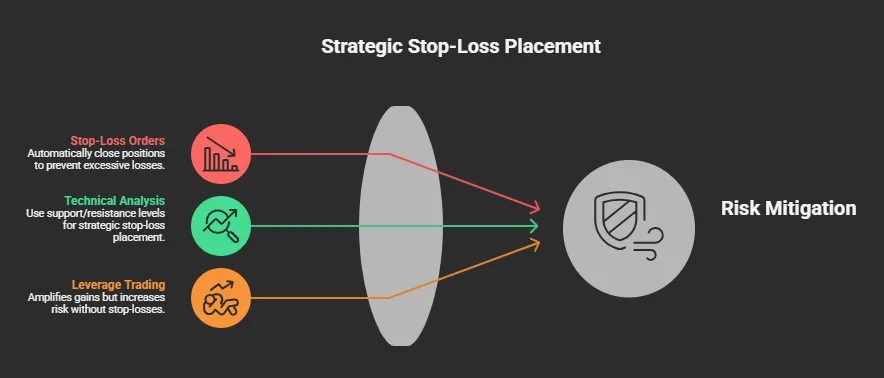
Stop-losses are pretty much non-negotiable when leverage trading altcoins. A stop-loss automatically closes your position when the underlying cryptocurrency’s price moves against you to a certain level. This way, investors can avoid humongous losses that can wipe their entire portfolio out. Basic technical knowledge, such as placing stop-losses based on support and resistance levels, is preferable to arbitrary price levels.
In the same vein, investors should have predetermined target prices to take profits, no matter how much the prospect of greater profit looks. By taking frequent profits, investors can ensure they lock in profits before the market course corrects.
Far too many traders make the mistake of holding winning positions for too long, only to see volatility swing against them. A disciplined approach to exits is just as important as choosing entries.
Maintain a margin buffer
If an investor is trading close to the liquidation price, there is barely any room for error. Even a temporary minor spike in price in either direction can liquidate the trader’s position if there is not enough margin, even if they are directionally right about the market in the long term.
Keeping additional funds in your account lets you survive sudden altcoin price movements. It also gives the trader enough time to strategically exit the position without losing all their funds. Traders can also choose to use isolated margin when trading altcoins on leverage, as isolated margin only exposes your collateral for a certain trade to liquidation, protecting the rest of the capital.
Always trade with a plan
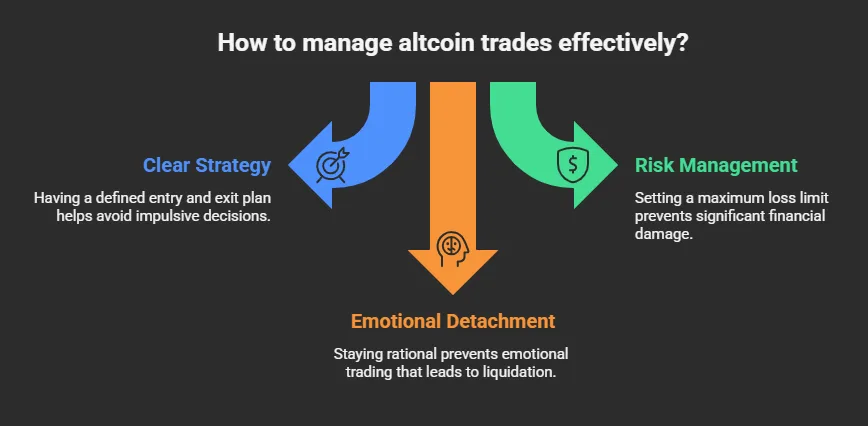
This one goes without saying. Every altcoin trade, with or without leverage involved, should have a clear entry and exit strategy. Even before opening a position, know the maximum acceptable notional loss you are willing to incur. Never be emotionally tied to your investments or holdings, as it is one of the quickest ways to get liquidated.
Finally, stay abreast of the latest developments in the market. Keep up to date with the latest market news, including regulatory developments, business partnerships, mergers and acquisitions, token unlocks, token listings, changes in tokenomics, and other relevant information. Reducing leverage or avoiding trading altogether during periods of market volatility can help investors avoid getting liquidated.
Final thoughts on leverage trading
Leverage trading is not for everyone. Even some of the most seasoned crypto traders, with as much as 7-10 years of trading experience in the industry, only prefer trading spot trading, since leverage introduces a whole host of other factors to take care of while entering or exiting a position.
However, if you must use leverage during trading for potential outsized returns, then be cognizant of the aforementioned points. Understand liquidation, always manage risk, use small leverage and position sizes, set stop-losses, book profits regularly, and always trade with a plan. Remember, survival comes first when dealing with profits. If you manage to survive, profits will follow naturally.