


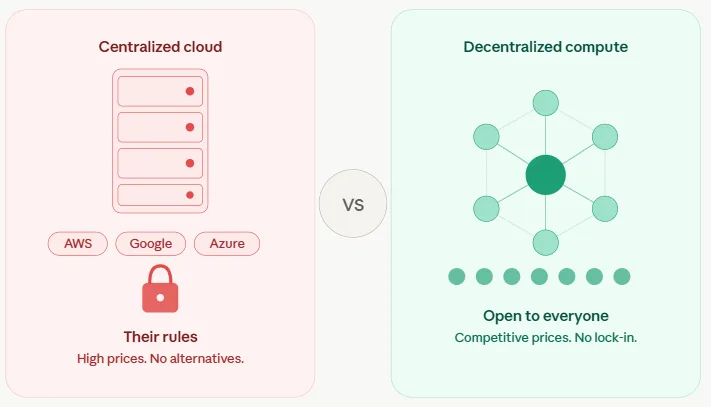
Right now, three companies control the majority of the world’s cloud computing power: Amazon Web Services, Google Cloud, and Microsoft Azure. They set the prices, they set the rules, and if they don’t like you, they can cut you off. That’s been the reality of how the internet runs for a while now, and honestly, it’s a pretty uncomfortable amount of power for three companies to have.
Decentralized compute networks are being built to fix exactly that. Instead of one corporation owning all the servers, these networks let thousands of people around the world contribute their unused computing power and get paid for it, with no middleman taking a cut and no single gatekeeper deciding who gets access.
What “compute” really means
Every time someone streams a video, runs an AI model, or loads a website, a computer somewhere is doing the work. That work is called compute, and the majority of it runs through data centers owned by Big Tech.
The problem isn’t that these companies exist. It’s that they’ve quietly become the only real option for anyone building something online. Want to build an app? Train an AI model? You’re almost certainly going through Amazon, Google, or Microsoft, paying their prices, following their terms, and hoping they never decide your project violates some policy buried in a document nobody read.
Decentralized compute networks are the alternative that’s been steadily building in the background.
How decentralized compute networks work
A rideshare app is a good way to think about it. Nobody owns all the cars – drivers offer their own, and the app just connects both sides and handles the money. Decentralized compute runs on the same principle, except instead of car rides, it’s server capacity being offered, rented, and paid for through crypto tokens on a blockchain.
No corporation owns the network, no single player controls pricing, and nobody can pull the plug on the whole thing unilaterally.
Top 5 decentralized compute networks right now
1. Akash Network: The open cloud marketplace
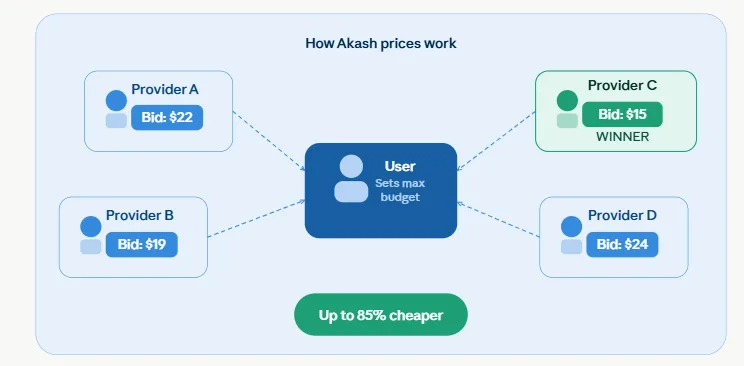
Akash flips the traditional cloud pricing model on its head. Rather than a provider posting a fixed rate and waiting for customers, it runs on a reverse auction where users post what they’re willing to pay and providers compete to win the work. That kind of competition keeps costs down significantly, with reported savings of up to 85% compared to what AWS or Google Cloud would charge for the same job.
Beyond the pricing model, Akash handles a wide range of workloads, including AI tasks, app hosting, gaming servers, and blockchain nodes. It runs on the Cosmos blockchain with AKT as its native token covering payments and governance, and a partnership with NVIDIA has helped bring serious GPU capacity into the network. With AI compute demand growing faster than Big Tech can keep up at affordable rates, decentralized compute networks like Akash are stepping into a real gap.
2. Render Network: GPU power for creators
Render connects people who need GPU power with people who have it sitting idle. It started with 3D rendering, which is notoriously expensive, and has since expanded into AI image generation, generative content, and metaverse workflows. It integrates with professional tools like Blender, OctaneRender, and Redshift, so it fits naturally into pipelines creative professionals already use.
What sets Render apart is real adoption. Productions tied to Westworld and Batman: The Animated Series have used the network, which is a different kind of credibility from a whitepaper and a promise. That’s the kind of track record that makes Web3 cloud computing feel less like a theory and more like a working industry. The token rebranded from RNDR to RENDER in 2025 as part of a broader sustainability push.
3. Bittensor: An intelligence marketplace, not just a compute network
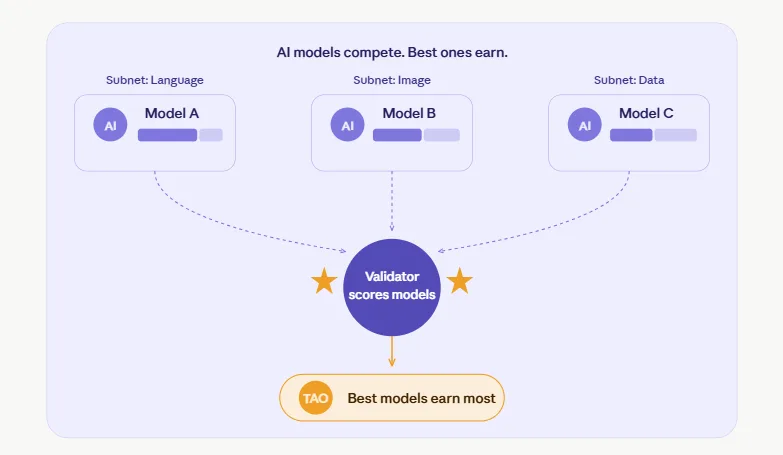
Bittensor goes a step further than most networks on this list. Rather than just renting out processing power, developers contribute AI models to the network, validators put them through their paces, and the ones delivering the most useful outputs earn TAO, the native token. Underperformers simply earn less, so there’s a built-in reason to care about quality.
The network runs through specialized sub-networks called subnets, each handling a specific job like language or image analysis, with over a hundred running at this point. It follows a capped supply model similar to Bitcoin and went through a halving event in December 2025. For anyone building AI products, it’s a way to access a whole pool of community-built models without being locked into whatever OpenAI or Google decides to charge that month.
4. Internet Computer (ICP): Running apps entirely on a blockchain
Most decentralized projects still have a quiet weakness: the front-end of an app still runs on Amazon or Google servers. ICP is trying to close that gap entirely by hosting full applications, front-end, back-end, and storage, directly on a blockchain with no cloud provider needed anywhere in the stack.
An app built on ICP can’t be taken down by a single company or policy change because it runs across a distributed network of independent machines simultaneously. ICP also supports AI models running directly on-chain and connects with Bitcoin and Solana through its Chain Fusion technology. Blockchain compute infrastructure like ICP is still maturing, but the goal of replacing centralized cloud at the foundational level is technically serious and not just a marketing claim.
5. Gensyn: Training AI models without the big lab budget
Training a powerful AI model costs serious money, which is why only the largest tech companies do it at scale. Gensyn is building infrastructure to spread that capability across thousands of machines worldwide, including consumer hardware that would otherwise sit idle.
The key problem it solves is verification: in a distributed network, how does anyone know a provider completed the job correctly and didn’t just fake it? Gensyn uses cryptographic proofs to catch dishonest behavior automatically. Its testnet has logged millions of completed jobs on consumer hardware and demonstrated the ability to fine-tune billion-parameter models across distributed nodes. It also integrates with Akash, letting developers combine both networks into a fully decentralized AI training pipeline, which is a meaningful step toward making large-scale AI development less of an exclusive club.
Why this matters beyond crypto
The conversation around decentralized compute networks isn’t really about tokens. It’s about who controls the infrastructure the entire internet depends on, and what happens when that control sits with too few companies. The more concentrated that power gets, the more everyone building online is essentially a tenant who can be evicted at any time.
Web3 cloud computing is still maturing, and none of these networks are yet as seamless as AWS. But they’re running real workloads, supporting real projects, and making it genuinely possible for developers, creators, and researchers to build without asking a trillion-dollar company for permission first. That shift is slower and quieter than most tech trends, but it’s real and it’s already underway.