



Crypto moves fast, and every few months, there’s a new concept pulling serious attention and serious money. Right now, that concept is restaking in crypto. Platforms like EigenLayer have attracted billions in deposits, and most of the people putting money in started exactly where you are, not entirely sure what restaking actually means.
The whole idea grew out of a frustration that almost every staker eventually hits. Your crypto is locked up, generating yields, but it’s only doing one job. One network, one reward stream, and that’s it. Restaking exists to change that by squeezing more out of assets that are already staked, without ever touching the original position.
Here’s how it all works, what you can earn from it, and where it can go wrong.
What is restaking in crypto?
Before getting into restaking, you need to understand regular staking first. Because one builds directly on top of the other.
Imagine a blockchain like Ethereum as a large building that needs security guards. Those guards are called validators. To become one, you deposit some of your crypto as a kind of trust deposit. The network then pays you rewards for showing up and doing your job honestly.
So staking is really just: lock your crypto, help secure the network, earn rewards.
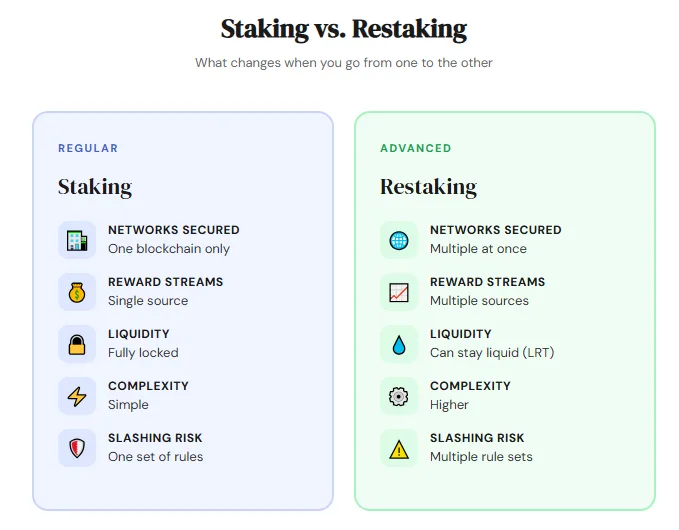
Here’s where the problem starts. Once your crypto is staked, it’s locked. It earns rewards, sure, but it can’t do anything else. It’s sitting there doing one job when it could realistically be doing more. That idle, locked-up capital is the inefficiency that restaking was designed to fix.
What is restaking? It lets you take that already-staked crypto and put it to work securing other networks at the same time, without ever unstaking it. Your crypto stays in its original position, keeps earning its original yield, and now earns additional yield from every other network it helps protect simultaneously.
Same crypto, multiple networks, multiple reward streams. That’s the whole idea.
The two ways to get into crypto restaking
1. Native restaking
This is the hands-on, technical route. You run your own validator node, manage your own setup, and restake directly at the protocol level. On Ethereum, that means a minimum of 32 ETH just to get started, which is a significant amount of money, plus the technical knowledge to manage everything yourself.
Most beginners won’t go down this path, and that’s completely fine.
2. Liquid restaking
This is where most of the real participation happens, and it’s the reason restaking grew as fast as it did.
Here’s how it works step by step:
- You deposit your ETH or another supported token into a liquid restaking platform
- The platform handles all the validator work on your behalf
- You receive a Liquid Restaking Token (LRT) that represents your staked position
- That LRT can be deployed across other DeFi protocols to stack even more yield, while your original assets keep restaking underneath
Instead of being the security guard yourself, you’re essentially handing your funds to a professional agency. They handle the hard parts. You get a receipt token called an LRT that you can still use across the crypto world, and the yields keep building in the background.
Where does your crypto actually go?
When you restake, your crypto gets put to work securing specific services called Actively Validated Services, or AVSs. These are newer networks that need security but haven’t built their own validator base yet. Building that from scratch takes years and serious money, so they tap into Ethereum’s existing network instead and pay for restaked protection to cover them.
Real examples of what your restaked crypto might be securing:
- Oracle networks: These bring real-world data like live asset prices onto the blockchain
- Data availability layers: These help blockchains stay fast and stable under heavier transaction loads
- Cross-chain bridges: These are what allow assets to actually move from one blockchain network to another
Your crypto does real work, the AVS gets security it couldn’t easily build alone, and you get paid for providing it.
The benefits, and why people find this attractive
There are real reasons billions have gone into this. Here is what restaking actually puts on the table.
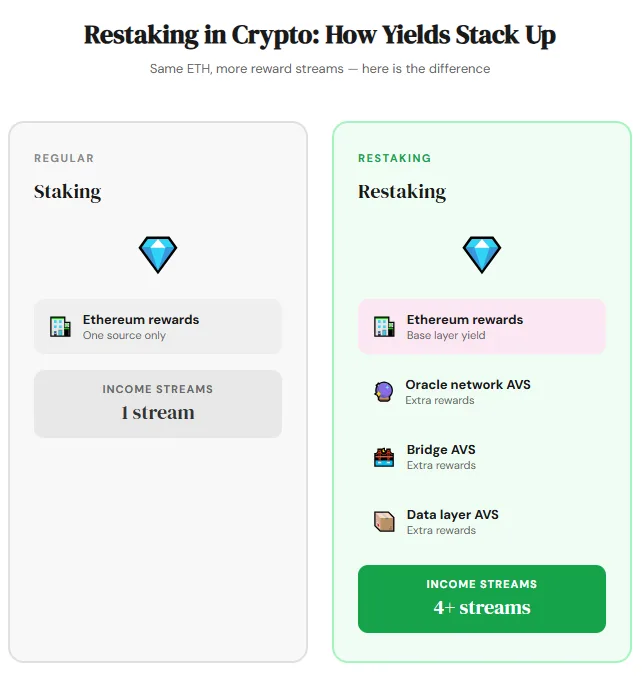
You earn from multiple places at once
Your staked ETH already earns a base yield from Ethereum. Restaking stacks more income on top of that, from every AVS your stake helps secure at the same time.
Same crypto, doing more than one job
Regular staking puts your capital to work in one place. Restaking spreads that same capital across multiple protocols simultaneously, without you putting anything extra in.
You pick where your stake goes
Most platforms let you choose which AVSs your stake supports. If there’s a project you believe in, you can back it and earn from that decision at the same time.
You stay liquid
Your LRT doesn’t just sit there locked up. Use it across DeFi, put it up as collateral, move it around however you want, while the restaking yield keeps building underneath.
The risks, and these are serious
Restaking is not free money. It comes with real dangers, and you need to understand them properly.
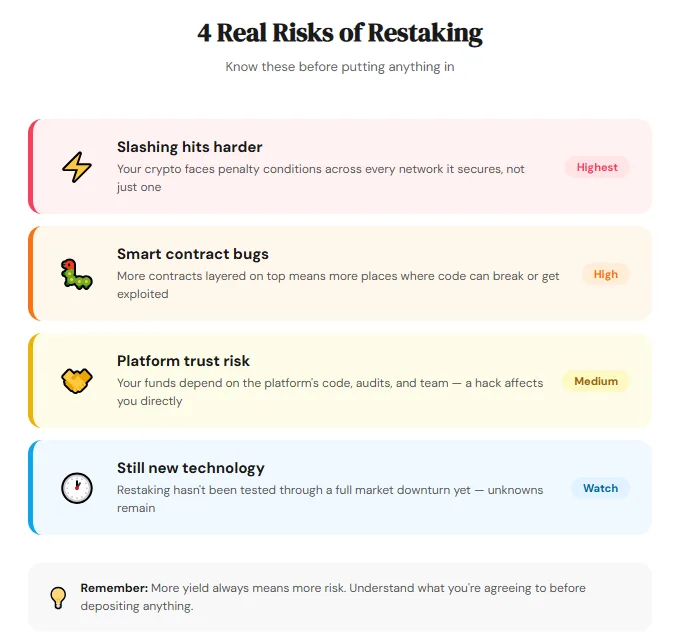
Slashing hits harder
In regular staking, a misbehaving validator loses part of their stake as a penalty. With restaking, your crypto faces slashing conditions across every network it helps secure. One issue on one network can cost you real money.
More contracts, more risk
Code has bugs, that’s just reality in this space. Restaking stacks more smart contracts on top of each other than regular staking does, which creates more spots where something could break or get exploited.
You’re trusting the platform
With liquid restaking, your funds are in someone else’s hands. A bad audit, a hack, or poor management puts your capital at risk regardless of what you did right on your end.
It’s still relatively new
Restaking hasn’t been through multiple full market cycles yet. How these systems hold up during a serious downturn is still an open question, and that’s worth keeping in mind before putting anything in.
Platforms worth knowing about
EigenLayer is where Ethereum restaking started, and it remains the dominant player in the space. It acts as the coordination layer connecting restakers with AVSs that need security, and it holds the largest share of the restaking market overall.
Several liquid restaking platforms have been built on top of it to make everything more accessible:
- Ether.fi is the clear market leader, issuing eETH when you deposit. It holds the largest TVL among all liquid restaking protocols, significantly ahead of any competitor, and your position stays usable across DeFi while it earns restaking yield underneath
- Puffer Finance builds slashing protection directly into its design, making it a more conservative option for people who want some downside coverage built in
- Kelp DAO offers rsETH and has held a solid position as one of the more established liquid restaking options in the space
Outside of Ethereum, Solayer is building a similar restaking model on Solana, and Babylon is developing restaking specifically for Bitcoin holders.
The honest take on getting started
The yields from crypto restaking are real, but so are the risks, and walking in blind is how people end up losing money they didn’t plan to lose. Get comfortable with regular staking first, learn what slashing actually means, and only put in what you can afford to lose completely. Chasing yield without understanding the downside is always the wrong move.
That said, restaking in crypto is a genuinely useful innovation. Your staked crypto earning from multiple networks at once, without moving from its original position, is a powerful concept. Just go in with the full picture.