


Think of staking as the modern version of a savings account, just with a little personality. It still helps your money grow, but this time, you are not sitting quietly on the sidelines. You are actually part of how the system works.
Most of us grew up hearing the same advice. Save your money. Open a bank account. Let it sit there and earn interest. Back then, that advice made sense. You deposited your paycheck, checked your balance every now and then, and trusted the bank to do the rest.
Fast forward to today, and that setup feels a little outdated. Interest rates barely move, inflation does the heavy lifting, and your money mostly just… waits. This is where staking walks in and says, there is another way.
If “staking” sounds complicated, take a breath. At its core, it is simply letting your crypto do something useful instead of gathering digital dust. When you stake, your tokens help keep a blockchain network running smoothly. In return, the network rewards you. Simple trade.
So what is staking, really?
Staking is when you lock up your cryptocurrency for a period of time to support and secure a blockchain. You are not lending it to a bank. You are not handing it to a mystery middleman. You are supporting the network itself, and you get paid in new tokens for doing so.
If you hold coins like Ethereum, Solana, or Cardano, staking is basically your way of saying, “I believe this network matters.” The system takes that commitment and says, “Thanks, here is your reward.” It feels a lot like earning interest, except instead of helping a bank’s balance sheet, you are powering an entire digital ecosystem.
And here is the real twist. There is no bank behind the curtain. You are not just the saver. You are part of the machinery that keeps everything moving.
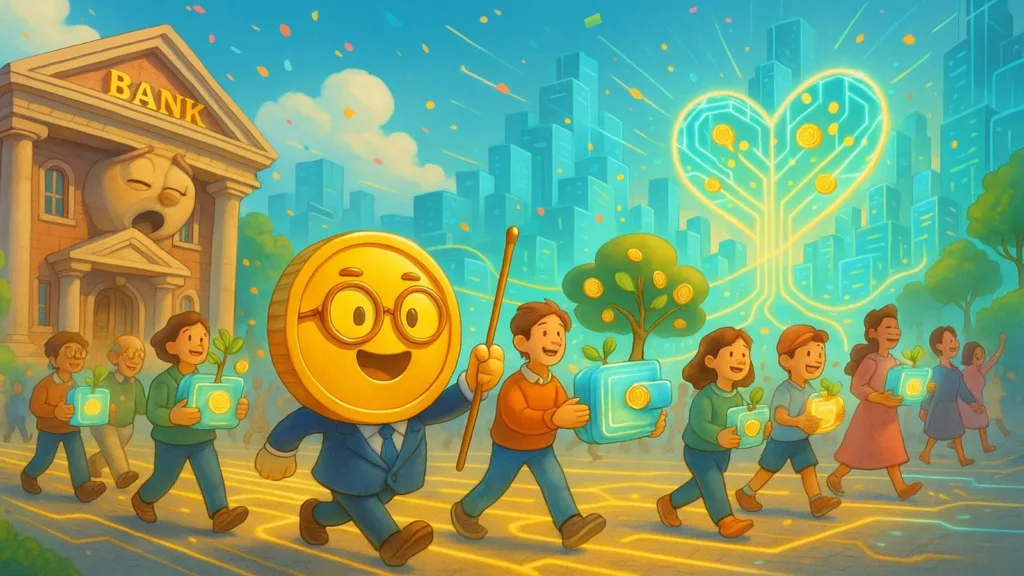
Staking vs. traditional saving: Same idea, very different vibe
Put $1,000 in a traditional savings account, and you might earn around 1% a year, on a good day. The bank then takes that same money, lends it out at much higher rates, and keeps the lion’s share. You get the leftovers.
With staking, you are much closer to the source of value. By locking or delegating your tokens, you help validate transactions and keep the network secure. In return, rewards can land anywhere from 3% to 15% annually, depending on the blockchain and conditions.
Yes, crypto prices move up and down. That risk is real. But so is the upside. You gain transparency, ownership, and a role that goes far beyond being a passive account holder. Staking turns saving into participation.
No tech talk, promise
Imagine a neighborhood where everyone agrees to keep an eye on things. No single guard, no central authority. Just shared responsibility. That is staking in spirit.
Your tokens are your contribution to keeping the neighborhood safe. The more people who participate, the stronger the system becomes. Your crypto is not gone forever either. It is temporarily locked, and in most cases, you can unstake later. While it is locked, it earns rewards as a thank you for showing up.
That’s what makes staking feel so human. It’s all about working together, trusting each other, and having the same goals, all in code.
Why this matters to everyday people
Staking brings back something that traditional finance lost without making a big deal out of it: involvement. Instead of watching institutions make money while your savings barely move, you can actively participate in a system that rewards giving.
At a time when inflation eats into savings and bank yields struggle to keep up, staking offers a different story. One where learning, earning, and participation happen together. You do not need to be a trader or a tech wizard. You just need to show up.
The human side of staking
Staking is not just a crypto buzzword. It is a quiet shift in how people relate to money. It invites you to stop watching from the sidelines and step into the game.
Think of it as a savings account with a plot twist. You are not only earning rewards. You are helping build the system that pays them.
And for once, the future of money does not feel distant or abstract. It feels a little more personal.