

Remember the last time you borrowed a loan from the bank? Yeah? Well, after getting the lump sum in your hand, you had to settle the payment to the bank in installments, with added interest. Didn’t you? Now, reverse roles; imagine you are the bank, and you have given some money to someone, and they pay you in installments. Well, vesting is something similar to the latter, at least in the way it is lent and the payback happens.
Let’s say you’re an employee at a new company, and part of your pay is in company shares. But here’s the catch: you don’t receive all those shares on your first day. Instead, the shares are given to you gradually over time.
For instance, let’s say the company offers you 1,000 shares with a four-year vesting schedule. You might receive:
25% after your first year (that’s called the “cliff”),
Then the remaining 75% is distributed monthly or yearly over the next three years.
This process is known as vesting. It’s a way for companies to reward loyalty—you earn more of your stock the longer you stay. If you leave early, you might only take a portion with you (or none at all, if you leave before the first year).
What is token vesting?
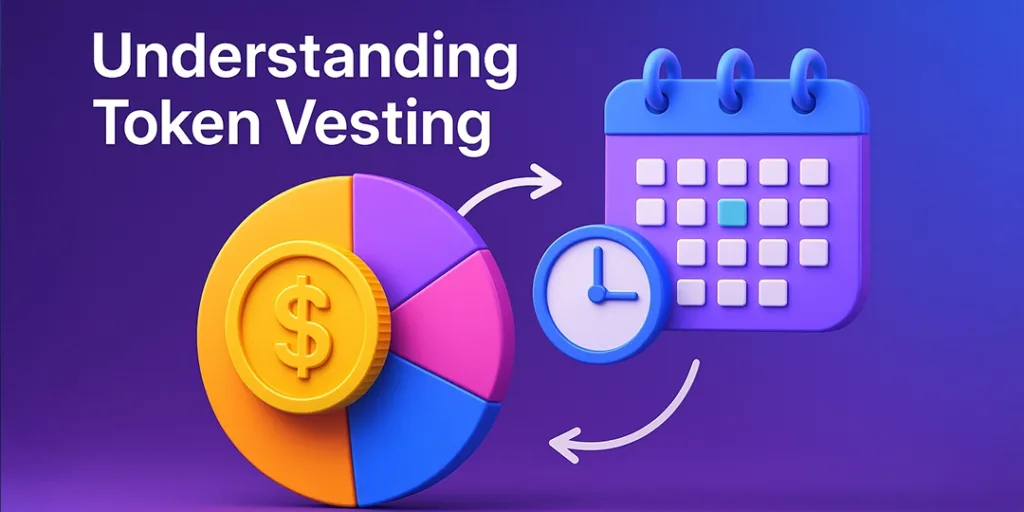
Token vesting is similar, but you vest cryptocurrency. Token vesting is a way to give cryptocurrency tokens to a project’s team and investors over time, instead of all at once. You could think of it as a time to wait for your tokens.
Why are crypto vesting schedules important?
Vesting schedules are very important for a project’s long-term success because they show how committed the founders and team members are. Locking up tokens for a set amount of time shows that the founders and team members care about the project’s future. This builds trust with investors and encourages them to get involved. This rule also stops early investors or team members from selling a lot of tokens at once, which could cause the price to drop suddenly and dramatically.
Vesting schedules are a strong incentive in addition to stability. Linking the release of tokens to certain milestones keeps the team focused on important goals, which is good for the project and its investors. You can get new weapons, powers, or rewards by finishing levels in a game.
This controlled release also helps keep the number of tokens in check, which is very important for keeping the price stable. In the end, vesting schedules are an important part of a cryptocurrency project that is healthy and trustworthy.
Types of vesting schedules
Milestone-based vesting—
Each project has its own rules for when to put the next batch of tokens on the market. Some of them might plan to release tokens based on reaching a milestone on the project’s road map. Some people release tokens after they get 10,000 users, finish the mainnet, or when trading volume reaches $1 billion.
Time-based vesting means that tokens are given out based on a schedule set by the founders. This could be every month, every three months, or every year.
Vesting that is hybrid
There are both milestones and timelines in hybrid vesting, as well as release tokens.
How vesting affects investors
Investors need to know what a project’s vesting schedule is. Locking up tokens can help keep prices stable and stop sudden drops. However, investors should be aware that prices may change more quickly and there may be more selling pressure when those tokens unlock. Investors can better prepare for these changes in the market by looking at vesting schedules.
Vesting is also very important for how people see a project’s legitimacy. People will trust you more and more investors will want to invest if you are clear and honest about how tokens are distributed. On the other hand, not being open can make people doubt and lose trust.
Token unlocks
Vesting data tracker Tokenomist stated that the crypto token unlocks may fall to $3 billion in August, down 52% from the $6.3 billion in value unlocked in July.
Sui unlocked approximately $167 million worth of tokens in August. On August 1, the unlock took place, and shortly after the release of the tokens, the price subsequently dropped from over $4 to around $3.53, breaking through a significant level.
Fasttoken (FTN) – On August 18, FTN plans to release $91.6 million worth of tokens. With this release, 94% of FTN tokens will be in circulation, and this might exert pressure on the market for a sell-off.
Aptos (APT) – Aptos has planned to unlock about $50 million worth of tokens in mid August, and this additional set of tokens in the markets could add short-term sell pressure.