

Crypto investors, both retail and institutional, are looking to find solutions to keep their assets safe while enabling them to work effectively. Traditional wallets and exchanges are convenient and easily accessible, but fail to provide structured security, transparency, and automation. That said, on-chain vaults are among the most powerful innovations in that field.
DeFi vaults give investors a chance to manage their crypto assets accurately, while giving them access to yield generation. These tools are programmable infrastructures that can be automated, have set rules determining asset movements, and integrate easily with decentralized finance (DeFi) protocols.
DeFi vaults explained: What are they, really?
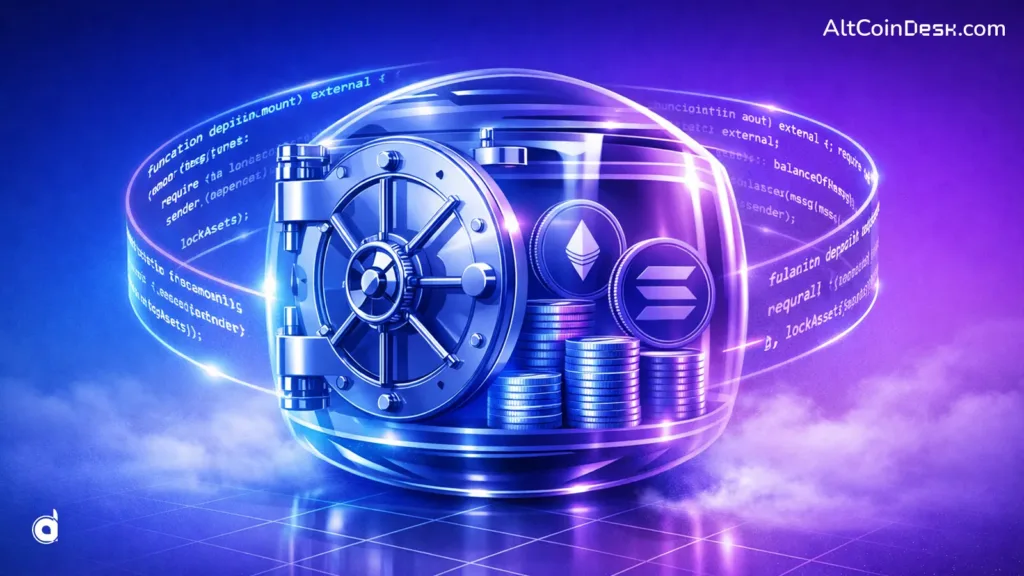
On-chain vaults are smart contracts that are programmable and that safely store and manage digital assets. They are designed to provide security, risk management, and maximization of capital efficiency. All vaults are independent systems; this minimizes systemic risk but allows automatic allocation of these systems to lending protocols, liquidity pools, or tokenized real-world assets.
One of the fundamental innovations in the contemporary vaults is the ERC-4626 standard that brings about uniformity and transparency in the manner in which the vaults operate. This standard allows investors to have direct exposure to the underlying assets through tokenized shares. While the tokenized shares can be redeemed at any time, the model differs from classical investment vehicles where institutional players enjoy direct access to the underlying assets.
Key features of on-chain vaults
The following are some of the key features of on-chain DeFi vaults:
- Security and governance: Vaults are developed with a multi-layered protection that includes signature controls, time-locks, and permissioned access. This is to make sure that a single party is not able to move funds at their own will.
- Automated yield generation: Dynamics assets may be automatically deployed to lending to a liquidity pool or tokenized real-world assets. This removes the process of manual intervention in DeFi yield farming and maximizes returns.
- Transparency and auditability: Any and every transaction and alteration to strategy is stored on-chain, allowing real-time access to balance and fee data as well as performance data. This is the most important level of reporting to both the retail and the institutional investors.
- Programmable control: Vaults have withdrawal controls, vesting controls, or access via policies that provide control and standards of service suitable for governing and operating an organisation.
Because of these benefits, on-chain vaults become not merely tools of safekeeping but active and risk-managed investment vehicles.
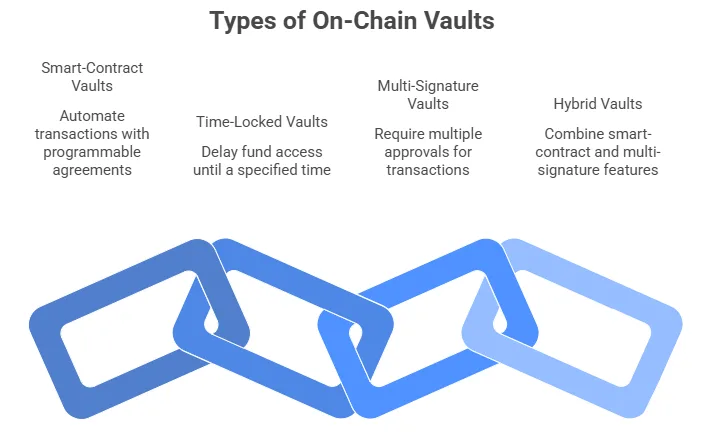
Types of on-chain vaults in crypto
On-chain vaults are customizable according to particular yield, risk, and capital targets. The most commonly used ones are:
1. Smart-contract vaults
These are the most well-known automated crypto vaults. These vaults are programmed to automatically perform operations like staking, lending, or providing liquidity. By defining rules for smart contracts, investors get to allocate their assets based on risks and yield parameters. These vaults are mainly used by decentralized autonomous organizations (DAOs), fintech services, and protocol treasuries.
2. Time-locked vaults
Time-locked vaults are the other form of on-chain vaults. Such vaults create a great degree of security by delaying withdrawals and transfers. In most cases, assets held in these vaults have a set unlock date or a gradual vesting schedule. Hence, these vaults mitigate operational risks by ensuring that it is not possible to transfer assets quickly.
3. Multi-signature vaults
These on-chain vaults allow transactions to be made only with multiple private keys, removing points of failure and increasing security to both individuals and organizations. These vaults are based on an M-of-N concept, in which N represents the total number of keys created, and M represents the minimum number of signatures to transfer funds so that even when one of the keys is lost, it is always possible to access the assets.
4. Hybrid vaults
Hybrid vaults combine multisig controls, time locks, and automated logic to establish layers of policy-based governance. Their design typically consists of off-chain reporting, fallback procedures, and emergency controls, and is typically suited to institutional-grade platforms, institutions with complex treasury operations, or fintechs that need both the backup and front office security.
Why automated crypto vaults are important in DeFi
The difference between the traditional wallets and the modern DeFi vaults is automation. Automated crypto vaults have the following benefits:
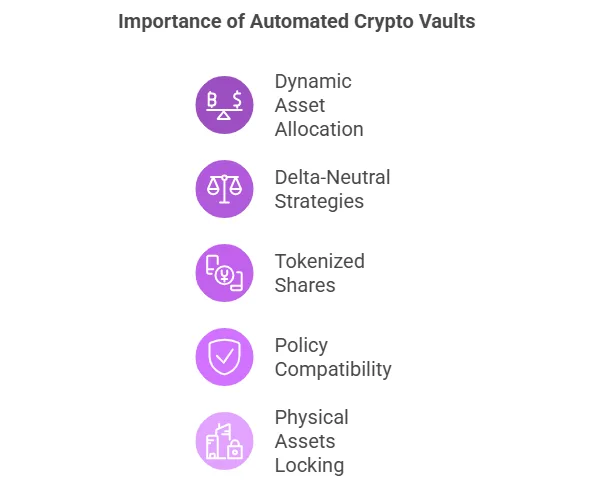
- Dynamic asset allocation: Vaults can shift capital between different protocols in real time to balance yield and risk.
- Delta-neutral and leveraged strategies: These vaults allow investors to avoid directional market risk by making investments that do not put capital at risk, or can be increased by making investments in structured loops.
- Tokenized shares: Vaults create tokenized shares, which are a representation of the stake of each investor using standards such as ERC-4626. The tokens are redeemable anytime, thus are permissionless and composable.
- Policy compatibility: On-chain vaults have the capability to create compliance controls, access controls to verified users, and have the ability to generate audit-ready reports. It exposes DeFi to funds, family offices, and fintech institutions that are seeking institutional-quality security and transparency.
- Physical assets locking: They permit the tokenization of T-bills, individual credit, or invoice financing. These tokenized products can be integrated into new T-vaults, thereby extending DeFi to include non-crypto-first assets.
Conclusion
On-chain vaults are transforming the way digital assets are stored, deployed, and managed. Besides acting as internet safes, they are programmable infrastructure that focuses on a balance between security, transparency, and automation. These vaults lay the groundwork for a new paradigm that allows investors to rely on smart contracts, time-locks, multi-signature approvals, and tokenized shares.
Vaults offer security and substantial access to yield, and risk management to crypto holders, DeFi enthusiasts, and institutional allocators. At the moment, these vaults are slowly turning into the cornerstone of decentralized finance.