
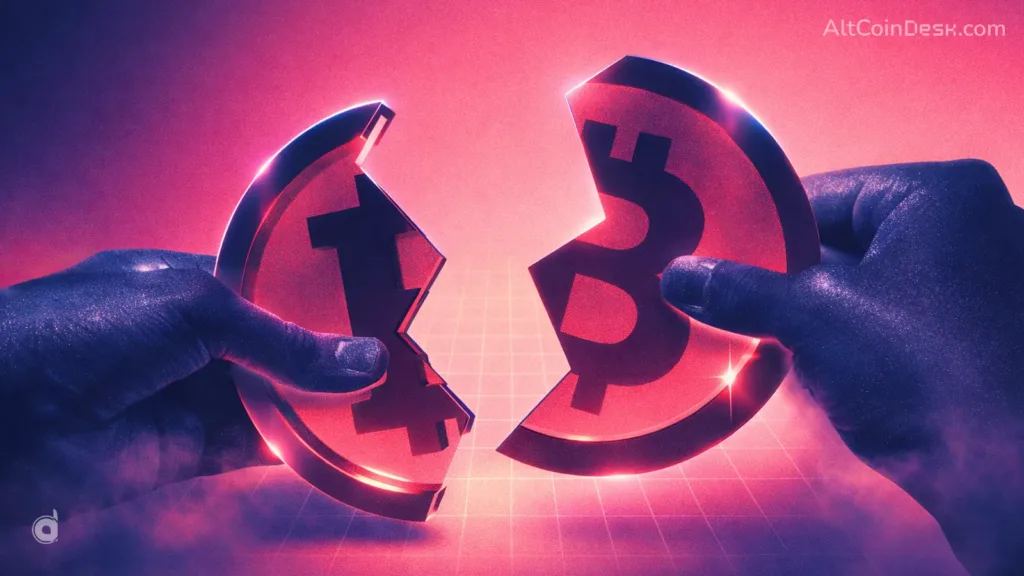

Crypto halving is an automatic process that reduces the number of new coins minted on a specific blockchain. This mechanism dilutes mining incentives and decreases the growth of supply in circulation.
The halving of Bitcoin is the most widely-known crypto halving event. Actually, Bitcoin was the first to introduce the halving model that was followed by other cryptocurrencies.
Since crypto halving plays a crucial role in reducing the increment in circulating supply, it aids in upward price discovery by increasing scarcity. That said, exploring crypto halving is crucial if you want to understand how it impacts crypto prices and mining rewards.
Bitcoin halving explained
Bitcoin was the first coin to have a crypto halving event. To better understand how Bitcoin halving works, we must first learn how Bitcoin works.
Bitcoin, the flagship cryptocurrency, is built around the Proof-of-Work consensus mechanism. This model requires miners to verify transactions and ensure network security. The miners engage in a tassel to solve Bitcoin’s cryptographic computations, which allows the miner who solves the mathematical problem to add a new block to the network.
Miners are then rewarded for every block added to the network, often by allowing them to mint new Bitcoin. However, once a certain number of blocks have been mined, that reward is halved to reduce the number of coins added to the circulating supply.
When Bitcoin launched in 2009, miners got 50 BTC per block verified. However, the first Bitcoin halving event took place in 2012, slashing the rewards in half to 25 BTC per block added. Consequent Bitcoin halving events took place in 2016, 2020, and 2024, with each reducing the BTC from the previous cycle by half.
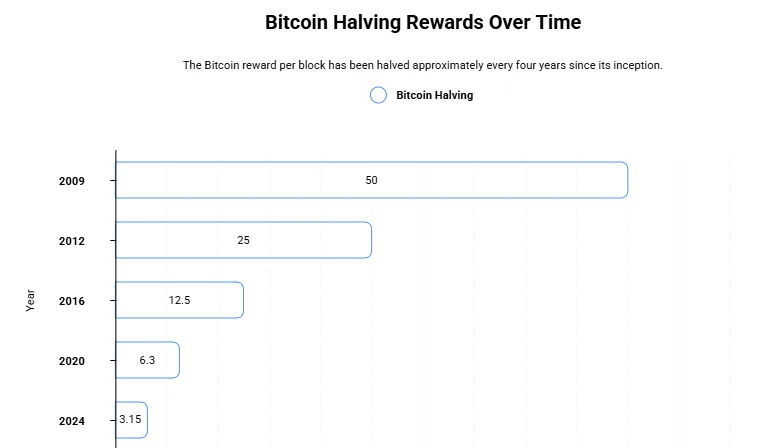
The last Bitcoin halving that occurred in 2024 has decreased the miner rewards to 3.125 BTC. This model will happen approximately every 4 years up until the limit of the Bitcoin supply, which is 21 million coins, is hit.
However, Bitcoin halving doesn’t happen on a specified date. What determines the timeline is the number of blocks mined. A particular set of blocks has to be mined before the halving happens, meaning each halving event changes by a few weeks or even months.
Altcoins halving: Other cryptos utilizing the halving model
The Bitcoin halving event inspired several crypto projects to take up the model. The following are some altcoins that hold a crypto halving event.
- Litecoin (LTC): This crypto holds its halving events every four years. The latest Litecoin halving event happened in 2023 and resulted in miner rewards being reduced to 6.25 LTC. The next LTC halving event is thus scheduled to happen in 2027.
- Bitcoin Cash (BCH): Bitcoin Cash also has a halving event every four years. The most recent LTC halving was in 2024, and it reduced miner rewards to 3.125 BCH.
- Zcash (ZEC): Zcash, too, has a halving event every four years. The last Zcash halving event took place in 2023. It reduced miner rewards, now sitting at 1.5625 ZEC. This cryptocurrency will have the next one in 2027.
Besides these three cryptocurrencies, other altcoins that hold halving events include Bitcoin SV, Ethereum Classic, Dash, and Monacoin, among others.
Why crypto halving matters
Crypto mining activities result in the addition of new tokens to the circulating supply. Unless effectively controlled, these tokens will lead to inflation on crypto networks. Crypto halving events help bring that control.
1. Crypto mining efficiency
Halving in crypto slashes miner rewards by half, thus impacting the coins entering circulation directly. This helps curb inflation by reducing the supply. In most cases, crypto halving events also result in a price surge due to the reduction in circulating coins.
Crypto halving events also reduce the rewards earned by miners. When the rewards are reduced by half, miners are forced to depend more on efficiency, cost reduction, and energy efficiency.
2. Measure of adoption
Halving also serves as a measure of adoption. Crypto traders and long-term investors often eye crypto halving events. These events are forecast, and a number of market participants look forward to them several years before they take place. For this reason, halving usually falls under the umbrella of generalization of price trends and adoption.
3. Predictable monetary policy
Halving also strengthens the notion that some cryptocurrencies have a fixed monetary policy. Crypto halving, as compared to traditional types of money, occurs at a specific time, thus serving as a deflationary mechanism.
The impact of the Bitcoin halving event on the general market
Bitcoin is the leading crypto by market capitalization and is often the main driver of market performance. Most altcoins, in fact, mirror the price action of Bitcoin. In the case of a Bitcoin halving event, it has several impacts on the general market. Some of them include:
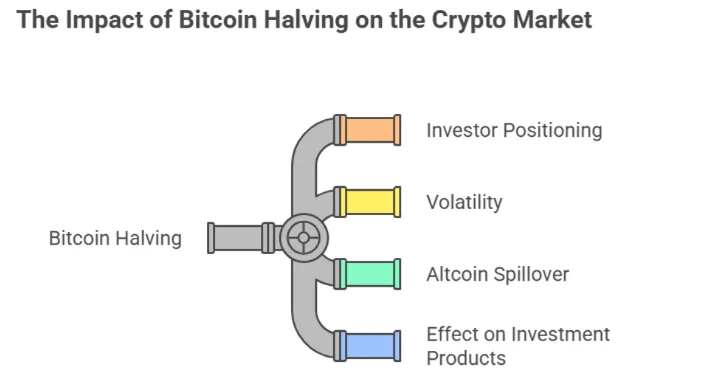
- Investor positioning: Most investors reposition in crypto ahead of the Bitcoin halving, majorly die to the expectations that the price of Bitcoin will rally after the halving event.
- Volatility: Speculations around the Bitcoin halving event often trigger swift sentiment shifts, thus affecting volatility across the market.
- Altcoin spillover: Bitcoin halving often spills into altcoins since this crypto often determines the general market direction.
- Effect on investment products: The Bitcoin halving often sparks attention across crypto-related products such as ETFs, thus determining their overall performance.
Long-term importance of crypto halving
Crypto halving serves as a deflationary model behind blockchain networks that rely on mining and limited supply. This model reduces the number of tokens entering the supply, thus serving a great importance in boosting price action.
Additionally, crypto mining events reduce miners. This helps boost efficiency in crypto mining operations since miners have to cut costs and focus on efficient systems to earn rewards.