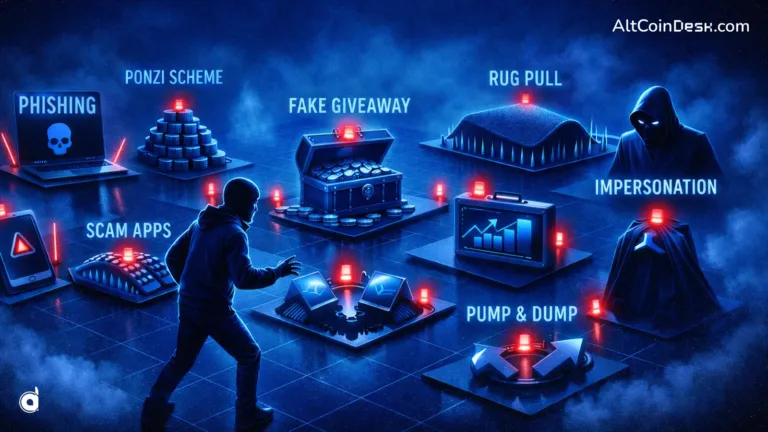


The crypto market offers real opportunities, but it also has risks that go beyond price volatility. One of the most persistent is manipulation, a set of practices designed to mislead investors about supply, demand, and true market activity.
If you don’t understand how manipulation works, you’re basically walking into the market blindfolded. Most investors only find out about these tactics after they’ve already been burned by them, and by then it’s too late.
What is crypto market manipulation and why does it happen
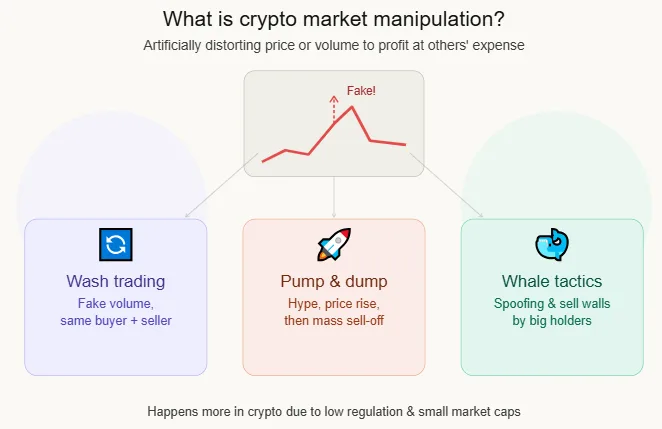
Crypto market manipulation is when someone deliberately messes with a cryptocurrency’s price or how valuable it appears, purely to make money off other people. They do this by creating conditions that don’t actually exist, things like fake buying interest, inflated trading volume, or price movements that look organic but aren’t, and regular investors end up making decisions based on information that was never real.
This happens way more often in crypto than in traditional markets for a few straightforward reasons. There’s far less regulation here than in stocks or futures, so bad actors have more room to operate. A lot of tokens also have small market caps, which means you don’t need that much money to push the price around. And honestly, a huge chunk of people in this space are still pretty new to it and haven’t seen these tricks before.
To give you a sense of the actual scale, Chainalysis found that roughly 24% of tokens launched in 2022 showed characteristics consistent with pump-and-dump schemes.
How crypto price manipulation works in practice
It doesn’t take much honestly, just money, a group chat, and enough retail investors who’ll react to price movement. Someone buys into a cheap token nobody’s watching, starts pushing it across social media and Telegram, and once enough people pile in and the price moves, they dump everything. The price craters, and anyone who bought during the hype is stuck holding it.
The scary part is that the people doing this don’t look suspicious at all. Verified accounts, normal posting history, real followers. $LIBRA memecoin scandal in February 2025 is the clearest example, promoted by a political figure, people bought in, and it collapsed within hours, with over $250 million in losses. On-chain data showed insiders were already selling the whole time. Regular investors had no idea until it was over.
Wash trading: The silent volume faker
Wash trading is the practice of simultaneously buying and selling the same asset to create a false impression of market demand. The party buying and the party selling are the same entity, or working together, so no real exchange of value takes place. The only thing that changes is the volume figure, which rises and misleads other investors into believing the asset is actively and legitimately traded.
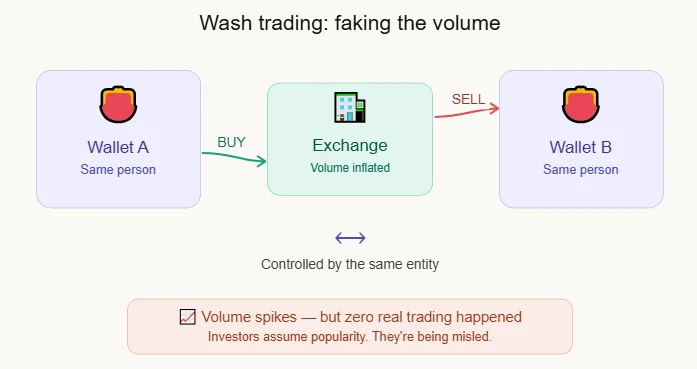
Wash trading is especially common on lower-cap tokens and exchanges with limited regulatory oversight. In October 2024, the SEC charged four market makers for generating artificial token trading volume using exactly this method.
More recently, in April 2026, U.S. federal prosecutors charged 10 individuals connected to multiple crypto firms following an undercover FBI sting operation that involved creating a fake token to identify firms that were selling volume inflation as a commercial service.
Pump and dump: The most common retail trap
Pump-and-dump is the oldest trick in crypto, and it plays out the same way every time. A group quietly buys into a cheap token, then starts pushing it everywhere, Telegram groups, crypto Twitter, influencer shoutouts, all saying the same thing: this one is about to explode, get in now. People get in, the price climbs, and for a moment, it looks completely real.
Then they sell everything at once, and the price falls off a cliff. Anyone who bought during the hype is left holding a token worth almost nothing while the people who started it walk away with the profit.
How to spot manipulation: Five practical red flags
Learning to spot manipulation consistently comes down to five reliable signals that are usually visible before any real damage is done.
The first is a sudden, unexplained spike in volume, so when a token’s daily trading volume jumps several hundred percent with no corresponding news event, it deserves investigation before any purchase is made.
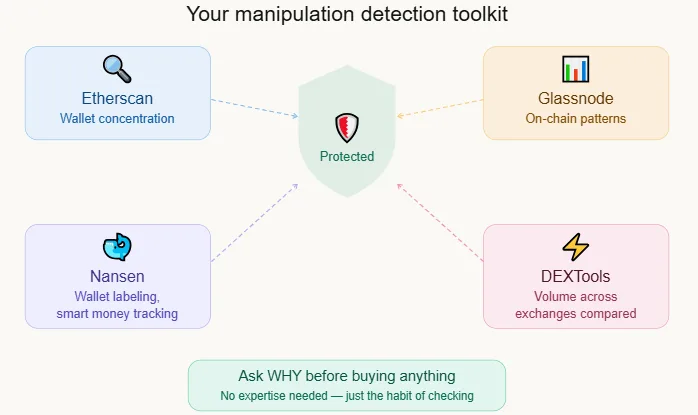
The second signal is token ownership concentration, because if 90% of a coin’s supply sits in five wallets, those holders can flood the market at any moment and collapse the price. Tools like Etherscan make this data publicly available for any Ethereum-based token.
Third, watch the order book for large orders that appear and vanish within seconds, which is a tactic called spoofing.
Fourth, trace where the momentum actually originated. If a token’s surge started in a private Telegram group or from a single influencer rather than through organic community activity, that source is worth questioning.
Fifth, cross-reference volume across multiple exchanges, because tools like DEXTools and Nansen are built specifically to compare organic trading patterns against those that appear algorithmically manufactured. None of this requires any particular expertise; it really just requires the habit of asking why before acting.
Whale manipulation tactics and how they move markets
Whales have enough money to push prices around in ways smaller investors can’t, and they use two tricks mostly. The first is spoofing, where a whale puts up a massive buy order to make it look like big money is coming in, waits for regular investors to buy in chasing the move, then cancels the order and sells into everyone who just bought.
The second is the sell wall, where a huge sell order sits at a specific price making it look like the price can’t break through, investors panic and stop buying or start selling, and once enough supply clears out the whale quietly pulls the order and the price moves freely.
Both tactics work best on low-cap tokens where there isn’t much liquidity to absorb the moves, so a relatively small amount of money can shake the entire market. Watching for large orders that appear and disappear for no clear reason in the order book is really the simplest way to catch this before it affects your position.
Final thoughts
Crypto manipulation isn’t something exchanges will flag in advance, so the responsibility for recognizing it sits entirely with you as the investor. The patterns are consistent and visible to anyone who knows what to look for, and building the habit of checking before buying is the most effective and accessible protection available.