


Fundamental, technical, and on-chain analysis are important in crypto trading. But the crowd’s mood matters just as much. When excitement around a particular token skyrockets, capital is most likely to flow in fast. And on the other hand, when fear spreads, the market could drop just as quickly.
That collective mood is what people call crypto market sentiment. It’s simply the general feeling investors have toward a coin, a project, or the entire crypto market at a particular moment.
Market sentiment can be used to explain most price fluctuations observed in Bitcoin, Ethereum, and thousands of other digital assets. It also provides investors with an improved understanding of whether the market is heating up, cooling down, or is about to make a big move.
Let’s explore what crypto market sentiment is and how you can analyze crypto social media sentiment for effective crypto trading.
Crypto market sentiment: What is it?
Crypto market sentiment refers to the general attitude that traders and investors express towards certain digital assets at a particular moment. However, it is not about data, but about perception, or what people think is going to happen next.
In conventional finance, firms have financial statements, decades of performance history, and foreseeable business models that can be used to measure upcoming scenarios. However, the case for crypto is different, especially for new crypto tokens. Adoption and community belief determine how these tokens ought to perform in the future.
Sentiment, thus, carries enormous weight in crypto trading. When many traders are convinced that a project has good potential, known as bullish sentiment, buying activity ought to go up. This demand pushes prices up.
On the other hand, a loss of trust means the crowd might sell just as fast, triggering a sharp drop. Such a phenomenon is what is termed bearish sentiment.
In crypto, market sentiment can change faster than fundamentals, shifting from bearish to bullish or vice versa within minutes. This explains the high volatility experienced across tokens.
How does market sentiment impact crypto prices?
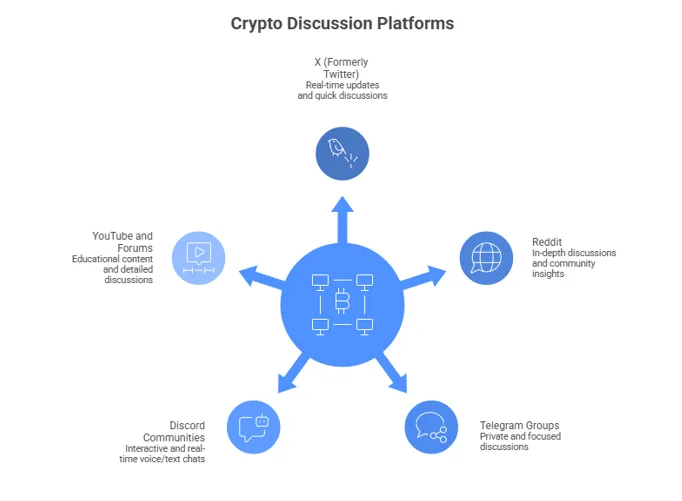
Crypto investors hold major discussions across various social media groups. Within these social pages, opinions spread fast, shaping the market sentiment.
Because of that, one favorable news item can generate a lot of buzz. Often, traders spread the news, new investors learn about the project, and the price begins to rise as the demand grows.
For context, a single positive tweet by Elon Musk about Dogecoin may trigger a frenzy, leading to a surge in the price of DOGE.
But the same can be said about negative news. Security, regulatory, or internal project concerns often cause uncertainty. This has mostly been the case around Trump’s posts on TruthSocial. Once uncertainty disseminates within the community, sell-side pressure may follow, crashing the prices.
Concisely, crypto market sentiment drives price movements. Even solid crypto projects may falter during bearish market sentiment, while weak projects may soar in times of bullish sentiment.
How to analyze crypto social media sentiment
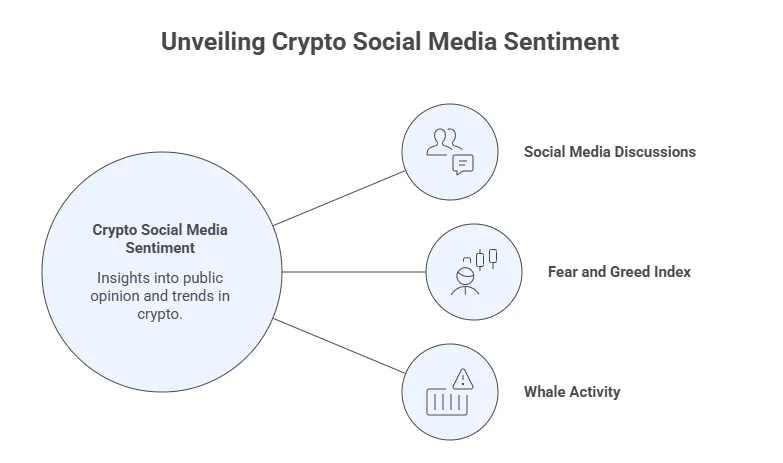
Traders must observe various signals to identify the market sentiment towards a particular coin or the general market. In most cases, community discussions, sentiment indicators, and blockchain activity are used to identify current market sentiment.
Below are a few ways in which traders can analyze crypto market sentiment:
1. Monitoring social media discussions
Projects, new stories, and market trends are discussed in social forums like X, Reddit, Discord, YouTube, and Telegram. Such discussions often exhibit premature emotional change.
Positive sentiment may be reflected through:
- Rising social media mentions
- Viral posts about a particular project
- Expert excitement around updates
- Strong influencer discussions
On the other hand, negative sentiment appears in the form of:
- Criticism
- Panic posts
- Diminishing community discussions
Social sentiment cannot guarantee crypto price movements, but may offer a glimpse of incoming upswings or breakdowns.
2. Tracking the ‘fear and greed index’
Crypto fear and greed analysis can be done by tracking the “Fear and Greed Index.” This indicator serves as one of the most popular crypto market sentiment indicators.
The Fear and Greed Index assesses the market’s emotional situation based on a score of 0-100. A low score is an indication of fear, while a high score indicates greed. This scale is categorized in the following manner:
- 0 to 24: Extreme fear
- 25 to 49: Fear
- 50 to 74: Greed
- 75 to 100: Extreme greed
The index is calculated based on a number of parameters, including market volatility, trading volume, social media trends, and Google search activity. Similar to mentoring social sentiment, the crypto fear and greed analysis does not reflect the exact future scenario.
3. Watching whale activity
Crypto whales are individuals or institutions that possess high volumes of cryptocurrency. Since their transactions often involve huge amounts of money, their activity can have an impact on the market trend and retail investors’ psychology.
To flag the prevailing crypto market sentiment through tracking whale activity, traders must keep watch of the following:
- Massive asset sales
- Accumulation or buying patterns
- Large exchange transfers
- Sudden movements across dormant wallets, such as Satoshi era wallets
For context, when whales transfer large crypto volumes to exchanges, it can indicate potential selling pressure. This may trigger bearishness among retail traders. Silent accumulation, on the other hand, suggests that the whales are optimistic about the long-run path of the market.
Monitoring the whales helps traders know how smart money is repositioning.
The role of sentiment analysis in crypto trading
Sentiment analysis helps traders know the prevalent crowd mood. Crypto prices often tend to fluctuate depending on the confidence or apprehension expressed by investors. Therefore, crypto market sentiment analysis is applied to determine future expectations.
A spike in good talk, high community participation, or whale concentration, for example, might indicate increasing demand for an asset. On the other hand, panic posts, negative headings, or enormous exchange transfers can signify an increase in selling pressure.
Is it okay to rely on crypto market sentiment alone?
Crypto social media sentiment may provide insights into where the market could be headed. But it should not be used as the sole basis for making crypto investment decisions. The crypto market is highly volatile, meaning crowd opinion may change very quickly. This confirms that sentiment analysis should be used alongside other analytical approaches.
Technical analysis helps to identify the price changes, and the fundamental analysis explores the actual price of a crypto project. A combination of these metrics might result in successful trades.