


Let’s examine how “crypto trading slippage” is quietly pickpocketing your portfolio while you’re busy watching the charts.
So there you are, sipping a lukewarm coffee, feeling like a modern-day financial wizard. You see the perfect moment. The chart does that little wiggle you’ve been waiting for. You tap “Buy” with the confidence of a movie star accepting an award. You close your eyes for a second, dreaming of Ferraris and financial freedom.
Then you open them. You check your bag.
And somehow, some way, you have less than you thought you would. The price moved against you. You didn’t get the deal you clicked on. Nobody broke into your house. You didn’t fat-finger the keyboard. You just got caught in the silent, invisible, and frankly, annoying vortex known as crypto trading slippage.
Let’s be honest. We usually blame the government, the whales, or a glitch in the matrix. But the truth is, slippage is the mischievous little gremlin hiding under the hood of your trade, giggling every time you hit “confirm.” And today, we are going to catch that gremlin, put it under a spotlight, and laugh at it. No jargon, no complex math that makes your brain hurt. Just the good stuff.
The day the price moved while you blinked
You’re at a coffee shop, and you see a sign: “Fancy Espresso, $5.” You throw a fiver on the counter. But by the time your hand reaches the cash register, the barista shouts, “Actually, inflation just hit. It’s now $5.50.” That 50 cents is crypto trading slippage. It’s the gap between the price you saw when you got excited and the price the market actually gave you when your order finally landed.
In crypto, this happens constantly. You click “buy” expecting a smooth transaction, but while your internet buffers or the blockchain takes a nap, the market does the cha-cha slide. Or worse, your own trade was so big it shoved the price around like a bully in a schoolyard.

How slippage works on centralized exchanges
Let’s visit the big fancy exchanges first. Think of these as massive shopping malls. They have an “order book,” which is basically a list of people screaming what they want to pay.
If you show up and say, “I want to buy 2.5 Bitcoins immediately,” the exchange looks at the first seller yelling, “I’ll sell one for $100,000.” You take it. Then it looks at the next seller yelling, “I’ll sell one for $100,200.” You take that too. Then it looks at the last poor soul who just wanted $100,500 for his half coin.
By the time you’re done, you won’t have paid $100,000. You paid a weird average that’s higher than you planned. This is “walking the book.” It’s less of a trade and more of a stroll through a very expensive neighborhood where every step costs you money.
How slippage works on decentralized exchanges
Now, let’s go to the decentralized exchanges, the DEXs. Here, there is no order book. There’s just a pool of money.
Imagine a kiddie pool with 100 toy boats and 200,000 floating rubber ducks. The price is basically the ratio of ducks to boats. Now, you come along and jump in with ten of your own boats. Do the ducks stay calm? No. The water sloshes everywhere. The ratio changes. The price moves.
This is the constant product formula, or as I like to call it, the “splash effect.” If the pool is massive, like an ocean, your jump barely makes a ripple. But if you’re trading a weird meme coin in a puddle, your own trade causes a tsunami. That tsunami is slippage. It’s not bad luck; it’s just physics. You moved the water, and the water moved your money.
The math interlude (don’t worry, it’s short)
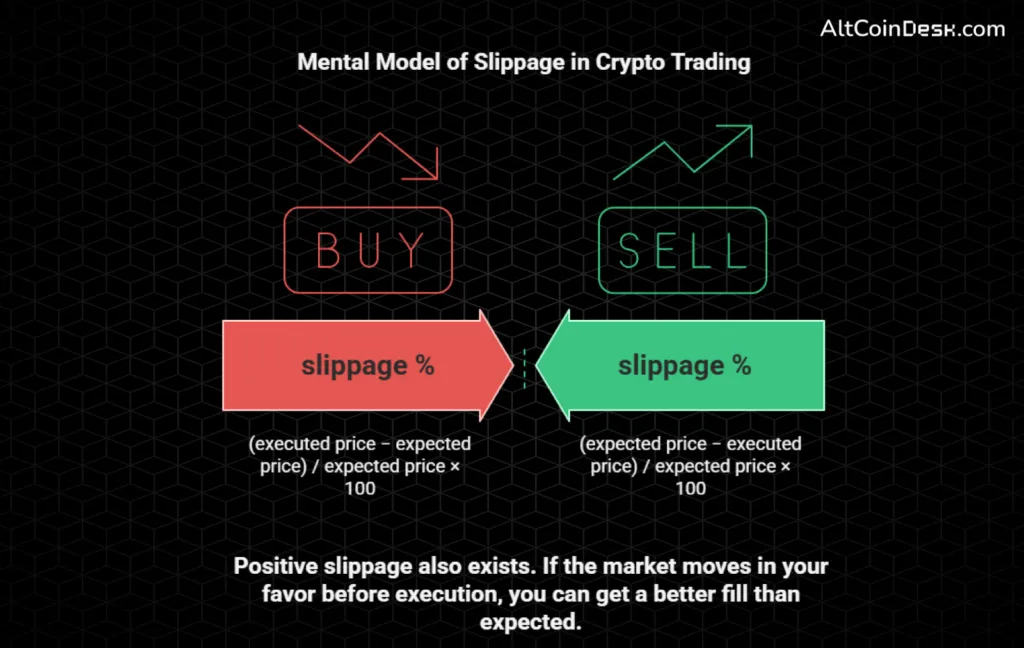
If you want to get technical for a second (and I promise we’ll keep it painless), think of it like this: You expected the price to be one thing, but the reality was another.
If you’re buying, and the price jumps up before you get it, that’s negative slippage. It hurts.
If you’re selling, and the price drops before you get out, that’s also negative slippage. It also hurts.
But here’s a plot twist nobody tells you about. Positive slippage exists. It’s the financial unicorn. Sometimes, the market moves in your favor while your trade is pending. You hit “sell” expecting $100, but by the time it goes through, the price is $102. You just made free money. It happens. Rarely. But when it does, you should feel like a genius. (You aren’t a genius. You just got lucky. But enjoy it.)
Slippage tolerance: what it actually does
Now we get to the part where you have the power to mess things up. Most DEXs ask you to set a “slippage tolerance.” This is a leash you put on your trade.
Set the leash too short, say 0.1%, and you’re a control freak. If the market twitches even slightly, your trade says, “Nope, I’m out,” and it fails. You waste gas fees and get nothing.
Set the leash too long, say 20%, and you’re basically handing a stranger your credit card and saying, “Surprise me.” If the price tanks, the trade will still go through because you allowed it. You told the machine, “I’m okay losing up to 20%.” And the machine, being a literal machine, will happily oblige.
It’s a tightrope walk. Too tight, you fall off and fail. Too loose, you swing into a wall.
Enter the bots, exit your profits
This is where things get a little spicy. There are little robots living in the blockchain, and they are not your friends. They sit in the waiting room, the “mempool,” watching for trades with that loose leash we just talked about.
If they see you coming with a 10% slippage tolerance, they do a classic scam called the “sandwich.” They buy just before you, pushing the price up. Then your trade goes through at the higher price (because you allowed it). Then they sell right after you, taking the profit and leaving you holding the bag. They didn’t break any rules. They just read your settings and took advantage of your generosity. It’s like leaving your car door open in a bad neighborhood and being surprised your radio is gone.

How to Stop Robbing Yourself
Here’s the beautiful, ironic truth. A lot of the time, we are the ones causing our own losses. We trade at 3 AM on a Sunday for a coin called “Dog Moon Rocket” that has a liquidity pool the size of a thimble. We are surprised when we get crushed.
So, how do we stop the leak?
- First, trade in deep water. Stick to pools and exchanges where there’s a ton of money. Big pools mean your little trade is just a drop in the bucket. The price barely moves.
- Second, don’t be greedy with speed. If you don’t need to buy right this second, use a limit order. Tell the market, “I will buy at this price, and not a cent more.” You might wait a while, but you won’t get mugged.
- Third, break up your big moves. If you’re buying a massive bag, don’t do it in one go. Buy a little, wait, buy a little more. It’s like walking through a crowded room. If you shove everyone at once, they shove back. If you slide through gently, nobody notices.
- Fourth, and this is the golden rule, tighten that leash. Set your slippage tolerance to the lowest you can get away with. If the trade fails, it fails. It’s better to waste a few bucks on gas than to lose 10% of your trade to a sandwich bot wearing a tiny top hat.
Practical takeaway
At the end of the day, crypto trading slippage isn’t a conspiracy. It isn’t the exchange stealing from you. It’s just the cost of doing business when you’re trying to move fast in a market that doesn’t always move with you.
It’s the invisible tax on impatience. It’s the penalty for trying to buy a yacht in a puddle. But now that you know the tricks, you can spot the gremlin. You can set your boundaries. You can stop walking the book and start standing your ground.
So the next time you go to hit that button, remember: you are the one in charge. Don’t let a loose setting or a thin pool rob you blind. Trade smart, stay tight, and keep your profits where they belong.
In your wallet. Not in the void.