


What happens when one of the strongest-yielding asset classes in traditional finance finally opens up to people outside institutional walls? That is the question tokenized private credit is beginning to answer. For decades, private lending deals were structured for large funds only, with lock-ups, high minimums, and no transparency to speak of.
Blockchain is now being used to change all three of those things at once, and the shift is already well underway.
What is private credit?
Private credit is lending that happens outside the traditional banking system. A lender, usually a large investment fund, works directly with a borrower to create a private loan that is not traded on any public market. No bank in the middle. No exchange listing. Just a custom deal negotiated between two parties.
The private credit market was valued at $3 trillion at the start of 2025 and is projected to reach $5 trillion by 2029. It has grown this fast because it offers something public markets generally cannot: historically strong returns in the range of 8% to 10%, sometimes higher during periods of elevated interest rates.
The problem has always been access. These deals were built for pension funds, hedge funds, and sovereign wealth funds. A regular investor, or even a moderately wealthy individual, simply could not get in the door.
The three problems private credit has always had
Private credit has never been a clean, investor-friendly asset class. The returns are attractive, but getting in, staying informed, and getting out have always been painful:
- No easy exit: Once money is committed to a deal, it stays there. Five- to ten-year lock-ups are the norm, and if an investor’s situation changes midway through, there is no market to sell the position. The money is simply stuck.
- Extremely high minimums: Getting into these deals has never been a realistic option for most people. The entry bar was set by and for large institutions, and it stayed there for decades.
- Very little transparency: Investors were largely kept in the dark. A quarterly PDF was standard practice. No live data, no dashboards, no way to track how the underlying loan was actually performing between reporting periods.
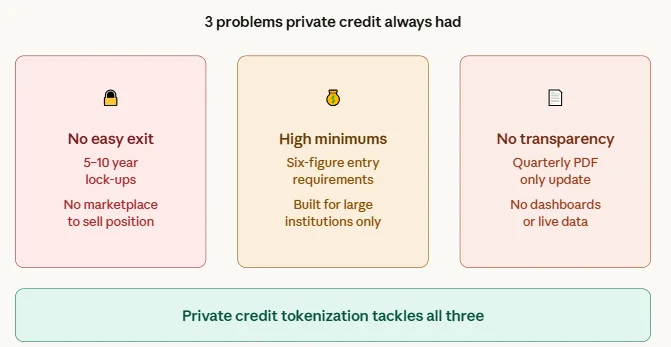
These are exactly the three problems tokenization is built to fix.
Private credit tokenization: What it actually means
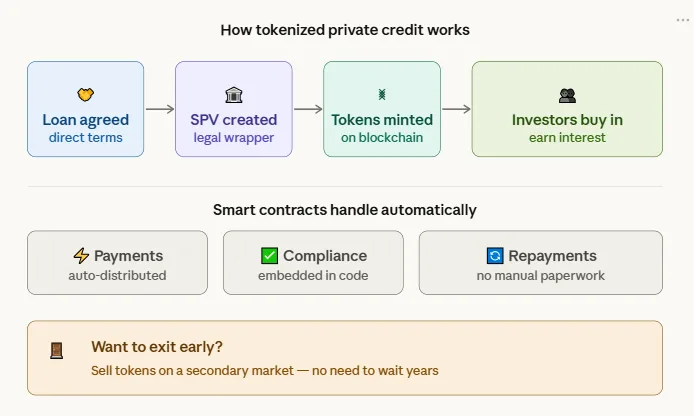
Private credit tokenization converts a private loan into digital tokens on a blockchain. Each token represents a fractional share of that loan, the interest it earns, and the rights attached to it. A lender and borrower agree on terms directly, that loan gets placed into a Special Purpose Vehicle (SPV) to hold it legally, and tokens are then minted representing small slices of ownership in that SPV. Investors buy in, earn interest on their share, and smart contracts handle payments and compliance automatically.
The borrower still repays on the same terms they agreed to from day one. What changes is that everything is built around that loan. Who can access it, how ownership is tracked, how easily positions can be traded, and whether investors are stuck waiting years to exit or can sell their tokens on a secondary market when needed.
Fractional ownership: The part that changes everything
Fractional ownership is what makes tokenized private credit genuinely accessible to a wider group of investors.
In traditional private credit, a $10 million loan is a single deal that requires institutional-scale capital to enter. With tokenization, that same loan can be divided into thousands of smaller tokens. Entry minimums on some platforms have dropped to as little as $25, compared to the six-figure minimums that defined traditional private credit funds.
This does not just benefit smaller investors. It also widens the capital pool for lenders and borrowers. Businesses that previously had no route to global capital, such as a motorcycle taxi company in Kenya and a logistics firm in Vietnam, can now tap into an international pool of investors through a blockchain-based platform. That was simply not possible before without going through a major bank or a well-connected Western fund.
Blockchain lending and how it replaces the old infrastructure
Traditional private credit deals involve layers of lawyers, fund administrators, custodians, and manual paperwork. Every interest payment, compliance check, and ownership transfer requires human coordination. It is slow and expensive.
Blockchain lending cuts through most of that. Smart contracts automate the labor-intensive parts of loan servicing. Interest is calculated and distributed automatically. Compliance checks are embedded in the code. Ownership transfers happen on-chain without paperwork.
Settlement on blockchain happens near-instantly. Compare that to the T+2 window in traditional finance, where capital is stuck waiting for days while transactions process. That gap costs money. Removing it reduces counterparty risk and cuts out the idle time that intermediaries historically charged for.
Platforms like CREDI are building on top of this foundation by adding machine learning to the equation, analyzing bank transaction data to assess creditworthiness faster and more accurately than any traditional model could.
Liquidity in private credit: What changes and what does not
Liquidity in private credit has historically been the biggest complaint from investors. Once capital is committed, it is locked until the loan matures. On-chain finance changes that by enabling secondary market trading of tokenized positions.
Investors can sell tokens to another buyer on a compliant secondary platform rather than waiting out the full loan term. Redemptions still require a willing buyer and may process on a T+2 window, so this is not the same as instant liquidity. But it is a genuine improvement over having no exit option at all.
The improvement in liquidity in private credit is one of the main reasons institutional money has started moving into this space. Major asset managers, including KKR and Hamilton Lane, have already tokenized private credit funds on public blockchains such as Ethereum, Polygon, and Solana.
Where the market stands today
Active on-chain private credit crossed $18.9 billion in November 2025, with cumulative originations hitting $33.6 billion according to rwa.xyz data. That puts private credit at more than half of the entire tokenized real-world asset market, making it the single largest category on-chain by a considerable margin.
On the protocol side, Maple Finance, Centrifuge, and Goldfinch are among the key players, handling billions in loans across consumer asset-backed securities, trade finance, and SME lending. Figure Technologies sits at the institutional end of the spectrum, having facilitated over $16 billion in home equity lending on blockchain, primarily through home equity lines of credit and cash-out refinance loans.
The risks you need to know
Tokenized private credit is not without serious challenges, and understanding them matters just as much as understanding the opportunity.
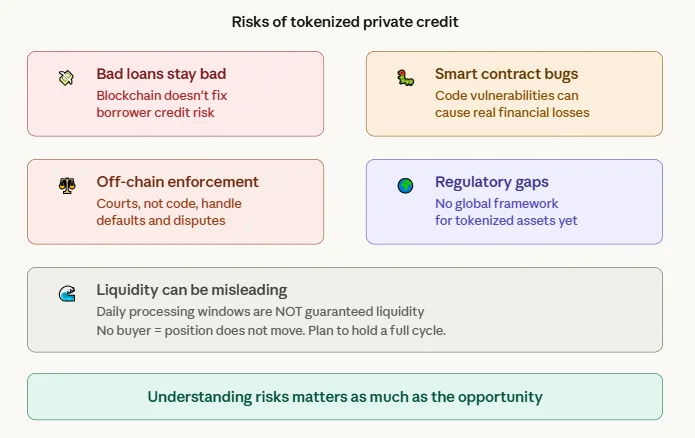
Tokenization does not fix bad loans
Goldfinch learned this when its emerging market lending portfolio ran into serious credit problems. Putting a loan on a blockchain does not change whether a borrower can actually repay.
Smart contracts can have bugs
The code running these platforms is not infallible. A vulnerability in a smart contract managing loan distributions can cause direct financial losses, with no institution behind it to make investors whole.
Legal enforcement is still off-chain
Smart contracts execute automatically, but they carry no authority in a courtroom. When a borrower defaults, recovering funds still runs through traditional legal systems that differ significantly across countries.
Regulatory uncertainty remains
There is no consistent global framework for tokenized assets. Countries are at different stages of figuring out how to classify and regulate them, which creates real exposure for both platforms and investors.
Liquidity can be misleading
A platform that advertises daily processing windows does not offer guaranteed liquidity. If there is no buyer on the other side, the position does not move. Anyone entering this space should be prepared to hold through a full credit cycle.
Why this matters
What was a closed system built for institutions is starting to function more like a global credit market. The infrastructure is there, the capital is moving, and the only part that has not caught up is the regulatory framework.
The next credit cycle will either validate this model or expose the parts of it that tokenization alone cannot fix.