


Reading a price chart without volume is like reading a headline without the article. Something happened, sure. But the full story is missing, and trading on half the information is how traders take their biggest losses.
Volume profile is the indicator that shows where the market actually made decisions, not just where the price happened to be. For altcoin traders especially, it changes how everything else gets read.
What is volume in crypto, and why does it matter for altcoin analysis?
Trading volume is the total amount of a cryptocurrency bought and sold over a specific time period. On any chart, it shows up as vertical bars at the bottom. Tall bars mean lots of activity. Short bars mean almost none.
Volume tells traders whether a price move has any real weight behind it. A coin that rises 20% on high volume suggests genuine demand. That same 20% move on near-zero volume is far less trustworthy and often reverses quickly.
There’s a widely used principle in crypto trading: volume must confirm price. When both align, a move carries conviction. When they diverge, caution is the right call. This is especially true in altcoin analysis, where markets are smaller and more easily manipulated.
How does low volume make the price more volatile?
Low volume and high volatility almost always go hand in hand, and understanding this is critical when conducting any kind of volume profile crypto analysis.
When very few buyers and sellers are active, a single large trade can swing the price dramatically. Small coins trade less often, fewer participants are active at any given moment, and one trade can move the price sharply. Big candles don’t always mean something significant happened. Sometimes it’s just thin liquidity doing the damage.
This is also why large holders, known as whales, have enormous influence over small altcoins. In a low-volume market, they don’t need to spend much to move the price significantly in either direction.
Low volume, market cap, and the risk connection
Market cap is calculated by multiplying a coin’s current price by its total circulating supply. Volume measures how actively that coin is actually being traded. Low-cap coins almost always have low trading volume, which means any single trade has an outsized impact on price.
Market cap categories generally break down like this:
- Large-cap (over $10 billion): High volume, relatively lower volatility.
- Mid-cap ($1 billion to $10 billion): Moderate volume, moderate risk.
- Small-cap (under $1 billion): Low volume, high volatility, high risk.
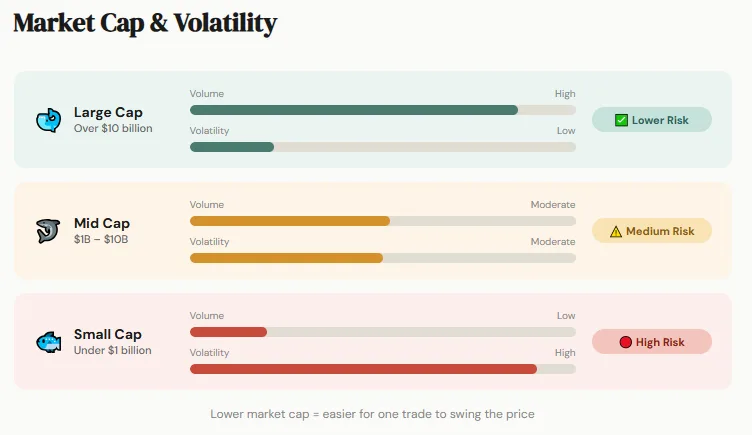
A low market cap doesn’t make a coin worthless, but it does mean price is far easier to push in either direction. In bear markets, high market cap coins tend to hold value better, while small-cap, low-volume coins tend to get hit the hardest.
Factors that affect trading volume in crypto
Volume doesn’t stay constant. Several factors cause it to move, and knowing what to watch for is a big part of reading any volume profile crypto chart correctly.
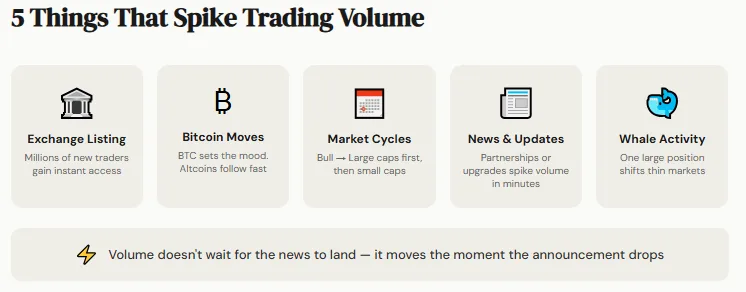
Exchange listings: When a coin lands on a major exchange like Coinbase or Binance, millions of new traders suddenly have access to it. Volume doesn’t wait for the listing to go live either. It starts moving the moment the announcement drops.
Bitcoin’s price action: Bitcoin sets the mood for the entire market. A big move from BTC pulls altcoin trading activity along with it. And when Bitcoin drops, altcoins don’t just follow. They usually fall harder.
Market cycles: It never happens all at once. Large-cap coins get the first wave of buying, and then the gains start rotating outward. Smaller altcoins catch attention later, usually when traders are already looking for bigger moves. When the cycle turns bearish, low-volume coins are always the first to get hit.
News and project updates: A partnership announcement, a protocol upgrade, or even a regulatory headline can send volume for a specific token spiking quickly. Minutes, not hours.
Whale activity: Thin markets don’t need a massive trade to move. A single large position can do real damage when the order book is shallow, and there’s almost nobody on the other side to absorb it.
Volume profile indicator explained: What it is and how it works
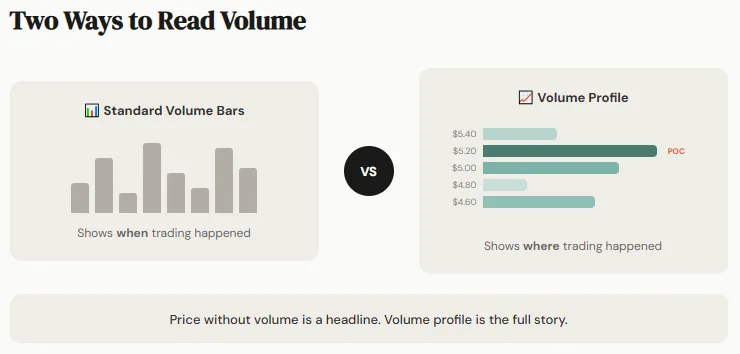
Standard volume bars show how much was traded during a time period. The crypto volume profile goes deeper by showing where, in terms of price, that trading actually occurred.
Instead of displaying volume across time, the volume profile indicator places volume vertically along the price axis. The result is a histogram on the side of the chart showing which specific price levels attracted the most activity. Once traders understand how to read it, guessing at support and resistance levels becomes unnecessary. The chart starts showing where the market actually made decisions.
The key components traders look at are:
- Point of Control (POC): The price level that saw the highest trading activity in a given period. Price tends to revisit it repeatedly, and it can act as both a floor and a ceiling depending on where the market currently sits.
- Value Area (VA): The range where 70% of all trading happened. The Value Area has a high boundary (VAH) and a low boundary (VAL). Price often gravitates back toward this zone when it moves away.
- High Volume Nodes (HVN): Areas where a lot of trading happened historically. Price slows down here. Buyers and sellers show up, friction builds, and these zones often hold as support or resistance.
- Low Volume Nodes (LVN): The quiet zones. Very little trading occurs at these prices, so when the price enters one, it tends to cut straight through with little pushback.
RSI and MACD are both reactive. They calculate based on what already happened. The crypto volume profile works differently. It records data as each transaction occurs, which makes it one of the few tools that reflect actual market behavior without a lag.
Volume profile trading in action: Render token and the Coinbase effect
Render (RNDR) is a decentralized GPU rendering network that connects artists and studios needing computing power with node operators who have spare GPU capacity. The RNDR token is used to pay for those transactions.
Before Coinbase’s involvement, RNDR had a limited trading audience and daily trading volume to match. Then, in August 2024, Coinbase announced it would add support for Render perpetual futures on Coinbase International Exchange and Coinbase Advanced.
The numbers backed it up. Price jumped 7.72%, volume shot up 47.64% to hit $64.5 million, and market cap climbed 7.13% to $2.04 billion, all within a single 24-hour window.
More traders came in, volume built quickly, and price followed. Pull up a volume profile chart from that period, and the story is right there. Heavy buying carved out new High Volume Nodes. The Point of Control landed exactly where most of that activity piled in. The Value Area moved up entirely, settling into a new range that reflected where the market actually agreed on value for the first time.
Those levels then became key reference points for any trader using volume profile trading on RNDR in the weeks that followed.
Final thoughts
Volume profile isn’t just a technical indicator. It’s a way of reading what the market actually did, at what price, and with how much conviction behind it. Raw volume, market cap, and the volume profile indicator together tell a story that price alone never can. For altcoin analysis specifically, that combination is what gives traders something to work with before a move, not after it.
The RNDR move wasn’t random. It was readable, at least in hindsight, and that’s the point. The tools were there. Traders who understood what volume profile was showing had a framework to work with. Whether the coin is a small-cap trading in dead volume or a mid-cap token about to hit a major exchange, volume profile crypto analysis shows where the market made real decisions and where it’s likely to return.