


What if you could prove you’re telling the truth without revealing a single detail? Sounds impossible, right? Yet that’s exactly what a Zero-knowledge proof does; it’s the art of saying “trust me” and actually being believable.
It’s the most mysterious technology in crypto, and perhaps the most poetic too. Because at its core, a Zero-knowledge proof isn’t about code or algorithms. It’s about trust without exposure.
The magic behind Zero-knowledge proof
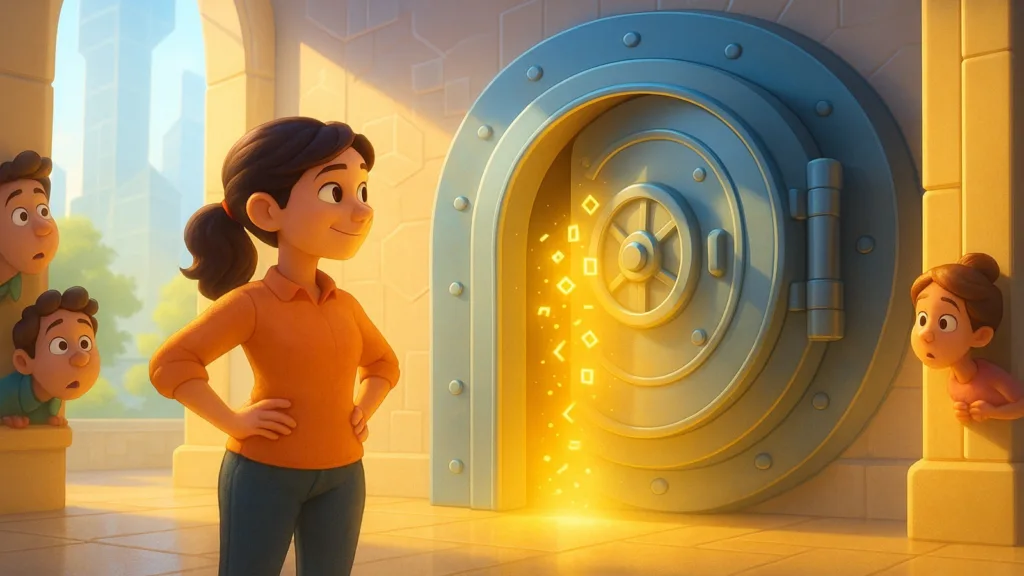
Let’s strip it of the technical gloss. Imagine you’re holding the key to a locked vault. Your friend doubts you have it. You don’t want to hand over the key or even show it. So, you walk into the vault and come out holding a document that only someone with the real key could get. You’ve proven your claim without revealing the key itself.
That, in essence, is a Zero-knowledge proof. It’s a clever way to show that you know a secret, such as a password or transaction code, without ever revealing the secret itself.
It’s trust turned into mathematics.
The importance of Zero-knowledge proof
The crypto world is built on trust, yet constantly threatened by exposure. Every time you sign in, send a token, or confirm your identity, you leave digital breadcrumbs. Hackers, advertisers, and even governments can follow them.
But with Zero-knowledge proof, those breadcrumbs disappear. You can verify transactions, prove your identity, or confirm account balances without revealing who you are or what you own.
In practical terms, ZKPs (as they’re called by developers) power some of the most privacy-forward crypto platforms today; think Zcash, zkSync, Polygon zkEVM, and StarkNet. They help make crypto faster, safer, and cleaner, like spring water running through murky pipes.
The power of privacy without secrets
Privacy has always been misunderstood. It’s not about hiding wrongdoing; it’s about protecting dignity. Zero-knowledge proof gives you a way to participate in public systems without peeling off your digital skin.
It lets a person prove:
- They have enough funds without showing their wallet balance.
- They’re over 18 without exposing their birthdate.
- They’re a verified user without sharing an email or ID.
It’s proof without confession. Security without surrender.
Beyond crypto: A universal tool for trust
What’s fascinating is that Zero-knowledge proof isn’t limited to crypto. Governments could use it for digital voting, where citizens can prove they voted without revealing who they voted for.
Banks could use it to confirm credit scores without seeing the customer’s entire financial history. Even dating apps could use it to verify real identities without exposing sensitive data. We live in an age where privacy feels like a luxury, but ZKP could make it a human right again.
In the next few years, the digital world will demand more proof than ever of identity, assets, and integrity. But no one wants to live in a glass house online. That’s why Zero-knowledge proof isn’t just another blockchain buzzword. It’s the foundation of a new internet culture: one built on silent honesty.
It’s not about hiding. It’s about protecting what matters: truth, identity, and trust, in the noisiest digital marketplace ever created.
Final thoughts
The beauty of Zero-knowledge proof lies in its simplicity. It allows truth to exist without exposure and trust to thrive without transparency’s chaos. It’s not about the math; it’s about the message that sometimes, what you don’t reveal speaks louder than what you do.
In a world obsessed with sharing everything, ZKP reminds us that real power often lies in what stays unspoken.