


The time of the year has come. Just a few more days before we open the door to 2026. Yes, the year 2025 is counting its final moments, with the crypto industry looking back at both the highs and lows that evolved its journey. This year, we saw crypto developments that impacted the industry, ranging from the stablecoin regulatory framework to Trump’s crypto initiatives and Europe’s MiCA regulatory framework.
Among these major moves, one stands out in particular — the stablecoin regulatory framework, one of the most discussed developments that impacted the crypto industry both in the US and globally.
Stablecoin regulatory framework: The most impactful event in crypto 2025
The US had a lot of pivotal crypto incidents in 2025. However, the GENIUS Act or the stablecoin regulatory framework earned a name for itself this year, creating a clear framework for payment stablecoins.
The GENIUS Act, or the Guiding and Establishing National Innovation for U.S. Stablecoins Act, signed on July 18, 2025, shows clear guidance on issuing, backing, and regulating stablecoins, and is widely considered the most significant crypto regulatory milestone in 2025.
As the US government clearly described for the first time how payment stablecoins can be issued, used, audited, and backed, the GENIUS Act unlocked the potential of large financial institutions, payment networks, banks, governments, and even private firms to explore the stablecoin niche.
GNENIUS Act in brief
- The act primarily requires stablecoin issuers to fully back the stablecoin (1:1) with high-quality assets.
- Licensed issuers like banks or financial institutions can issue stablecoins.
- Issuers must undergo regular audits whenever authorities request one and publicly disclose their holdings.
- Issuers must comply with Anti-Money Laundering (AML) standards, the Bank Secrecy Act, and other rules.
- The GENIUS Act prioritizes consumer protection by preventing issuers from spreading misleading claims.
How did the stablecoin regulatory framework impact the crypto industry?
More institutional participation
One of the major outputs of the GENIUS Act implications is increased institutional participation. When stablecoins got clear rules, banks and other fintech firms spontaneously broke into the stablecoin industry and expanded their services in the niche.
For instance, the Visa payment network enables stablecoin settlement for banks using USDC (Circle’s stablecoin).
Stablecoin launches and adoptions
As institutions, governments, and firms strived to dive into the industry, new 1:1 pegged coins arrived, and stablecoin adoption and integration increased. Ripple’s RLUSD stablecoin and Tether’s upcoming USAT stablecoin launches have kept the crypto industry awake.
Phantom Wallet’s CASH stablecoin is also prominent, which allows users to spend, send, receive, and earn the stablecoin and use it for online and in-store shopping using a native debit card.
Competition tightens in crypto
As the stablecoin rule book emerged, institutions gained more confidence and trust in the industry, paving the way for more institutions to integrate stablecoins. This has also led to increased competition between several fintech firms.
Stablecoin use cases escalate
If you have been actively watching the crypto industry in 2025, you might have probably noticed increased use cases of stablecoins, including online shopping, in-store payments, fund transfers, taxi payments, flight booking, and so much more.
Let’s take an example of the UAE’s native stablecoin, AE Coin (AEC). It enables users to pay for taxis, flight bookings, ADNOC petrol stations (in the future), property transactions, and groceries in selected shops.
PayPal’s PYUSD has also found one of its biggest use cases recently — now, content creators in the US can earn through PYUSD stablecoin.
Consumers feel more protected
As it is very evident, clear rules grant more confidence for consumers to easily approach stablecoin issuers and earn profits from stablecoin usage. In cases of issuers misusing funds, consumers can even report it to the relevant authority.
Reaffirms the role of the dollar in crypto payments
USD or dollar-denominated stablecoins are widely used all around the world, such as USDC, USDT, PYUSD, USDD, TrueUSD, and more. Here, USD stablecoins are used as a regulated payment instrument that is mostly used for cross-border transactions where dollar stablecoins already dominate.
Before we dive into how the stablecoin regulatory framework will impact the crypto industry in the future, here are the latest stablecoin launches and integrations you should know.
- SoFiUSD stablecoin by SoFi Bank marks the first US national bank to issue a dollar-pegged stablecoin on a public permissionless blockchain.
- USD1 stablecoin by Trump-linked World Liberty Financial reached approximately $2 billion in circulation.
- MoonPay and Mastercard’s stablecoin debit card help convert stablecoin balances into fiat.
- South Korea’s debut into a KRW-pegged stabelcoin also marks its entry into the growing niche.
- JPYC stablecoin of Japan becomes the first Yen-pegged stablecoin to roll out in the country.
Is the future of stablecoin industry bright after the regulatory framework?
The GENIUS Act is one of the prime reasons why the stablecoin industry has exponentially boomed. In October, the industry saw $300 billion in supply, which is a huge milestone driven by institutions, firms, banks, investors, and governments.
A recent post by Credible Finance, an on-chain credit platform, showed that stablecoins added nearly $100 billion in market cap this year, indicating that the infrastructure is maturing, institutions are stepping in, and real-world usage is becoming unavoidable.
Even in the European Union, Markets in Crypto Assets (MiCA), a comprehensive digital asset framework, is also reshaping the region’s stablecoin landscape. “Europe is moving toward a compliance-first, transparency-driven stablecoin ecosystem”, read an interesting post by LADT, a Web3 payment paradigm.
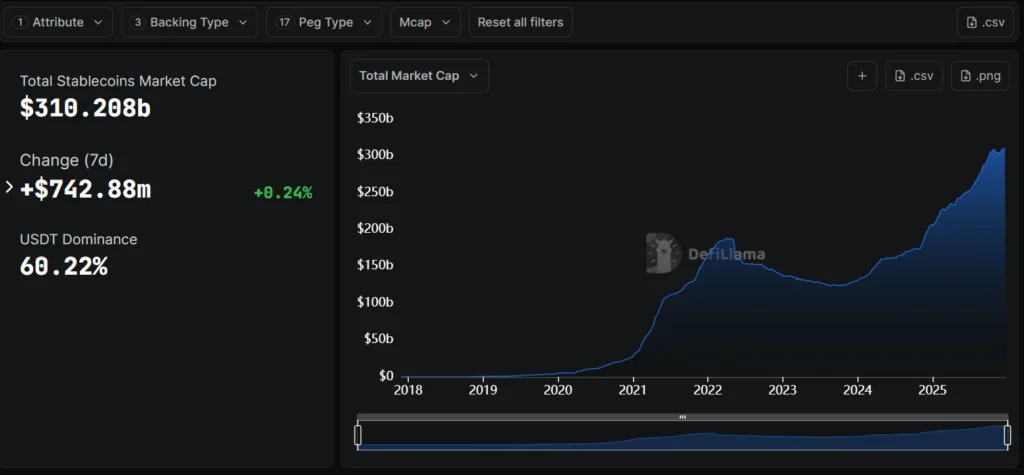
Apart from the GENIUS Act pushing the value of stablecoins, their stable 1:1 nature preserves the beauty as a less volatile asset. Moreover, for international transfers, stablecoins payments take a lower transfer fee compared to traditional payments. What’s more, 24/7 service is another unique feature that users can look for in stablecoin and other crypto transfers.
So, what do you think the future will look like for the stablecoin industry? In fact, stablecoins are expected to boom in 2026 with advanced regulation, more institutional adoptions, investor confidence, and their stable value.
The US Treasury Secretary Scott Bessent recently addressed a crypto audience that the stablecoin market could grow tenfold by the end of the decade, followed by the GENIUS Act.
The stablecoin regulatory framework signals a major, impactful moment in the crypto industry that invited several crypto firms to turn their attention toward the US. As explained, the framework has ignited the path for firms and institutions to launch, integrate, and adopt stablecoins with more real-life use cases.
Importantly, apart from stablecoins, the US is moving into establishing comprehensive rules for the crypto industry. The regulators, such as the Securities and Exchange Commission (SEC) and Commodities Futures Trading Commission (CFTC), are loosening their grip on crypto firms and guiding them with proper guidance for better operations.
All these significant moves primarily point to the country’s crypto-supportive atmosphere that aligns with its ambition to become the crypto capital of the world.