



Crypto market signals do not always warn you with a giant green candle. Sometimes the market tells you first through structure, liquidity, and participation. Right now, the headline numbers look calm: CoinGecko shows the total crypto market at about $2.50 trillion, with $83.46 billion in 24-hour trading volume.
Bitcoin dominance sits at 56.5%, and Ethereum dominance at 10.4%. That is not a picture of broad, explosive risk-taking. It is a picture of a market still leaning on a few heavyweight assets while capital waits for a clearer reason to rotate.
The interesting part is underneath that surface. Stablecoins are enormous, Layer 1 is large but not moving much, Proof-of-Work is still carrying a huge share of total value, and exchange-linked tokens are not showing the kind of activity surge that usually accompanies a full speculative breakout.
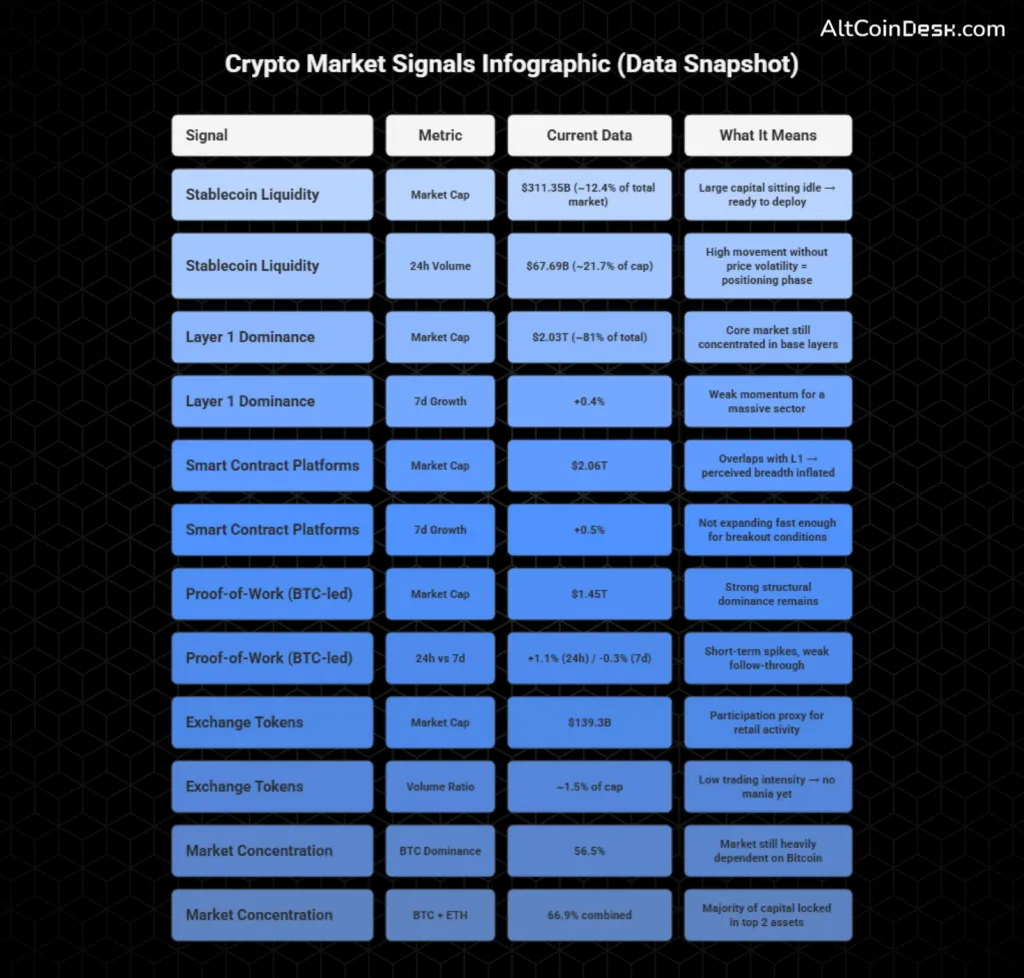
Stablecoins are too large to ignore
Stablecoins are now a market signal, not a side category. CoinGecko puts the stablecoin category at $311.35 billion in market cap with $67.69 billion in trading volume over 24 hours. Against the total crypto market cap of $2.50 trillion, that means stablecoins alone account for about 12.4% of the entire market. Their daily trading volume is about 21.7% of their total market cap, which is very high for assets designed not to move in price.
That is the first contradiction. If traders were already in full risk-on mode, more of that dry powder would likely be deployed into volatile sectors. Instead, a huge chunk of capital remains in instruments built for waiting, settlement, hedging, and quick redeployment. The stablecoin stack is also heavily concentrated: USDT alone is about $184.15 billion, and USDC is about $79.04 billion, while the broader USD stablecoin category is $306.35 billion, which means the stablecoin market is overwhelmingly dollar-based.
This does not prove an immediate breakout. It does show that liquidity is present, mobile, and unusually large.
Layer 1 is huge, but the momentum does not match the size
CoinGecko currently values the Layer 1 category at about $2.03 trillion, up 1.0% over 24 hours. The broader Smart Contract Platform category is even larger at $2.06 trillion, up 1.0% over 24 hours.
On the main categories page, Smart Contract Platform is up 1.1% in 24 hours and only 0.5% over 7 days, while Layer 1 is up 1.0% in 24 hours and only 0.4% over 7 days.
Those are not weak numbers in isolation, but they are underwhelming relative to the scale. A sector worth around $2 trillion that is only adding roughly 0.4% to 0.5% over a week is not showing broad speculative acceleration.
Using CoinGecko’s total market cap of $2.50 trillion, the Layer 1 figure is about 81.1% of the total market, and Smart Contract Platforms are about 82.3%. That does not mean those sectors literally represent four-fifths of all crypto in additive terms, because CoinGecko warns that categories can overlap. It does mean the market’s center of gravity is still sitting on the same base layers.
That is signal number two: size is there, but momentum is not expanding at the same pace.
Bitcoin is still carrying the market harder than many narratives admit
CoinGecko’s market dashboard shows Bitcoin dominance at 56.5% and Ethereum dominance at 10.4%. Combined, that is 66.9% of the tracked crypto market sitting in just two assets by dominance. At the same time, CoinGecko’s Proof-of-Work category stands at $1.458 trillion with $37.23 billion in 24-hour trading volume and a 1.1% to 1.2% daily gain, depending on the page view.
That matters because many traders talk as if the market is being driven by a wide mix of fresh narratives. Sometimes it is. But the structural data still says Bitcoin remains the anchor. A market where BTC holds 56.5% dominance is not a market in full altseason-style breadth. It is a market where leadership is still narrow. If capital rotates aggressively later, this number would usually need to soften while lower-cap and sector-specific flows broaden. Right now, that has not happened in a convincing way.
So the third signal is concentration at the top. When leadership stays this narrow, the market often looks stronger than it is underneath.

Exchange-linked tokens are not showing classic mania behavior
The Exchange-based Tokens category sits at about $139.32 billion in market cap with only $2.125 billion in 24-hour trading volume, according to CoinGecko. That means daily volume is only about 1.5% of the category’s market cap. The category is up 0.7% over 24 hours and 1.0% over 7 days on the main categories page.
This is where nuance matters. The category is not collapsing. But it is also not behaving like a market that has fully flipped into a participation frenzy. In strong speculative phases, exchange-linked tokens often benefit from a visible rise in platform activity, listing excitement, retail turnover, and fee capture narratives. Instead, the current volume-to-market-cap relationship looks relatively restrained. The category is large enough to matter, but the turnover is not screaming “mania.”
That makes exchange tokens a useful sentiment gauge. They are not flashing panic. They are also not flashing full-throttle euphoria.
The market looks diversified, but the data says it is more concentrated
CoinGecko says directly on its categories page that some cryptos may overlap across multiple categories. That warning is easy to skip, but it changes how the whole table should be read. Ethereum can sit inside the Smart Contract Platform and Layer 1. Bitcoin can influence Layer 1 and Proof-of-Work. A single major asset can support multiple category totals at once.
That means the category leaderboard can make the market look wider than it really is. The table reinforces this concentration story. The top categories are still Smart Contract Platform, Layer 1, and Proof-of-Work, while stablecoins and exchange-based tokens remain major secondary structures rather than independent growth engines. Meanwhile, Bitcoin and Ethereum together still account for 66.9% of market dominance on CoinGecko’s dashboard.
This is the fifth signal, and arguably the most important: crypto is not as broadly distributed as it appears from category labels alone. That can suppress obvious upside breadth for a while, then amplify the next move once flows rotate more decisively.
What the numbers are really saying
Put the five signals together, and the message is more technical than dramatic. The total market is large, but leadership remains concentrated in Bitcoin and Ethereum. Stablecoins are massive and liquid, which means capital is available. Layer 1 and smart contract platforms dominate market structure, but their weekly gains are still modest for sectors of that size.
Exchange-linked tokens are positive, but their turnover does not yet look like a late-cycle frenzy. And category overlap means the market is less diversified than a casual glance suggests.
That combination usually points to a market in pre-expansion or pre-repricing mode, not one already in full directional breakout. It is not dead money. It is a market waiting for stronger confirmation.