



The Vitalik Buterin staking proposal signals a new way for Ethereum validators to operate that could significantly change how staking works, without directly challenging large staking providers or rewriting Ethereum’s economic rules.
In a post published on Ethereum’s EthResearch forum, the Vitalik Buterin staking proposal introduces the idea of native Distributed Validator Technology, or native DVT, built directly into the Ethereum protocol. The goal is simple in theory: make staking more secure and more decentralized by changing the structure of validators themselves.
Rather than naming or restricting major staking services, the proposal adjusts incentives and mechanics in a way that allows large and institutional Ethereum holders to operate their own validators more safely. Supporters say this could reduce Ethereum’s growing dependence on centralized staking operators.
What the Vitalik Buterin staking proposal actually suggests
Today, most Ethereum validators rely on a single machine and a single cryptographic key. If that setup fails, whether through downtime, bugs, or key compromise, the validator can lose rewards or face penalties.
The Vitalik Buterin staking proposal replaces this single point of failure with a grouped approach. A validator with a larger stake would be allowed to register multiple signing keys, up to a capped number. Instead of one computer signing messages, several independent machines could share responsibility.
Ethereum would see those machines as a single validator, but it would only trust the action if enough of them agree. Instead of rewarding or punishing one computer, the system would treat the entire group as responsible, sharing both the upside and the risk together. The idea builds on existing Distributed Validator Technology used by third-party tools but moves the logic into Ethereum’s base protocol itself.

Why Ethereum cares about decentralization pressure
Ethereum’s staking system has grown rapidly since the Merge. With that growth has come concern about centralization, especially as large staking providers attract an increasing share of staked ETH.
The Vitalik Buterin staking proposal avoids targeting any specific provider, including well-known platforms like Lido. Instead, it focuses on why many users rely on them in the first place.
Running a validator safely is complex. Key management, uptime guarantees, and protection against bugs are difficult for individuals and institutions alike. By allowing validators to spread risk across multiple machines without custom cryptography, Ethereum could lower the operational barrier to self-staking. In that sense, the proposal attempts to change behavior through design rather than regulation.
Native DVT versus existing DVT tools
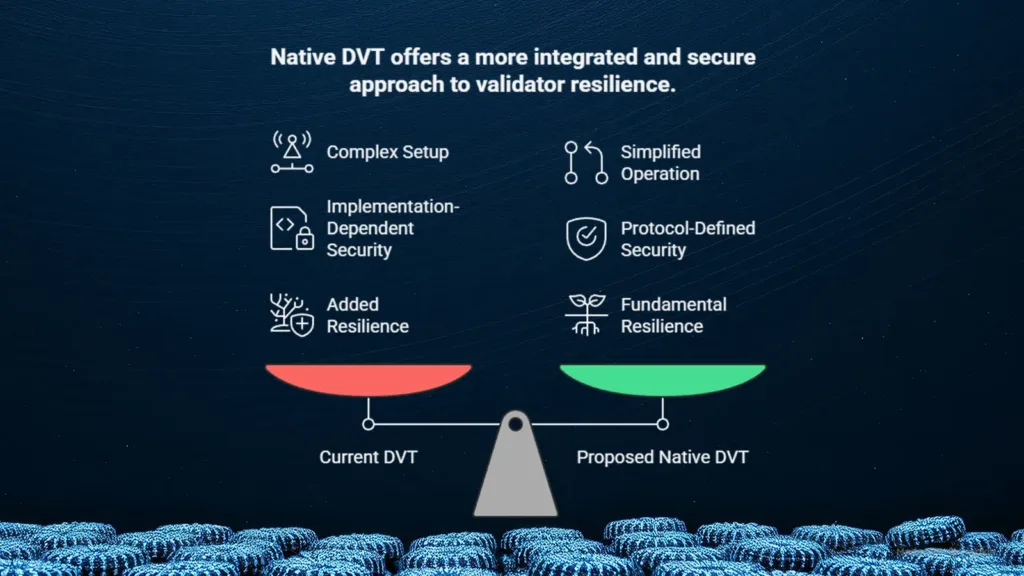
Distributed Validator Technology already exists today through external networks such as Obol and ssv.network. These systems split validator keys using cryptographic techniques and require coordination layers between machines.
Vitalik Buterin argues that while these tools work, they introduce complexity and depend heavily on cryptographic properties that may not align with Ethereum’s long-term roadmap.
At its core, the Vitalik Buterin staking proposal tries to take complexity out of the hands of operators and put it where it belongs, inside Ethereum itself. Instead of asking validators to stitch together extra tools, custom networks, and complicated signing setups, the network would simply understand that several keys belong to the same validator. Ethereum would do the coordination natively. For operators, that means fewer moving parts and fewer things that can quietly go wrong.
A subtle signal about Ethereum’s future security
There is also a longer view baked into this idea, even if it is easy to miss on a first read. Much of today’s Distributed Validator Technology depends on cryptographic assumptions that may not age well, especially as conversations around post-quantum security become more serious. Vitalik is not proposing an immediate cryptographic overhaul, but the structure he outlines leaves room to adapt if those assumptions change.
By shifting validator coordination into the protocol itself, Ethereum keeps its options open. If cryptographic standards evolve, the system would not need to be rebuilt from scratch. That kind of flexibility is what many developers see as the real signal here. It suggests Ethereum is trying to prepare for risks that are still years away, rather than waiting until they become emergencies.
Early debate and open questions
The idea has already triggered thoughtful debate inside the Ethereum research community. Some developers worry that adding new logic at the protocol level could increase complexity at a time when Ethereum is trying to simplify validator operations. Others question whether grouping validators actually improves diversity, since multiple machines could still be running the same software and exposing the network to correlated failures.
Vitalik does not dismiss those concerns. He presents the proposal as a starting point for discussion, not a finished upgrade ready to ship. In that sense, the staking proposal feels less like an announcement and more like an invitation, a way of asking the Ethereum community how much future resilience is worth building into the protocol today.
What happens next
There is no rollout date and no named upgrade attached yet. For now, the Vitalik Buterin staking proposal lives as an idea, not a mandate, something for developers and operators to test, debate, and stress-check.
What matters is the direction it suggests. Rather than trying to curb participation or police who gets to stake, Ethereum appears to be exploring a softer approach. Make secure self-staking easier, and decentralization starts to happen on its own.
If the concept moves forward, native DVT would not arrive as a dramatic overhaul. It would work in the background, quietly changing incentives and architecture so that running a validator independently becomes the most natural choice, not the hardest one.