

XRP finally ended its 10-month-long crash after Japan’s Rakuten integration. Although many in the crypto community expected XRP to take off with the integration, the coin’s consolidation after the integration was underwhelming.
Rakuten exposes crypto to 44 million users
XRP is now accessible in Asia after Japan’s e-commerce giant Rakuten integrated XRP payments into its application. As such, 44 million users will be able to spend it across 5 million merchants on the application. This integration exposes the regular e-commerce shopper to cryptocurrencies.
This move is significant not just because people can use XRP but also because of what it does to the way things are spread out. When you add crypto functionality to a system already widely used for shopping and financial transactions, regular people who have not previously used crypto are gradually introduced to it through their everyday activities.
This helps make a connection between the crypto market and the real world, which could make more people aware of and use blockchain-based payments in Asia.
Rakuten is one of the technology and digital commerce groups in Japan, and it does a lot more than just sell things online. It makes around ¥2.0–2.2 trillion every year, which is about $13–15 billion USD because it has a lot of different parts that work together, including online shopping, financial things, phone services, advertising, and digital services.
The company has many customers, with over 100 million people using it in Japan and more than 1 billion people using it around the world because it has a lot of different services that all work together under the Rakuten “super app” idea.
Rakuten is more than an online shopping platform. It also offers services. Rakuten has one of the digital banking and credit card systems in Japan. The company is a player in financial technology.
It does lots of things like processing payments and lending money. Rakuten also offers services related to cryptocurrency through Rakuten Wallet. This makes Rakuten a big part of Japans finance world.
Another thing that makes Rakuten strong is its loyalty system, where people earn and spend “Rakuten Points” when they use services, which creates a system that keeps people using the services and makes them more engaged. Rakuten’s loyalty program offers more than 3 trillion points, which accumulate to an estimated $23 billion USD, and these could be convertible into XRP, linking its closed-loop rewards system with digital assets.
XRP struggles to clear resistance at $1.50
The integration comes at a time when the XRP price is struggling to push past the $1.50 psychological resistance level. When the XRP price is observed from a broader perspective, it is currently consolidating after crashing since last July.
In July 2025, the coin was selling for more than $3. The coin’s price kept going down because people kept selling it. Those who only wanted to make a quick profit sold the coin after the price went up at first. This meant there were a lot of coins being sold in the market.
As the selling pressure intensified, each attempt to recover was futile. Every low and high was met with renewed distribution. This happened because buyers lacked the conviction to absorb the excess supply at higher levels.
As time passed, structure weakened, and lower highs and lower lows began forming, signaling the fading demand and the change in sentiment from accumulation to distribution. The market had these moments where it went back up but people who were selling were very quick to take advantage of that. They were looking for any chance to make a bit of money.
This made the market keep going down and caught people who bought in late thinking it would go up. In this situation there were a lot of people selling and not many people buying. The sellers were in charge.
Initially, the price of the coin went down slowly, but it accelerated afterwards. The market had some rebounds, but the sellers were always ready to sell, which made the downtrend even stronger and trapped the late buyers who bought the market.
Although still not confirmed, XRP appears to be entering a consolidation phase. The prices consolidate here as the buying and selling pressure temporarily balance each other out.
During this phase, the price typically fluctuates within a narrow range, with no strong trend in either direction, as neither the bulls nor the bears possess sufficient momentum to dominate the market.
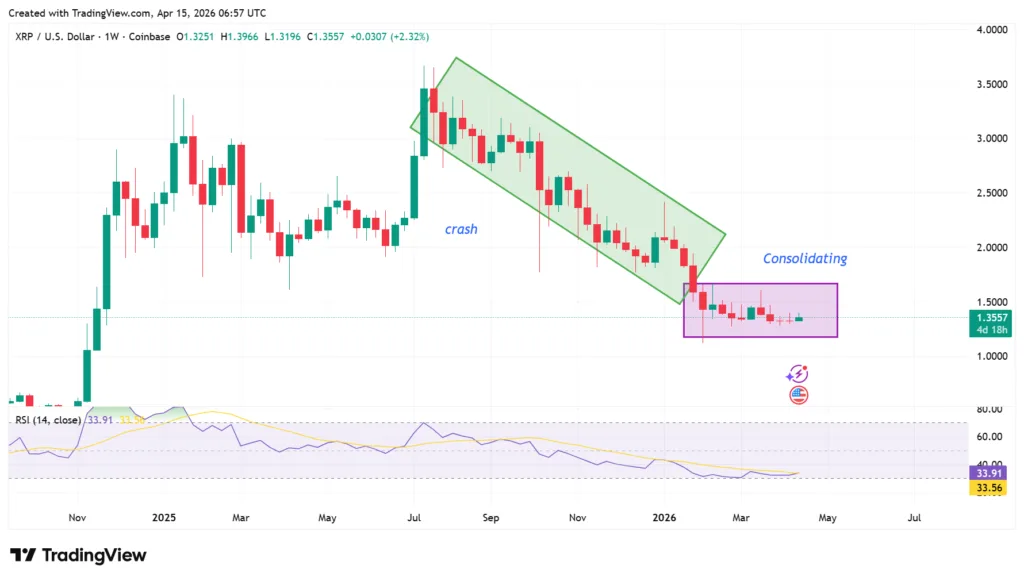
Volatility seen during the early stages begins to fade as traders begin to take profits after prior moves. With no clear direction of price movement, new participants hesitate to enter the market.
As the buyer conviction is lacking, it leads to a reduction in momentum and often lower trading volume as the market “coils” and builds energy for its next significant move. Within that tight range, the price is repeatedly hitting and testing the support and resistance levels. Each rejection or bounce establishes a stronger boundary for the structure.
Zooming into the consolidation phase and observing it from a shorter time frame, XRP looks bearish. As shown in the chart below, although the prices are making higher lows and higher highs, it is forming a rising wedge pattern.
XRP fluctuates inside a rising wedge on the 4-hour chart
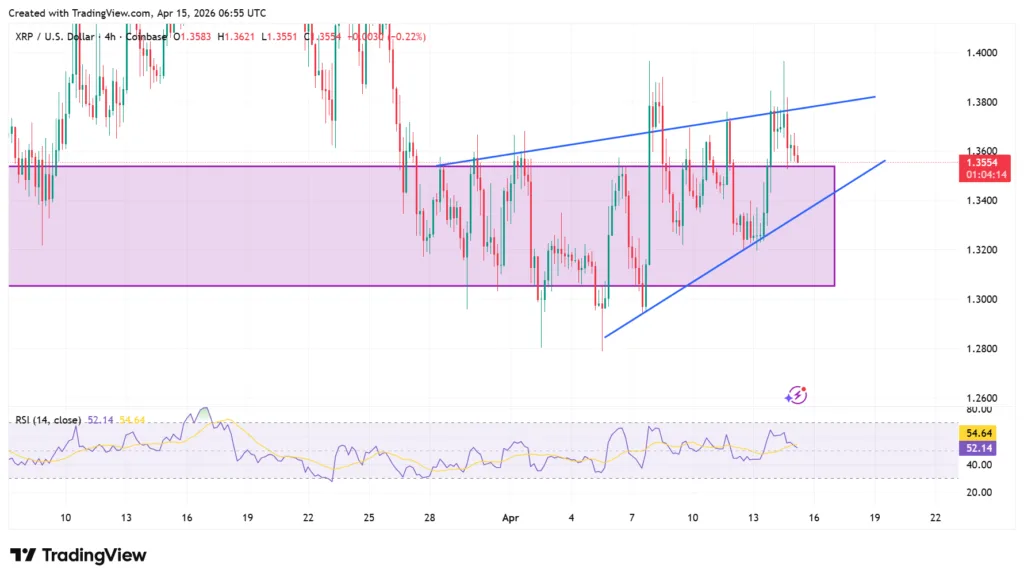
A rising wedge is a pattern that takes form when price moves upward inside two converging trendlines that both slope higher, but with the lower trendline rising more sharply than the upper one. Although it may look like a healthy uptrend because the market makes good progress with higher highs and higher lows, in reality, the momentum behind the move is weakening over time.
Each push higher becomes smaller and less convincing, showing that buyers are gradually losing strength while sellers begin to step in earlier on every pullback.
Retail traders often continue buying, anticipating the uptrend to continue while the more experienced participants start taking profits into strength or even opening short positions near the upper trendline of the wedge.
Traders who wait for the breakout usually stay on the sidelines, waiting for confirmation of a breakdown before entering. As the pattern develops, trading activity often slows down and volatility compresses, creating a sense of calm before the next big move.
When the breakout happens, XRP will probably go below the line of the rising wedge, which means the pattern is going to be bearish. If this happens in a way, the price of XRP will usually drop quickly because the market is leaving a tight space where buyers were already getting weaker.
As the price of XRP falls below the support level, stop-loss orders from people who bought XRP late will be triggered. This will add to the selling of XRP, making the price of XRP go down even faster.