


Solana is currently trading close to the 50-day moving average, and there are three possibilities that could happen at this level. An analyst who observed Solana’s price action stated that when SOL hovers just below the 50-day moving average, there is a three-step cycle. Firstly, the reclaim of the 50-day moving average, the failure, and the consolidation trap.
The analyst who goes by the pseudonym Ali Chart made a significant observation of SOL behaved when it was about to lose momentum. According to the analyst, this pattern has been consistent since October 2025, where the price loses momentum.
Initially, Solana reclaims the 50-day Simple Moving Average (SMA) and manages to close above it. However, following this, it then loses the 50-day simple moving average. After losing this level, other coins usually experience a straight leg down, but Solana lingers, moves sideways for a bit, and then catches many traders here.
A simple moving average is an important tool that smoothens out the price action by averaging closing prices over a fixed period. Traders use this indicator to remove the noise or jagged short-term fluctuation, which is misleading.
Once these are removed, it helps them better focus on the broader trend. In crypto, this is important, as volatility is ever present; the SMA acts as a structural guide or a GPS that guides and shows whether the market is leaning bullish or bearish while also serving as dynamic support and resistance.
A breach or respect of this level indicates changes in momentum, and that is why the SMAs become crucial for trade entry and exit.
Quoting instances, the analyst wrote on an X post: “November 2025: We saw a drop below the 50-day SMA, followed by a multi-week consolidation. The market eventually resolved lower, leading to a new local bottom.”
In January 2026, Solana briefly reclaimed the 50-day SMA and once again lost. It “drifted” or consolidated for a while before the next major sell-off took place.
And now that it’s March/April 2026, SOL has moved above the 50-day SMA (peaking near $97). We have since dropped back below it.”
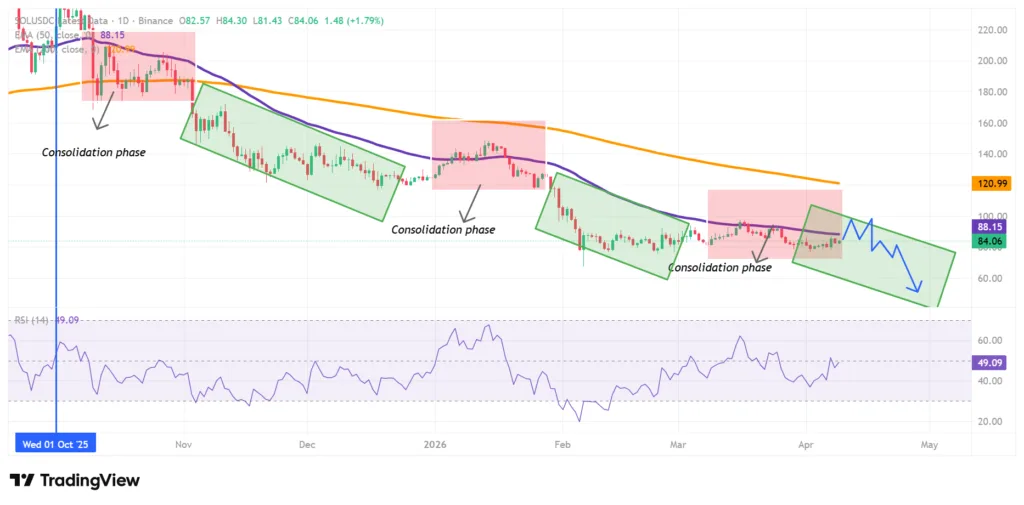
With SOL prices consolidating close to the $84 under the 50-day moving average, there is a great expectation that the prices could reclaim and rise above this SMA and then start to consolidate for some time before the real crash sets in.
The reclaim: what happens, why it happens, and how traders behave
Once the SOL price breaks down the 50-day SMA support line, the next reclaim attempt brings everyone back on board. The price starts moving above the level again, the structure seems to have healed up, and there’s new momentum on the charts.
On the face of it, everything seems like the previous trend is resuming its course. However, behind the scenes, this kind of price action is usually fueled by short covering positions and new breakout bulls who jump into the market.
The latter is providing enough liquidity to let the bigger traders get out. There is plenty of genuine demand, but the players who are driving it aren’t the ones who will be holding onto their positions for the long term—they simply jumped in to ride the wave.
The failure: why SOL loses this 50-day SMA
This is due to the fact that there is a lack of support for the recovery. With the end of the buying surge, there is not enough interest to maintain the price above the 50-day SMA line. Sellers, which were operating in the course of the recovery, begin to take control and move the price lower.
If SOL goes below the price level, it becomes apparent that the preceding recovery was weak and there is more supply than demand. Consequently, the 50-day SMA acts as resistance, where any rallies against it will be sold off.
Consolidation Trap: where SOL moves sideways before the real breakdown
Unlike a crash, where the price plummets instantly, the SOL price often falls into a choppy consolidation pattern below the 50-day SMA. It’s all about trapping traders in such a scenario. The asset remains stuck in a range and keeps giving false breakouts and breakdown signals that fool the bulls and bears.
The retail investors continue buying the dips hoping for another attempt to reclaim the highs, whereas some traders end up shorting early and getting trapped by small pops. The truth, however, is that institutional players slowly begin taking profits out of the asset into each bounce because it offers them a perfect setup to exit positions safely and avoid any sharp fall in the asset’s value.