



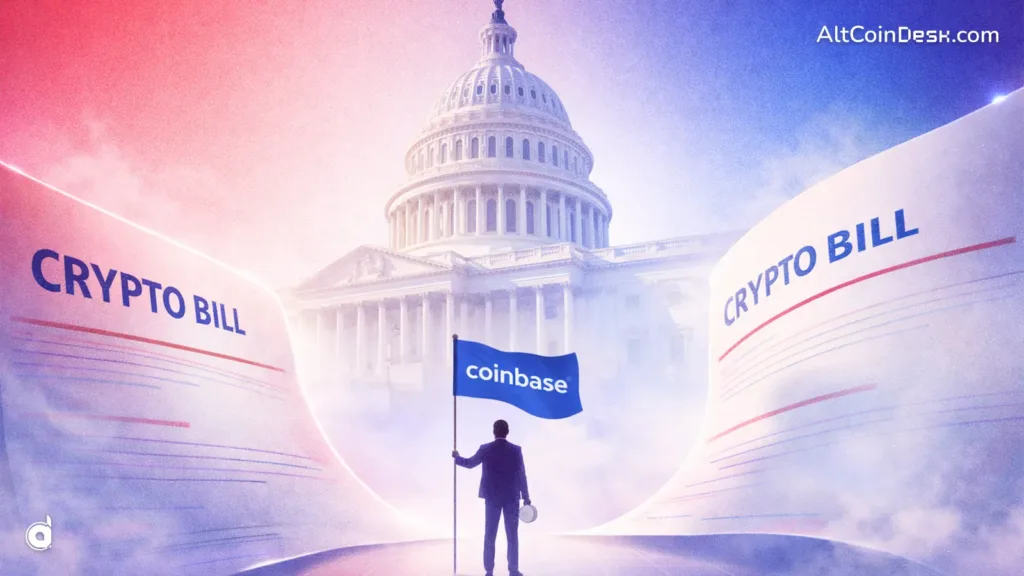
The crypto bill that was supposed to move Washington closer to regulatory clarity has instead done the opposite. This week, the US Senate Banking Committee delayed discussion on a long-awaited crypto market structure proposal after Brian Armstrong, chief executive of Coinbase, publicly withdrew his support.
At first glance, the delay looked procedural. In reality, it revealed something far more consequential. The fight was not about memecoins, speculation, or retail excess. It was about tokenized stocks, the most institution-friendly use case crypto has produced so far, and one that lawmakers still struggle to define. Let’s examine how a crypto bill meant to unlock clarity instead exposed who really holds the pen.
A bill designed for clarity runs into its sharpest edge
On January 13, 2026, Reuters reported that US senators introduced a draft crypto bill aimed at creating a clear regulatory framework for digital assets. The proposal leaned toward assigning spot market oversight to the Commodity Futures Trading Commission and introduced restrictions on rewards paid simply for holding stablecoins.
One day later, Armstrong publicly objected. His concern was not cosmetic. He argued the draft risked effectively banning or severely limiting tokenized equities, digital representations of stocks traded on blockchain rails. Within hours of that statement, the Senate Banking Committee postponed the markup it had been expected to hold.
The timing mattered. Lawmakers acknowledged that talks with industry stakeholders were continuing, but the pause followed Armstrong’s criticism almost immediately. In Washington terms, that sequence spoke volumes.
Tokenized stocks, not speculation, became the breaking point
Tokenized equities sit at the intersection of traditional finance and blockchain infrastructure. They promise faster settlement, global access, and programmable ownership without rewriting the idea of what a stock is. For major exchanges and institutional crypto firms, this is the bridge to mainstream adoption.
That is why this crypto bill stalled where others have limped forward. Lawmakers still lack clear guidance on how tokenized equities fit within existing securities law. Are they simply new wrappers around familiar assets, or something that demands a fresh framework? The draft bill attempted to answer that question implicitly, and in doing so, triggered resistance.
The irony is hard to miss. A bill designed to clarify crypto markets ran aground because it touched the most conventional, least controversial corner of the industry. Tokenized stocks are not fringe experiments. They are Wall Street’s first serious step onto blockchain rails.
The quiet power shift behind the delay
There is another layer to this story, one that goes beyond tokenization. The Senate Banking Committee did not delay because votes were missing. It was delayed because industry support fractured.
This episode underscored a reality Washington rarely states openly. In crypto, regulatory momentum increasingly depends on industry consent, not just legislative agreement. Coinbase did not lobby quietly behind closed doors. It objected publicly, and the process slowed.
That does not mean lawmakers have surrendered authority. It does mean the balance of influence has shifted. Crypto firms are no longer petitioners waiting for permission. They are stakeholders whose approval now shapes the pace and direction of regulation.
Stablecoins and banks add pressure from the sidelines
While tokenized equities may have been the spark, stablecoin rewards added fuel. Banking groups have argued that yield or rewards on stablecoins resemble deposit-taking without bank-level regulation. Crypto firms counter that rewards are a product feature, not a banking function.
This tension runs through the crypto bill and through nearly every recent debate on digital asset policy. It is less about risk and more about competition. Banks see erosion of their core business. Crypto platforms see innovation being constrained by rules written for a different era.
What the delay really signals
The Senate Banking Committee delay is not a collapse of crypto legislation. It is a pause that exposes the unresolved questions at the heart of US crypto policy. Who gets to define financial innovation? How existing laws stretch to fit new infrastructure. And whether Washington is prepared to regulate systems it does not fully conceptualize yet.
Tokenized stocks forced those questions into the open. That is why this crypto bill stalled here, not on speculation or consumer protection, but on the part of crypto that looks most like traditional finance.