



The Monad community raised concerns about the token allocation for the team just after the project launched its mainnet. Despite all these negative comments, the price of the coin has been on the rise.
Monad, a layer-1 blockchain that claims to address the drawbacks of Ethereum–scalability, while maintaining full compatibility with Ethereum Virtual Machines (EVM), launched its mainnet on Monday.
Although there was some excitement surrounding the launch of this coin and the airdrop, the community was not happy with the tokenomics.
The project allocated 27% of the supply to the team, exceeding the industry standard, which usually ranges from 15% to 20%. Holding more than a quarter of the total supply as founders, core developers, and early contributors comes with its bag of benefits.
The team captures the long-term value of the project, and based on the price fluctuation, the team will earn profits disproportionately.
It’s not just financial benefits that the team receives, but they also have the final say when it comes to making decisions about the project’s direction. For instance, in cases like protocol upgrades, treasury spending, validator/economic parameters, and community proposals, they get to have the last say. This creates a power imbalance favoring the insiders.
However, let’s not forget that a larger allocation also has its benefits. Large insider allocation makes it harder for whales, rival chains, and other external actors to buy their way into controlling the network.
In addition, a larger team allocation can be used to pay engineers competitively, provide token-based bonuses, and retain core contributors, which can be beneficial for the project in the long run.
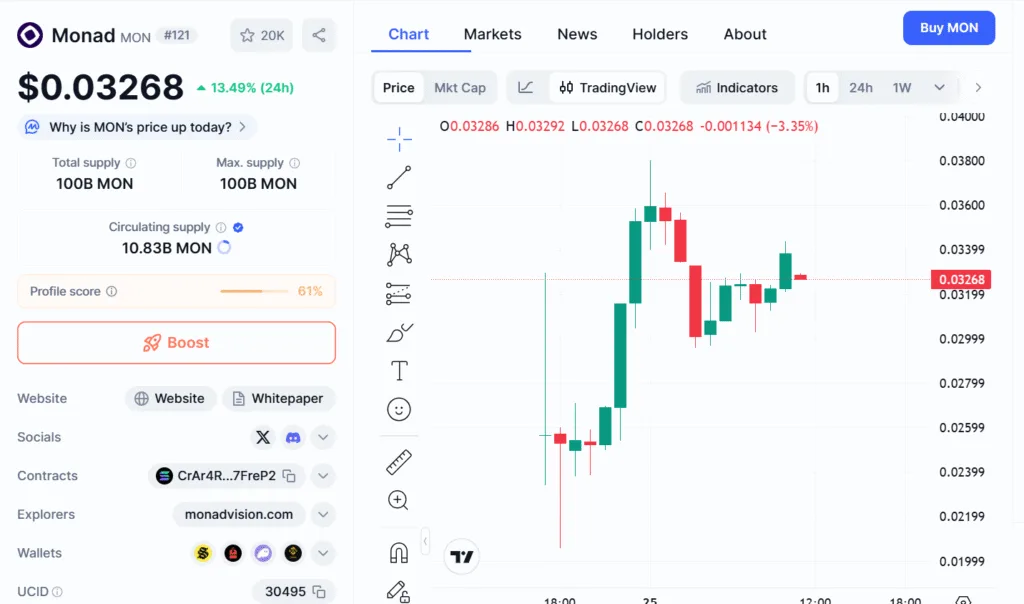
Source: CoinMarkCap
Despite the negative comments spewing on social media, the coin has been gaining value and traction. MON gained more than 13% during the past 24 hours, rising from $0.025 to $0.033.
It has a circulating supply of 10.8 billion MON, which is just 10% of the total supply. Most coins witness a spike in price following their launch. MON’s real value will be seen only when the project starts to scale.