

China’s securities watchdog has advised some local brokerages to pause their real-world asset (RWA) tokenization business in Hong Kong, said two sources, signaling Beijing’s concerns of a euphoric drive toward a booming digital assets market offshore.
What Is RWA tokenization?
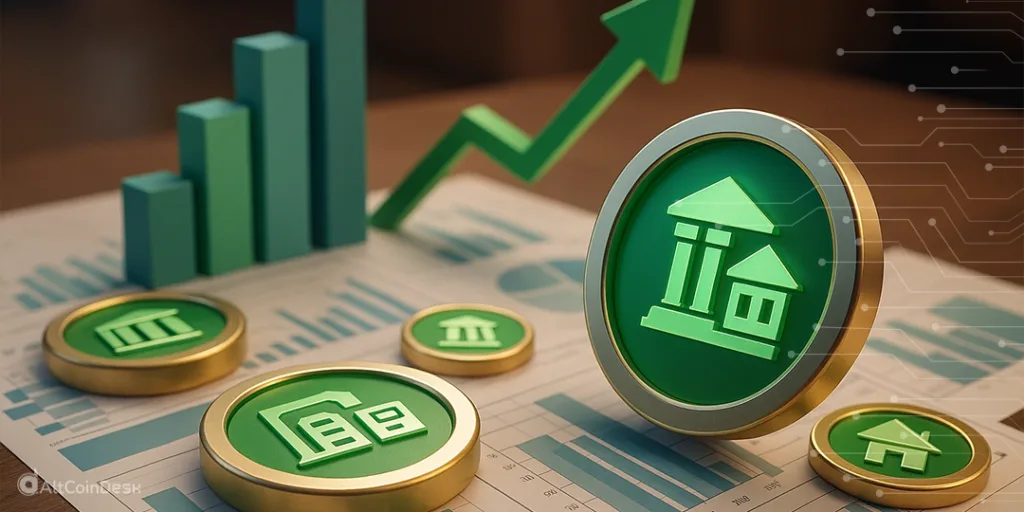
The RWA tokenization process usually converts traditional assets such as stocks, bonds, funds and even real estate, into digital tokens traded on a blockchain. A raft of Chinese firms, including brokerages, have launched RWAs in Hong Kong over the past few months.
Informal guidance from regulators
At least two leading brokerages have received informal guidance from the China Securities Regulatory Commission (CSRC) in recent weeks to refrain from conducting RWA business offshore, said the sources with knowledge of the matter.
One of the sources said the latest regulatory guidance is aimed at strengthening risk management of a new business and making sure the claims made by companies are backed by strong, legitimate businesses.
Market reaction in Hong Kong
Shares in top Chinese brokerages listed in Hong Kong, including Guotai Junan International and GF Securities, lost between 2% and 7.25% on Tuesday, while the broader market was down 0.9% at the close of the morning session.
The move comes as Hong Kong over the past year ramped up efforts to position the Asian financial center as a digital assets hub, with many firms, including Chinese brokerages, preparing for the launch of virtual asset trading, investment advisory and virtual asset management.
China’s cautious stance on digital assets
China, once the world’s biggest Bitcoin trading and mining center, has taken a cautious approach toward digital assets after it banned cryptocurrency trading and mining in 2021 due to financial system stability concerns.
Last month, Chinese regulators asked big local brokers to halt publication of research endorsing stablecoins in a bid to curb a surge in interest in the digital currency among domestic investors, Reuters has reported, citing sources.
Hong Kong conducts legal review of tokenization
Beijing’s latest move comes even as Hong Kong said in June its Financial Services and the Treasury Bureau (FSTB) and the Hong Kong Monetary Authority (HKMA) are conducting a legal review of RWA tokenization, drawing on international experience.
The global RWA market is currently worth around $29 billion, according to data provider RWA.xyz. China Merchants Securities, citing industry forecasts, said last month the figure could exceed $2 trillion by 2030.
It was not immediately known how long the Chinese securities regulator’s informal guidance to some brokerages on halting RWA business in Hong Kong would remain in force. The sources could not be named as they were not authorized to speak to the media.
“HKMA has guidelines in place to govern sale and distribution of tokenized products by banks to protect investors,” a HKMA spokesperson said in a statement to Reuters, without commenting on the CSRC’s new guidance.
The spokesperson said the “tokenization space is rapidly evolving” and it is exploring the potential use cases through Project Ensemble, known as a “sandbox” project for tokenization. The legal review of Hong Kong’s tokenization market will focus initially on the bond market, the spokesperson added.
The CSRC and FSTB did not respond to Reuters’ request for comment. The Securities and Futures Commission (SFC) of Hong Kong declined to comment.
Virtual asset frenzy in Hong Kong
Chinese brokerage GF Securities’ Hong Kong unit in June launched “GF tokens,” a suite of yield-generating products that are backed by the prices of U.S. dollar, Hong Kong dollar and offshore renminbi, its partner HashKey Chain said at that time.
China Merchant Bank International, a subsidiary of China Merchant Bank, last month assisted Shenzhen Futian Investment to raise 500 million yuan ($70.29 million) via the issuance of a RWA-based digital bond, CMBI has said in a statement.
Spokespersons at GF and CMBI did not respond to Reuters’ request for comment on whether they have received any regulatory guidance on their RWA plans.
Besides brokerages, Chinese property developer Seazen Group also said last month it was setting up an institute in Hong Kong to push RWA tokenization.
Hong Kong’s stablecoin push sparks investor interest
Hong Kong’s recent introduction of its stablecoin regime has fueled a wave of crypto enthusiasm. The Hong Kong Monetary Authority (HKMA) said earlier this month 77 firms have expressed interest in applying for a license as of August 31.
Shares in Chinese companies, which expressed an interest in foraying into virtual asset business — a wider sector that covers trading and investments of digital assets, stablecoin and tokenization in Hong Kong — have rallied in the recent past.
State-owned Guotai Junan International shares once shot up more than 400% after the broker said that it had obtained regulatory approval in Hong Kong to offer cryptocurrency trading services in June.
Shares of Fosun International jumped as much as 28% on Aug 12 on the news that its chairman Guo Guangchang, together with Fosun’s stablecoin team, met with top Hong Kong government officials earlier in the month.