



This piece is to help you understand how the proposed HONEST Act Congress trading ban targets crypto, derivatives, and the very tools of political wealth. For decades, the dance has been familiar: elected officials make policy that moves markets, and some have found ways to profit from those moves. The proposed remedy, the qualified blind trust, has long been the gold-plated fig leaf. A new piece of legislation, however, isn’t just polishing that old shield; it’s declaring it obsolete.
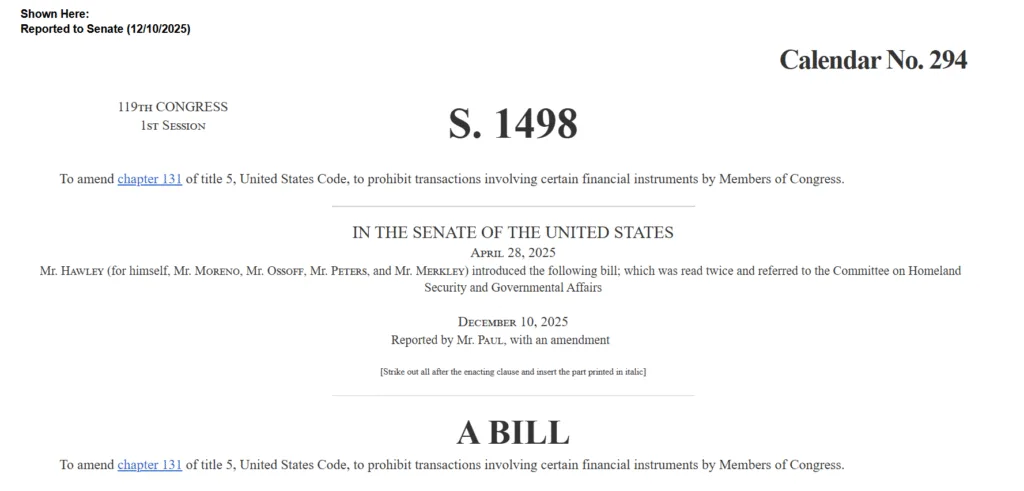
The HONEST Act Congress trading ban is not your average political reform but a structural reset. Currently waiting on the Senate calendar, this bill, born as the “PELOSI Act” and transformed in committee, seeks to sever the direct financial interests of the most powerful people in America from the markets they influence. And it does so with a startlingly modern and comprehensive grip.
HONEST Act Congress trading ban: The death of blind trust
The most telling detail in the HONEST Act is its treatment of qualified blind trusts. The bill doesn’t just regulate them; it phases them out. Existing trusts would be forced to sell their “covered investments,” a term we’ll expand on in a moment, and then dissolve. After a set period, no new ones could be established.
This is a profound policy choice. It signals that simply not knowing what you own is no longer an acceptable ethical standard for those crafting national law. The HONEST Act Congress trading ban framework demands divestment, not just ignorance. It pushes toward fewer conflicted holdings entirely, moving the goalpost from managed conflict to eliminated conflict.
A net cast over modern finance

Calling this a “stock trading ban” is a drastic understatement. The definition of a “covered investment” is where the bill reveals its teeth and its awareness of 21st-century finance. It explicitly includes:
- Digital Assets: Cryptocurrencies and other blockchain-based assets are named directly, ending any ambiguity.
- Commodities & Futures: From oil to wheat to precious metals.
- Synthetic Exposure: This includes options, warrants, and other derivatives that let someone profit from an asset’s movement without owning it.
- Indirect Interests: Economic benefits through funds, trusts, and certain compensation plans are also in scope.
The message is clear: the law is designed to be a catch-all net. It acknowledges that wealth and market exposure today are held in complex, layered ways. By including a spouse’s and dependent children’s holdings, it tries to close the most obvious family-sized loopholes. For the crypto world, the explicit inclusion is a landmark recognition of digital assets as a serious financial instrument, serious enough to be considered a conflict of interest at the highest levels of government.
Teeth you can feel: Penalties and transparency
A law is only as strong as its enforcement, and here the HONEST Act introduces mechanisms meant to hurt. If an official fails to divest after notice, the penalties are recurring and severe. A supervising ethics office must impose a civil penalty every thirty days of noncompliance. The amount is the greater of:
- The monthly equivalent of the official’s annual salary, or
- 10% of the value of each non-divested covered investment.
That “10% of value” hook is the engine of deterrence. It scales directly with the size of the noncompliant holding, making it financially untenable to hold out.
The second pillar is sunlight. The bill mandates a complete modernization of public financial disclosure. The system would be required to provide searchable, sortable, and downloadable data, with access via an API, all compliant with accessibility standards. This turns a static PDF dump into a truly searchable database, empowering journalists and watchdogs to audit compliance at scale.

The practical roadmap and its implications
The path to compliance is staged, tied to an official’s term. Upon enactment, purchases of covered investments are immediately banned. 90 days later, sales are also banned (except for allowed divestment).
The clock for mandatory divestment, however, starts on an “effective date” linked to the start of an official’s next term of service. This “term boundary” approach avoids a chaotic, immediate fire sale but sets a firm, inescapable deadline.
The Joint Committee on Taxation says that tax deferrals from divestment will cost the government $6 million in revenue from 2026 to 2035. The Congressional Budget Office says that setup costs will be less than $500,000 through 2030.
A masterpiece of modern regulation
What makes the HONEST Act Congress trading ban proposal a potential masterpiece of modern regulation is its holistic design. It isn’t a single rule but an interlocking system: a vastly expanded definition of financial interests, a forced divestment mechanism that dismantles the old shields, penalties with sharp teeth, and a transparency regime built for the digital age.
It represents the first serious legislative attempt to not just manage but fundamentally dismantle the financial conflicts of the political class. Whether it passes or not, its drafting signals a new benchmark for what true ethical reform might look like, one that finally tries to keep pace with the complexity of modern finance and political power.