
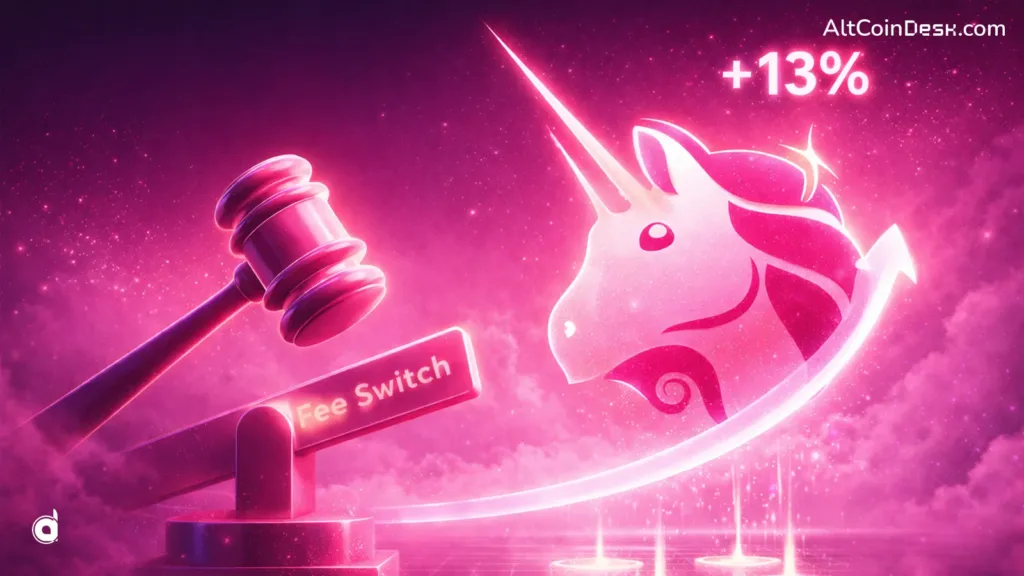

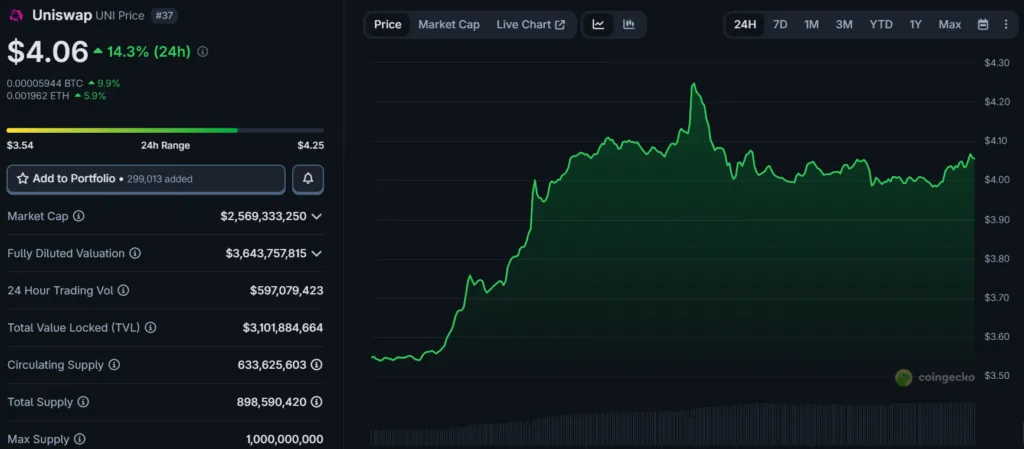
Uniswap’s native token, UNI, jumped about 13%, reaching $4.03. This price surge happened because of a new governance vote. The goal is to expand a fee switch across eight more blockchains, where every swap makes the token more valuable.
For years, the UNI token was mostly a tool for voting, but it is currently undergoing a massive transformation called “UNIfication.” This new proposal aims to turn on a fee switch across eight additional blockchains, like Arbitrum, Base, and OP Mainnet.
In the past, turning on fees for a specific trading pool was a slow process that required a separate vote for every single pair of tokens. This new proposal changes all of that by using a smart tool called the v3OpenFeeAdapter.
Instead of voting on every pool, the system automatically sets a default fee for every new trading pool based on its category. This will instantly activate fees across a huge network of chains, including Celo, Soneium, X Layer, Worldchain, and Zora.
Fees collected are sent back to the Ethereum mainnet and used to buy and burn UNI tokens.
Fee expansion could add $27M a year
This expansion is expected to bring in an extra $27 million every year. When you add that to the money Uniswap is already making on the Ethereum mainnet, the total revenue reaches over $60 million annually.
Recent data shows that Uniswap is stronger than ever. In Q4 of 2026, the platform made a profit of $3.12 million, proving that its new business model is working. Uniswap is ensuring that no matter where people trade, the protocol and its token holders will benefit. And data from DeFi Llama confirms that the platform is now consistently profitable. This is a huge shift from its early years, when it handled trillions in volume but didn’t take a single penny for itself.