

If you close your eyes and then open them again, you will likely see new cryptocurrencies, blockchain projects, or other digital assets emerging! While this remark may sound a bit exaggerated, the point is that the crypto industry moves in the blink of an eye, with both promising and questionable projects. Amid the growth in crypto comes a fundamental question from the regulatory watchdog of the European Union (EU): Can stablecoins shake the EU’s financial market?
With Markets in Crypto Assets (MiCA) making the EU one of the leading regions with a regulatory framework for digital assets, the bloc is positioning itself as a global standard-setter. Yet alongside this growth comes a looming risk.
Stablecoins could be a risk to EU market
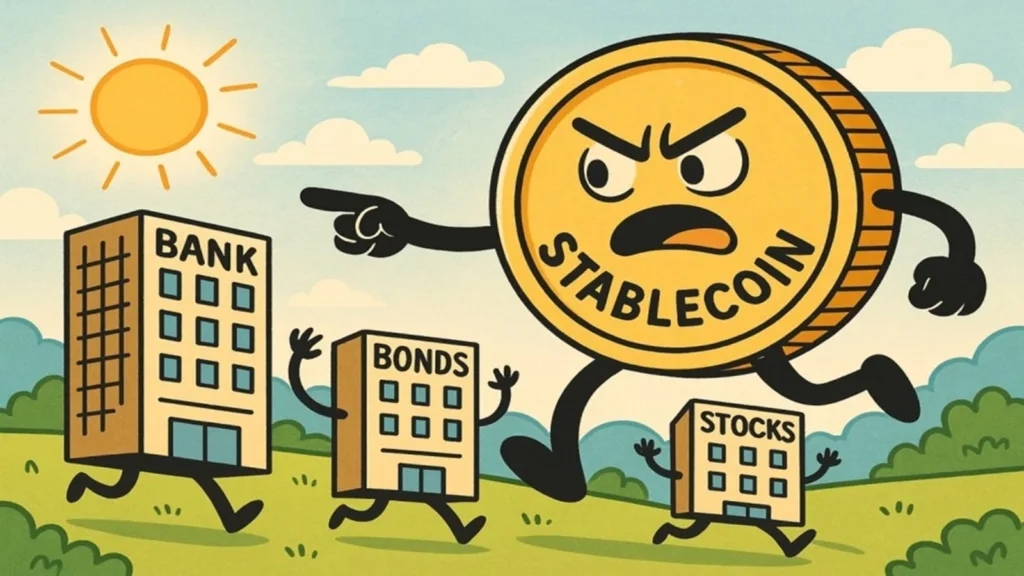
Stablecoins, a type of digital asset, are an important part of the broader crypto market. The European Systemic Risk Board (ESRB), the EU’s financial stability watchdog, recently noted that stablecoins carry risks that could impact the financial markets in the EU region.
The members of ESRB have assessed risks related to stablecoins and highlighted: “Third-country multi-issuer schemes – with fungible stablecoins issued both in the EU and outside – have built-in vulnerabilities which require an urgent policy response.“
In other words, when a stablecoin issuer launches a stablecoin both within the EU and outside, it can create weak spots.
Why is it risky?
- Stablecoins issued outside the EU might have looser rules.
- If an unpredictable crash happens, it is unclear which rules matter or who is responsible.
- Coins can be used interchangeably in both the EU and other countries. Any weakness outside the EU can quickly move into the EU financial markets.
The EU’s financial system is also facing risks due to ongoing geopolitical uncertainty, although the recent US-EU tariff deal has given some relief, according to ESRB members.
The country’s financial markets are also overheated as investors are pushing asset prices to record highs. ESRB finds that this optimism could quickly collapse in the case of uncertainty.
However, banks are stronger. They are more resilient to handle possible shocks better than before.
AI adds to financial risk
For the EU regulator, stablecoins are not the only risk factor to its financial market; instead, Artificial Intelligence (AI) also carries a potential threat. The regulatory body acknowledges the benefits, but warns of systemic risks.
When financial institutions increasingly depend on a few or the same AI providers, it could make the market less diverse and more fragile. Institutions typically rely on AI to accelerate trading and investment decisions, as well as to detect fraud.
As the European Union competes in the digital asset industry with standard frameworks like MiCA, watchdogs warn that cryptocurrencies, including stablecoins, could be the very cracks that test the strength of financial markets. Globally, if the digital asset sector expands to adopt new technologies to mitigate risks, financial markets can finally sleep a little easier.