



When China accuses the U.S. of 127k Bitcoin theft in a digital heist, the story is never just about stolen coins. It is about control, credibility, and code. This week, China’s National Computer Virus Emergency Response Center (CVERC) released a technical report claiming that the United States “stole” 127,000 bitcoins, roughly $13 billion, in what it called a state-backed cyber operation disguised as law enforcement.
Washington says it was a lawful seizure tied to a criminal case. Between the two lies a riddle that defines the modern crypto era: who really owns the world’s most traceable untraceable money?
The disputed genesis of the Bitcoin theft 127k
The origin story dates back to December 2020, when the Chinese mining pool LuBian lost 127,272 BTC in less than 2 hours. Investigators traced the theft to a vulnerability in the pool’s wallet key generation, but the perpetrators vanished into the blockchain fog.
For nearly four years, those coins sat still, digital ghosts worth billions, until mid-2024, when blockchain analytics firms noticed suspicious transfers into addresses later flagged as belonging to the U.S. government.
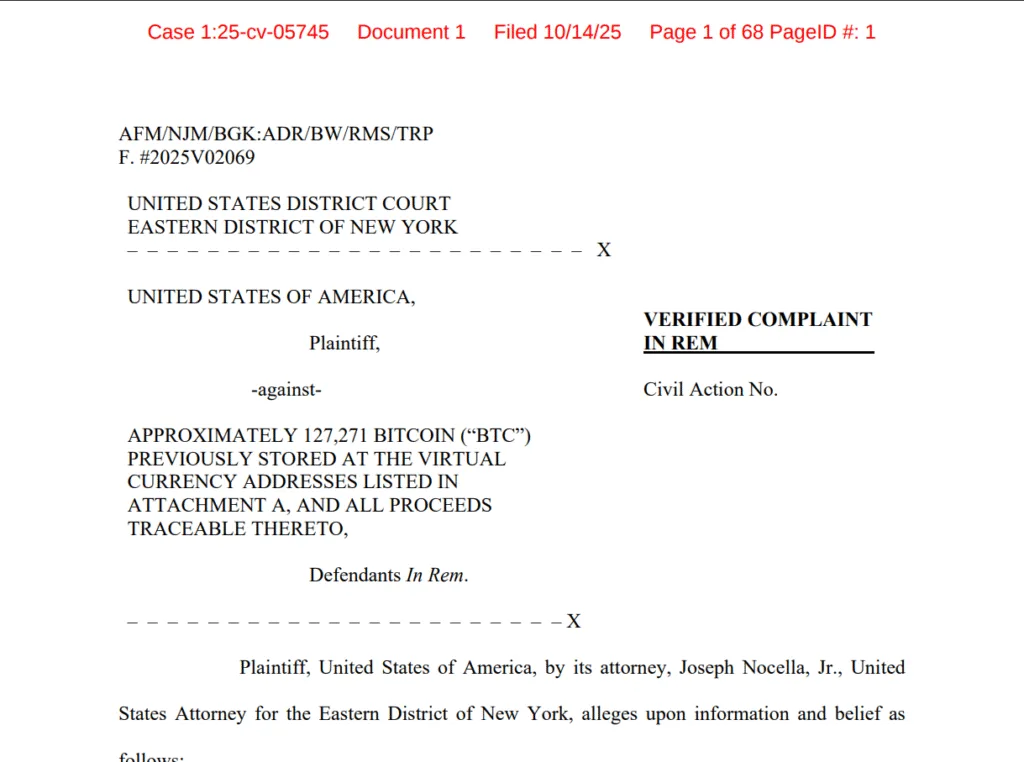
CVERC’s report alleges this was no coincidence. It claims that a “state-level hacking organization” breached the wallets and then quietly moved the coins into U.S. custody. The U.S. Department of Justice (DOJ), on the other hand, insists the 127k BTC were seized as criminal proceeds linked to a Southeast Asian fraud network led by Cambodian businessman Chen Zhi, known for the Prince Group money-laundering case.
When a seizure feels like Bitcoin theft
Here lies the moral paradox. If one nation’s hack is another’s lawful seizure, what happens when the blockchain evidence looks identical? In the age of crypto, transaction trails are visible to everyone but owned by no one. China sees sovereignty violated; the U.S. sees justice served. Yet, both rely on the same blockchain transparency that exposes everyone and exonerates no one.
The numbers are not trivial. 127k BTC represents nearly 0.6 percent of the total supply, enough to ripple through markets if ever liquidated. While traders watch price charts, governments are fighting over cryptographic signatures. The Bitcoin theft of 127k has become less about wallets and more about worldviews: who enforces the law in a borderless financial system?

The politics beneath the protocol
This dispute is not a one-off; it is the latest chapter in a growing rivalry over digital dominance. China, which banned crypto trading but embraced blockchain research, now frames the issue as technological sovereignty. The U.S., which regulates through enforcement, frames it as anti-money-laundering vigilance. Each claims legitimacy. Both use blockchain for national narratives.
CVERC’s report fits neatly into Beijing’s broader argument that the West uses cyber tools to control global finance. Meanwhile, U.S. analysts, including CryptoSlate and Arkham Intelligence, counter that no credible evidence proves the government “hacked” anything. They point instead to technical flaws in LuBian’s system, not American spycraft. The result is a geopolitical courtroom where every block on the chain becomes a piece of forensic testimony.
Trust, transparency, and tomorrow
For investors, the Bitcoin theft 127k case raises a deeper concern: when national disputes spill into crypto, neutrality disappears. If a superpower can claim your coins in the name of justice or accuse another of hacking under the same banner, decentralization starts to look like theater.
Still, this confrontation may accelerate something valuable, a global conversation about ownership, accountability, and cross-border crypto law. Whether the U.S. returns the coins, keeps them as evidence, or proves its legal case, one truth remains clear: the blockchain never forgets. It records every accusation, every justification, and every movement of power in code.
Crypto promised a world without intermediaries. Yet here we are, watching the biggest intermediaries on Earth argue over who hacked whom. Perhaps the true lesson of this $13 billion saga is not who stole what, but how nations are redefining digital property itself.