

The most fascinating financial experiment in crypto right now is not a new token launch or a billion-dollar ETF. It is an AI trading experiment quietly unfolding inside Chinese developer communities.
Thousands of programmers, students, and traders are now using an open-source tool called OpenClaw to build autonomous trading systems. These agents do not just analyze markets. They click buttons, run software, connect to exchanges, and place trades on their own without human input. The idea sounds futuristic. A machine watches the market and trades faster than any human could.
But the results of this AI trading experiment have been far less glamorous. Some bots made money. Many lost it. A few triggered security scares. What matters is not whether the first generation works perfectly. What matters is that the architecture now exists. And once markets become programmable, they rarely go back.
When an AI can use a computer like you
To understand the current AI trading experiment, you first need to understand what OpenClaw actually does. Traditional AI tools answer questions. OpenClaw behaves differently. It acts like a digital operator sitting in front of a computer: It can open applications, click buttons, run code, connect to APIs, and execute multi-step workflows.
In simple terms, OpenClaw can operate software the same way a human does. That means it can log into exchanges, monitor price feeds, read news, analyze signals, and place trades automatically. Developers connect these agents to exchange APIs, DeFi protocols, trading signals, and market data feeds. Once connected, the system becomes a self-operating trading machine. This architecture is what powers the current AI trading experiment taking place across China.
The architecture of OpenClaw Crypto trading bots
The structure of most OpenClaw crypto trading bots follows a surprisingly simple design.
- First comes the data layer. The bot collects information from crypto exchanges, blockchain analytics platforms, and sometimes even social media sentiment.
- Next comes the reasoning layer. Large language models such as DeepSeek and Qwen process the data and generate trading strategies.
- Then comes the execution layer. This is where OpenClaw becomes powerful and dangerous at the same time. The agent directly interacts with trading platforms and executes the orders.
- Finally comes the risk layer. Some developers add systems like the Kelly Criterion to control position sizes. In one documented case, a bot limited each trade to six percent of total capital.
This setup has already produced some surprising results. A prediction market bot reportedly turned $50 into almost $3,000 in 48 hours on Polymarket. Another automated account executed more than 20,000 trades and reportedly earned about 1.7 million dollars. Yet these examples are exceptions, not the rule. Many traders discovered that the same system capable of placing a brilliant trade can also destroy an account at three in the morning if the AI hallucinates.
China’s AI trading experiment
China has become the epicenter of this AI trading experiment for several reasons:
- First, the developer base is massive. China produces some of the largest open-source engineering communities in the world.
- Second, cloud infrastructure is cheap and accessible through providers like Alibaba Cloud, Tencent Cloud, and Baidu Cloud.
- Third, local governments are actively funding AI agent startups. Cities such as Shenzhen, Wuxi, Hefei, and Suzhou have offered subsidies up to five million yuan along with office space and computing resources.
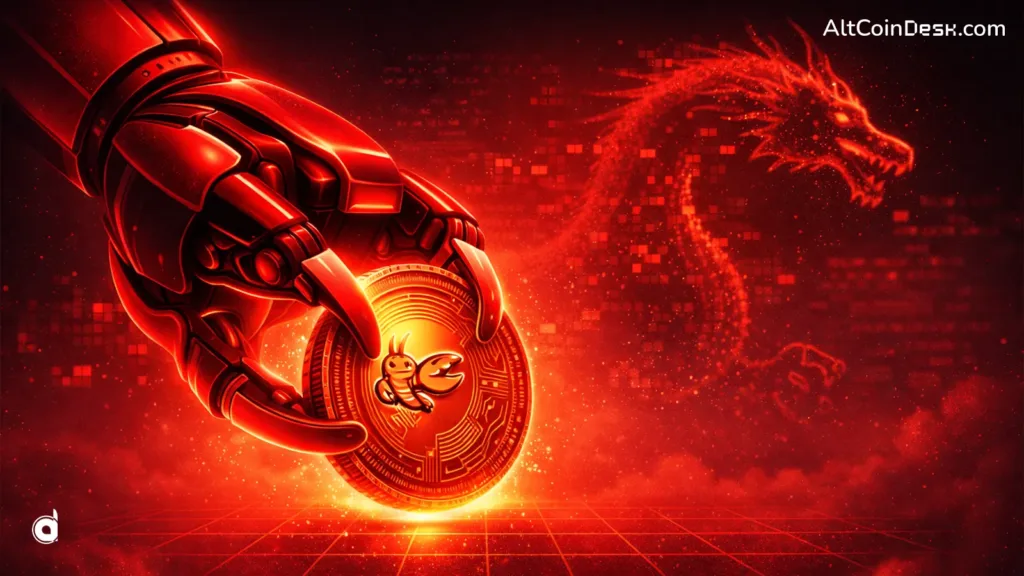
Chinese tech communities even gave OpenClaw a nickname. They call it raising the lobster, a playful reference to the project’s claw-shaped logo. The popularity of this AI trading experiment has been so intense that installation events now attract crowds ranging from engineers to retirees.

When the experiment turns risky
Behind the excitement sits a darker reality. Security researchers have warned that OpenClaw agents require access to sensitive data, including local files, browser sessions, and exchange credentials. This creates new attack surfaces.
A supply chain attack called ClawHavoc compromised more than a thousand malicious plugins inside the ClawHub marketplace. Security researchers later found that seventeen percent of third-party tools attempted crypto theft.
Meanwhile, China’s Ministry of Industry and Information Technology has already issued cybersecurity guidelines. Several universities have banned OpenClaw from campus networks.
The backlash became visible when the uninstallation of OpenClaw started trending on Alibaba’s Xianyu marketplace. Some technicians now charge about forty dollars to remove the software from nervous users. For many participants in this AI trading experiment, the technology felt powerful but unpredictable.
The bigger shift toward an AI agent economy
Even with the risks, the experiment points to something much larger. The rise of the AI agent economy. In this model, autonomous agents perform tasks that once required human operators. They research markets, execute trades, rebalance portfolios, and hunt for arbitrage opportunities across exchanges.
Crypto markets are particularly suited for this shift because they operate 24 hours a day and expose programmable APIs. Machines never sleep. Machines never hesitate. And when machines trade against machines, market behavior changes.
Why some analysts see a bull market ahead
Some analysts believe the AI trading experiment may help ignite the next crypto bull market. Autonomous agents increase liquidity. They search for inefficiencies and close price gaps between markets. They can also generate entirely new trading strategies that humans might never consider.
But the same forces can also amplify volatility. Markets dominated by algorithms can move faster, swing harder, and occasionally break in unexpected ways. We have already seen glimpses of this in traditional finance. Crypto may simply be the next stage.
Key takeaway
China’s AI trading experiment with OpenClaw shows how quickly markets can change once machines are given the power to act. The first wave of trading bots has produced mixed results, security scares, and plenty of losses. But it also reveals the early architecture of an AI agent economy where software does the trading and humans supervise the risk.