
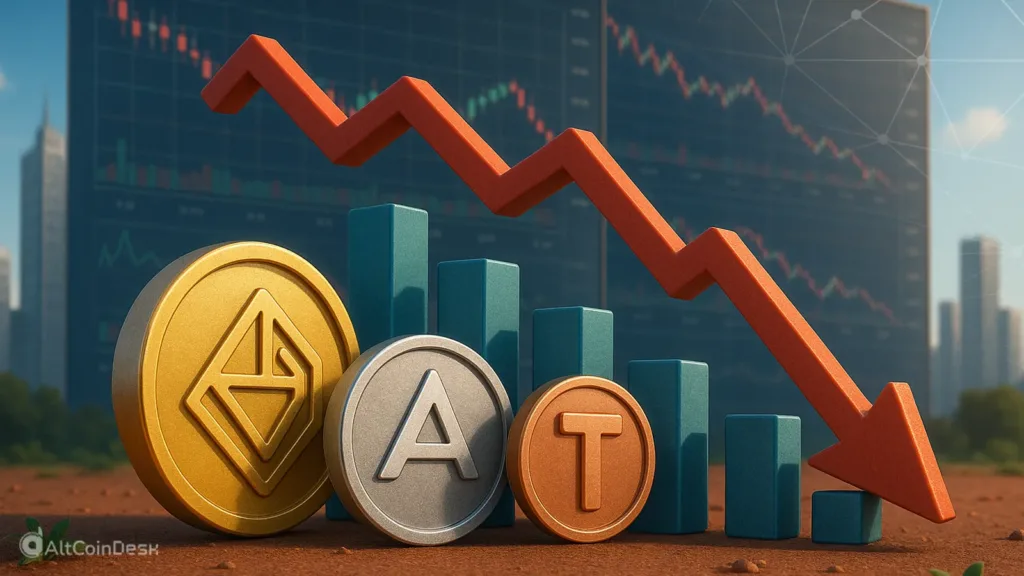

The crypto market has been sliding this week, with Bitcoin and most altcoins trading well below their recent highs. The selloff has rattled investors and triggered a wave of liquidations across the board.
Fear has taken hold. The popular “Fear and Greed Index” has dropped into the fear zone, showing that traders are retreating. After last week’s crash, more than 1.6 million traders were wiped out and over 19 billion dollars in positions were liquidated. Futures open interest has dropped sharply from more than 233 billion dollars to about 161 billion, and daily trading volumes have fallen from 728 billion to 328 billion.
Institutional demand has weakened as well. Spot Bitcoin ETFs saw outflows of more than 328 million dollars this week, and spot Ethereum ETFs lost over 22 million. Other funds tied to Solana, Dogecoin, and XRP have struggled too. Meanwhile, gold and silver ETFs continue to attract inflows as investors search for safety.
The broader economy is adding pressure. Tensions between the United States and China are escalating, with China threatening tariffs and restrictions on rare earth metal exports. Such moves could worsen global inflation and push the Federal Reserve to delay long-awaited interest rate cuts. As a result, traders are increasingly cautious about risk assets like crypto.
It is clear that fear is rising, institutional inflows are drying up, and uncertainty is spreading. Yet, as painful as these corrections are, they can also be healthy. History shows that liquidation shocks often act as a reset for overheated markets.
Why liquidation shocks aren’t purely destructive
Corrections play an important role in cleansing markets of excess leverage and speculation. When prices rise too quickly on borrowed capital or unrealistic expectations, a correction forces weak players out. This reset leaves space for more serious innovation and disciplined capital allocation. Crashes also serve as a psychological reset. Investors become more cautious, founders become more focused on fundamentals, and developers turn their attention to building rather than chasing hype.
Bear markets tend to breed builders. Once the noise fades, the best minds in crypto focus on improving usability, security, and scalability. To see why downturns can fuel progress, it helps to look at past examples.
Historical case studies and market cycles
1. The 2018-2019 crypto winter and the rise of DeFi
The crash that followed the 2017 ICO boom wiped out hundreds of overhyped projects with little real utility. Prices collapsed, and investor enthusiasm vanished.
Yet beneath the surface, developers kept working. Wallets, developer tools, and scaling solutions quietly improved. When the next bull run arrived, the groundwork was in place for the rapid rise of decentralized finance. Projects like Uniswap, Aave, and Compound thrived because the previous crash had cleared the field of weaker players.
2. The FTX collapse and market recovery
The fall of FTX sent shockwaves through the crypto world. It exposed massive counterparty risks and forced projects to reassess how they managed funds and trust. But in the years that followed, the market rebounded, and Bitcoin reached new highs. The collapse pushed the industry toward greater transparency, stronger governance, and proof-of-reserves standards.
Painful as it was, it accelerated maturity and trust within the ecosystem.
3. The Terra and LUNA collapse
In 2022, Terra’s algorithmic stablecoin lost its peg, causing LUNA’s price to spiral to near zero. The event was devastating, yet it triggered deep reflection within the community.
Developers and investors began exploring safer stablecoin designs with better collateralization and risk controls. The lessons learned from Terra’s failure continue to shape how new stablecoins are built today.
4. Lessons from the dot-com crash
The dot-com bubble burst in 2000, erasing huge amounts of paper wealth. Many early internet companies vanished, but survivors like Amazon and eBay emerged stronger and more disciplined. They focused on sustainable business models and infrastructure that later powered the modern internet. Crypto markets show a similar pattern. After each collapse, the survivors tend to be more focused, more innovative, and better prepared for long-term growth.
How crashes fuel innovation
Crashes serve as catalysts for improvement. They expose weaknesses in protocols, governance, and risk management. Developers respond by upgrading systems, tightening security, and designing more resilient architectures.
When speculative projects disappear, capital and talent do not vanish. They often flow into stronger ventures. The result is a smaller but more focused ecosystem. Valuations become more realistic, and founders are forced to build sustainable products rather than hype-driven tokens.
As fundamentals improve, institutional investors start to take notice. Mature projects with proven stability become more attractive, paving the way for long-term capital inflows.
The path toward a healthier market
Liquidation events can be more than market carnage. They can be moments of clarity that force the industry to evolve. The noise fades, the builders stay, and the groundwork is laid for the next wave of real progress.
Of course, not every crash leads to renewal. Recovery depends on the strength of the community and its willingness to rebuild trust. Transparency, clear governance, and regulatory adaptation all matter. Projects that demonstrate real utility and robust economics are the ones that will survive.