

For much of 2025, the hot trend wasn’t just holding Bitcoin or Ethereum; it was entire companies rebranding themselves into crypto treasuries. From gaming firms to vape sellers to golf cart makers, dozens jumped on the bandwagon, filling their balance sheets with tokens and betting their share prices would soar in parallel.
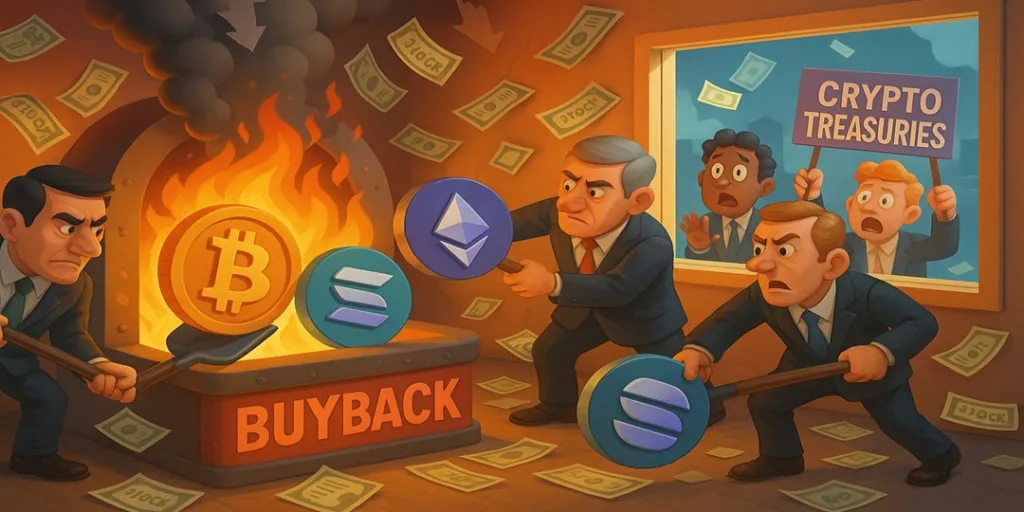
Now, just months later, the shine is fading. With stock prices falling below the value of the very crypto they hold, many of these companies are turning to an old corporate trick: share buybacks. It’s a tactic that raises eyebrows in the traditional markets. In the context of crypto treasuries, it looks more like a red flag.
Share buybacks hit the crypto sector
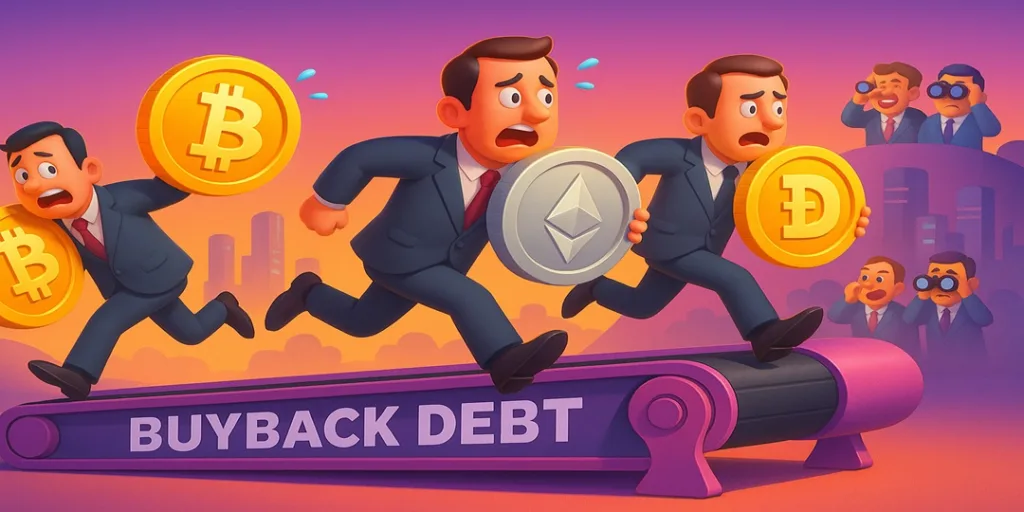
At least seven companies have announced buyback programs in recent weeks. The logic is simple: if the market thinks your stock is undervalued, you buy it back, shrink the supply, and hopefully boost the price. But here’s the catch: several of these companies are borrowing money or issuing debt to fund these buybacks, ironically undermining the premise of their crypto-first strategy.
Take ETHZilla, a biotech firm that renamed itself and went all-in on Ethereum. Despite holding about $460 million in ETH, its market cap sank to $416 million. Its solution? A massive $250 million buyback plan, financed with debt collateralized by its Ether holdings.
Or Empery Digital, formerly a golf cart manufacturer, which pivoted to Bitcoin earlier this year. After a 380% surge in share price, it has now given up those gains. Facing a slide, the company raised $85 million in new debt to buy back its stock, even though its Bitcoin stash is worth more than its current valuation.
Analysts are sounding the alarm
Some experts see these moves as a last gasp. Adam Morgan McCarthy, a senior analyst at Kaiko, called the buybacks “probably the death rattle” for certain firms. His view: these companies are trying to buy time until the next crypto rally, but the strategy looks circular and unsustainable.
Elliot Chun, partner at Architect Partners, went further, noting that raising money to repurchase shares is “antithetical” to the whole crypto treasury model. After all, these companies were supposed to thrive by buying tokens, not their own stock.
The criticism is sharp, but it reflects a deeper truth: many crypto treasuries were loss-making shell companies to begin with. They relied on hype and token value appreciation to justify their stock prices. When that equation broke down, so did their narrative.
Ripe targets for acquisitions
The downturn has already created opportunities for bargain hunters. Strive Asset Management, founded by Vivek Ramaswamy, recently acquired Semler Scientific, a healthcare firm turned Bitcoin hoarder. More deals like this may follow, as companies with crypto holdings trade below the value of their assets.
For larger players, this could be the moment to scoop up treasuries on the cheap, essentially buying discounted crypto via corporate acquisitions. But for the companies themselves, the consolidation wave is another reminder of how fragile the model can be.
Lessons from the craze of crypto treasuries
The rise and wobble of crypto treasuries offer three clear takeaways:
- Hype cycles are short – The boom lasted barely six months before cracks appeared.
- Debt is dangerous – Borrowing against volatile assets to buy back stock doubles the risk.
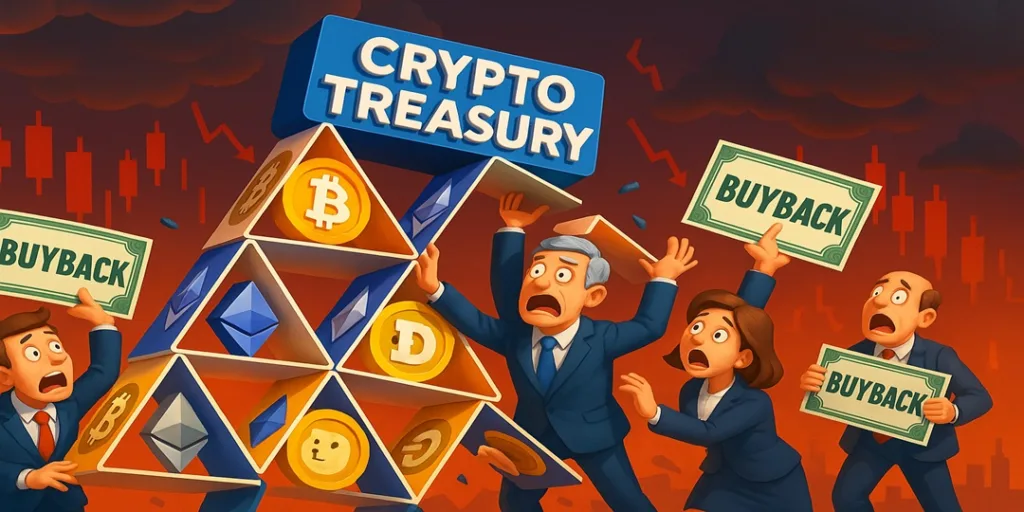
- Only a few will survive – Analysts agree that a small percentage may succeed, but most are house-of-cards experiments.
Some executives remain committed, even doubling down on tokens. One Dogecoin treasury, chaired by Elon Musk’s lawyer Alex Spiro, just increased its DOGE stash from 500 million to 600 million. Still, the prevailing mood is caution, not confidence.
Final word
Share buybacks are a classic Wall Street maneuver. But in the crypto world, they may be less a sign of strength than of desperation. For crypto treasuries, the strategy risks becoming a vicious circle: raising money to buy back shares, while the market questions the value of the underlying business.
The verdict? A handful may reinvent themselves and thrive. But for many, the buybacks look like stalling tactics before collapse. In the high-risk theater of crypto finance, even the once-fashionable treasury model may not escape the brutal laws of market gravity.