



Altcoin liquidity compression explains why Bitcoin hoarding looks strong while the rest of crypto quietly bleeds. When Eric Trump says American Bitcoin Corp is “leading the charge” in Bitcoin accumulation, he is not wrong on the surface. The company has stacked thousands of Bitcoin in a short period of time, climbing the ranks of public corporate holders faster than many expected.
On paper, that sounds bullish. Strong even. But markets do not trade on slogans. They trade on flows. And the charts tell a more uncomfortable story. While Bitcoin treasuries grow, the rest of the crypto market is experiencing something traders feel but rarely name clearly: altcoin liquidity compression. This is the real signal hiding inside Eric Trump’s statement.
The headline claim versus the market reaction
American Bitcoin Corp now holds about 5,843 Bitcoin, worth roughly $520 million at recent prices. That puts it ahead of companies like GameStop and Gemini Space Station in raw Bitcoin holdings. Eric Trump frames this as proof that ABTC is building America’s Bitcoin infrastructure faster than anyone else. Yet since its Nasdaq debut in September 2025, ABTC’s stock is down roughly 75%.
This gap between Bitcoin accumulation and equity performance matters because it shows how capital is actually behaving. Bitcoin is being accumulated, but not in a way that lifts the wider crypto market. Instead, capital is concentrating, and concentration is the enemy of altcoins. That is where altcoin liquidity compression begins.
What altcoin liquidity compression actually means
In simple terms, altcoin liquidity compression happens when money flows into Bitcoin faster than new money enters the crypto market as a whole. Bitcoin absorbs capital. Altcoins are left fighting over what remains.
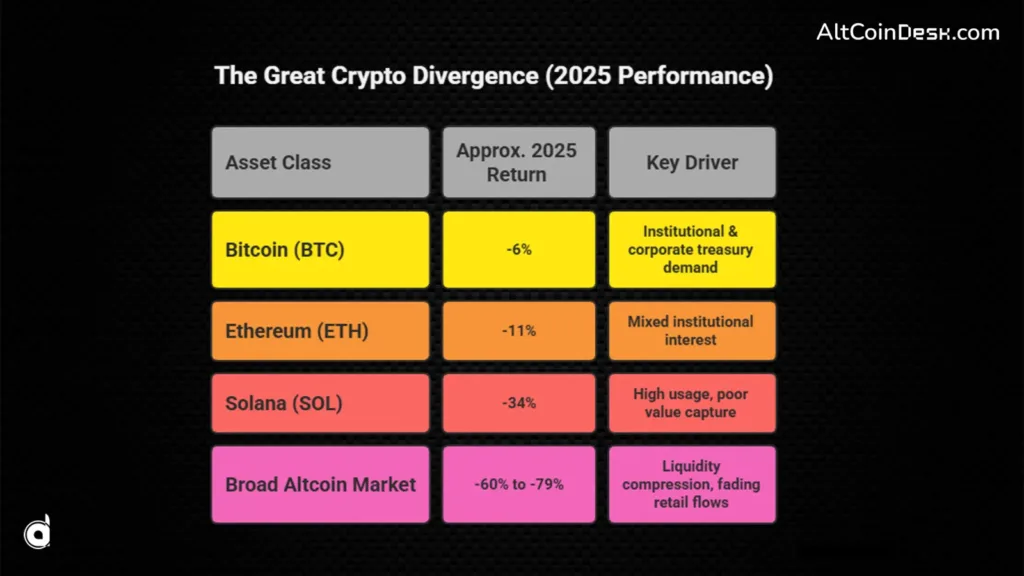
Since September 2025, Bitcoin dominance has climbed from around 51% to roughly 56 to 57%. During that same period, the total market value of altcoins excluding Bitcoin has fallen by an estimated 18 to 22%. That is not a coincidence. It is a reallocation.
Ethereum has dropped about 14% against Bitcoin. Solana is down roughly 21% versus Bitcoin. Newer sectors like AI tokens and layer 2 networks are down 30 to 45% despite steady product releases. This is altcoin liquidity compression in real time.
Why corporate Bitcoin hoarding changes market structure
In past cycles, altcoin seasons thrived when Bitcoin slowed down. When Bitcoin paused, traders rotated profits into smaller assets. Capital dispersed. Risk expanded. Today, the opposite is happening.
Public companies are converting equity and debt into Bitcoin. That pulls capital out of equity markets and locks it into treasuries. Shareholders then sell. Stocks fall. Risk appetite shrinks.
The result is a market where Bitcoin rises slowly, treasury stocks fall quickly, and altcoins lose their marginal buyers. This is why altcoin liquidity compression accelerates when corporate Bitcoin buying dominates the narrative.
Treasury stocks act like hidden leverage
There is another layer that most retail investors miss. Bitcoin treasury stocks behave like leveraged versions of Bitcoin, but without the upside symmetry. When Bitcoin drops 10%, treasury stocks often fall 25 to 50%. ABTC’s 75% drawdown versus Bitcoin’s modest pullback is a textbook example.
When these stocks unwind, risk desks do not move into altcoins. They move out of risk entirely. Volume migrates toward Bitcoin spot products and away from smaller tokens. That feedback loop deepens altcoin liquidity compression across the market.

History already warned us
The data is consistent across cycles. In late 2020, corporate Bitcoin buying was low, and Bitcoin dominance fell. Altcoins exploded. In mid-2021, Bitcoin accumulation flattened and dominance collapsed. Altcoins peaked. In early 2024, Bitcoin ETFs drove dominance from 48% to 55%. Altcoin season failed.
Now in 2025 and 2026, treasury-driven accumulation is pushing dominance higher again. Altcoins are suppressed. The lesson is simple. Altcoins do not rally when Bitcoin is being hoarded. They rally when Bitcoin is being spent. That is why Eric Trump’s bullish statement reads as accidentally bearish for altcoins.
The human side traders feel but charts confirm
Retail traders sense something is wrong. Projects announce partnerships. Roadmaps progress. Yet prices keep slipping. The issue is not development. It is liquidity. When capital concentrates at the top, smaller assets suffocate. That suffocation has a name, and it is altcoin liquidity compression.
What actually changes this trend
Altcoin liquidity returns only when one of three things happens. Bitcoin accumulation slows.
Bitcoin dominance peaks and rolls over. New capital enters the market faster than Bitcoin can absorb it. Until then, Bitcoin treasury headlines will continue to sound bullish while quietly draining oxygen from the rest of crypto.