

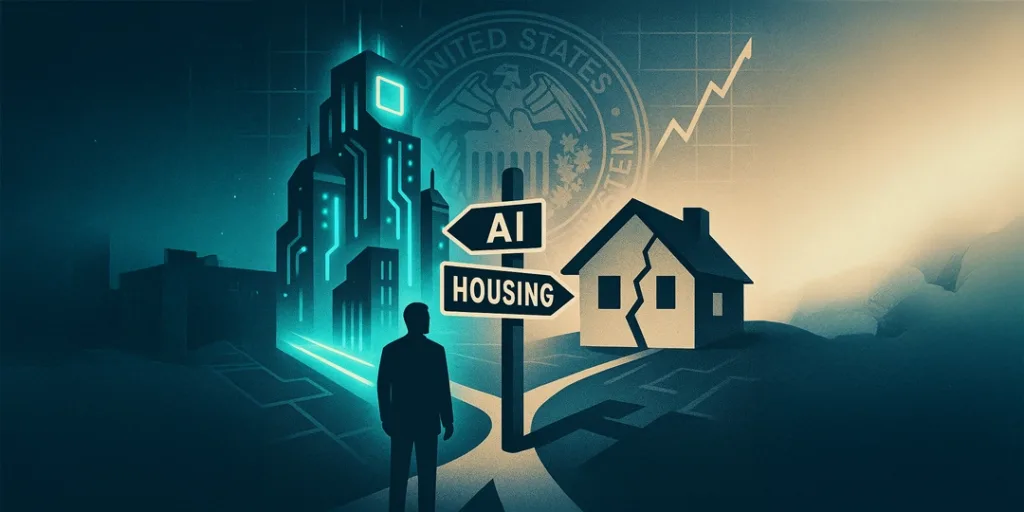

The Federal Reserve’s traditional balancing act between its jobs and inflation mandates may be less of a concern than a new dilemma: whether to prioritize the struggling housing market or booming tech infrastructure spending.
By most metrics, the U.S. central bank is still missing its 2% inflation target, and neither market-based nor household inflation expectations suggest confidence that it will be met anytime soon, even before factoring in rising tariffs.
Meanwhile, the debate about the labor market is clouded by modest layoffs, low new jobless claims, and a still-low jobless rate, which likely reflects halted immigration and worker shortages.
Intense political pressure aside, none of these standard indicators argue for the Fed to resume cutting interest rates aggressively, or even easing at all.
But the central bank’s true conundrum may be best captured by the contrast between the artificial intelligence boom and the increasingly ailing housing market.
Easing now to support housing would most likely supercharge the tech capital expenditure binge and kill any chance the Fed has of meeting its inflation goal. Yet, keeping rates high to manage the excesses of the AI explosion could spell deeper trouble for a housing sector that accounts for well over 10% of U.S. GDP.
Home truths
A gauge of U.S. homebuilder sentiment fell this month to its lowest level in more than two and a half years. More than a third of residential construction firms are cutting prices, and two-thirds are offering incentives to attract buyers put off by still-high mortgage rates. New housing inventory is near levels last seen in late 2007.
Even though housing starts picked up in July, total permit issuance — a guide for future activity—fell 2.8% to a five-year low.
One major problem is homeowner stasis rooted in the previous period of ultra-low interest rates.
While the average rate on a 30-year fixed-rate mortgage has started to fall, hitting a four-month low of 6.67% in the week ending August 8, according to the Mortgage Bankers Association, it remains more than 2.5 percentage points above the average rate of all outstanding mortgages.
With no portable mortgages from property to property, homeowners with cheap mortgages have been hesitant to sell and move, given they would need to obtain substantially more expensive financing for any new home purchase. This situation has helped push the median price of existing home sales above those of new home sales for the first time on record.
Crowding out
This distortion is one of the arguments for the Trump administration’s push to get interest rates down urgently.
But Jason Thomas, head of global research at Carlyle, points out another real estate trend the Fed needs to consider: the hundreds of billions of dollars being poured into AI-related data centers, with pledges for trillions more, as this industry’s rapid pace is set to accelerate.
Thomas believes the massive demand for capital involved in this AI buildout, along with the huge demand on savings from a federal budget deficit projected at more than 6% of U.S. GDP over the next three years, means lower interest rates now could create serious risks of overheating the entire economy.
“The issue is not whether high rates are ‘crowding out’ interest-sensitive sectors like for-sale housing. Clearly, they are. The question for policymakers is how much crowding out is necessary to meet price stability targets,” he wrote on Tuesday.
“The Fed has proven unable to hit its inflation target while high rates have depressed housing-related incomes and spending,” he concluded. “What are the chances that target is hit after a series of rate cuts causes the sector to rebound?”
Of course, the Fed is setting policy that typically won’t have a pronounced effect for at least a year, and it may decide the economic situation will be different by then. Higher unemployment may result from a weak housing sector, a tariff-related consumer retrenchment may ensue, or perhaps AI spending could slow down.
But preempting those outcomes now would require a giant leap of faith rather than scientific forecasting. Inflation expectations and the long end of the bond market may pass harsh judgment on a hasty easing.
The opinions expressed here are those of Mike Dolan, a columnist for Reuters.