


2025 was a breakout year for artificial intelligence (AI) agents, and 2026 promises to finally reward the people who bought sector-specific tokens at discounted prices during the market rout. In this guide, we will discuss how to position for the upcoming boom in 2026.
What exactly are AI agents?
While the general populace may well now be sufficiently aware of AI, there might still be some confusion about the utility of AI agents. Put simply, AI agents are software programs that autonomously use large language models (LLMs) to plan and execute certain actions to achieve a target.
For example, think of an AI agent as a snippet of code that analyzes a digital asset’s price dataset over the past year to formulate predictions of where it might be headed in the next 2, 3, or 4 months. While not always accurate, AI agents can offer an approximate idea about the direction of the underlying asset’s price trajectory.
How did AI tokens perform in 2025?
Although Bitcoin (BTC) made its latest all-time high (ATH) of $126,080 in October 2025, the wider crypto market did not see any spectacular price movements that piqued the bulls’ interest, including AI tokens. In fact, barring perpetual decentralized exchange (DEX) tokens, there wasn’t much steam in any of the other cryptocurrencies in the market.
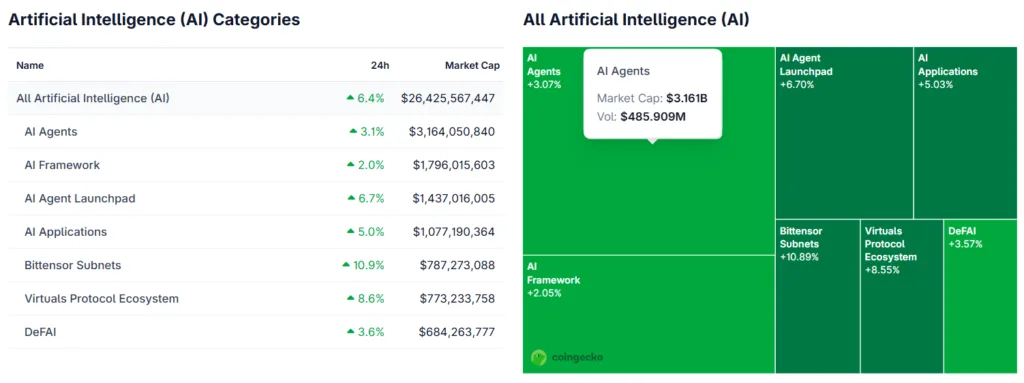
According to data from Coingecko, AI tokens such as Chainlink, Near Protocol, Render Network, The Graph, Arweave, and others now hold a market in excess of $26 billion. Among these, the AI agent tokens sub-vertical commands the highest share, worth $3.15 billion. That said, the market cap of these tokens witnessed continual decline throughout the year.
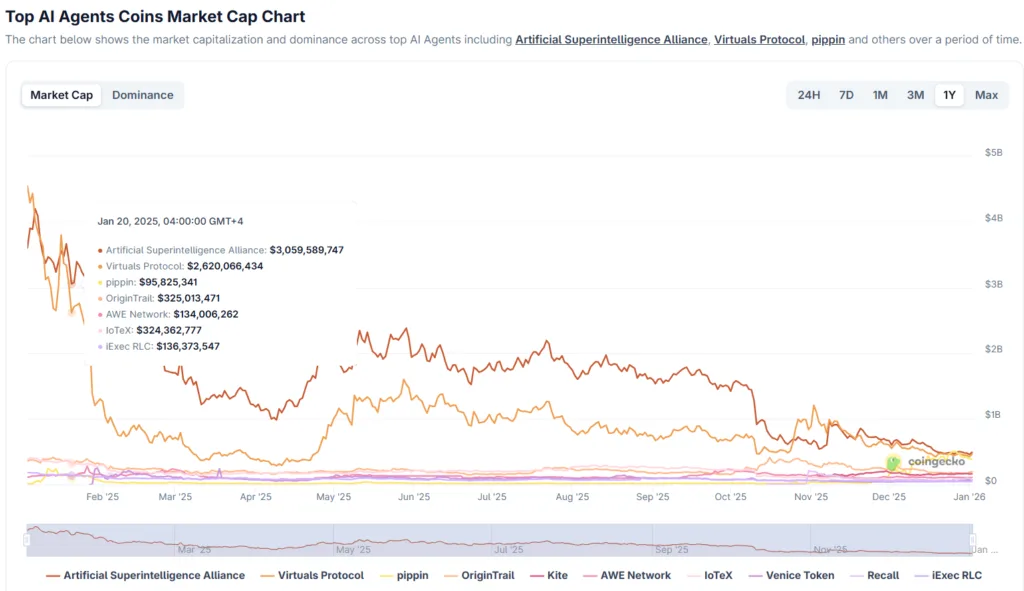
AI agent tokens to surprise in 2026?
While several tech leaders, including Google CEO Sundar Pichai, have expressed concerns about the potential overvaluation of AI firms, there is still some opportunity to benefit from AI agents’ narrative going into 2026.
In commentary shared with AltCoinDesk, Dr. Leo Fan, co-founder of Cysic, the first full-stack compute network built for AI/ZK and mining workloads, said that 2025 was a booming year for AI agents and model launches.
Demand for high-end GPUs surged as large companies competed for cards, especially for inference tasks. But we also saw something else: AI inference quality still isn’t reliably strong. In many settings, the output is not as accurate as users expect, wasting additional energy to obtain satisfactory results. This opens the door for verifiable AI, which combines ZK and AI to prove that an inference was executed faithfully. The workload this requires will be heavier than anything Ethereum faces today, and is likely to become the dominant driver of ZK hardware demand.
Dr. Leo Fan, co-founder, Cysic
Dr. Fan’s thoughts signal an opportunity for digital asset enthusiasts, especially in the AI agent vertical. Recent releases – such as GPT-4 to GPT-5 – show that AI models may have matured, giving little to no incremental improvements in terms of intelligence.
On the contrary, the next phase of growth is likely to be witnessed in reliability, verifiability, and integration with large applications. It is this space where blockchain-based AI agents come into play, offering cryptographic guarantees that AI computations are accurate and tamper-proof.
Projects to watch out for in 2026
Fetch.ai remains the undisputed leader when it comes to blockchain-enabled AI agent projects. The decentralized, AI-powered network uses its native FET token to enable autonomous software agents to connect devices, servers, and users.
The following dashboard from Dune Analytics shows that the FET token was closely watched and traded by crypto whales in 2025. The token dominated the total AI token whale volume for most of 2025, only losing its top spot toward the end of the year to AGIX token.
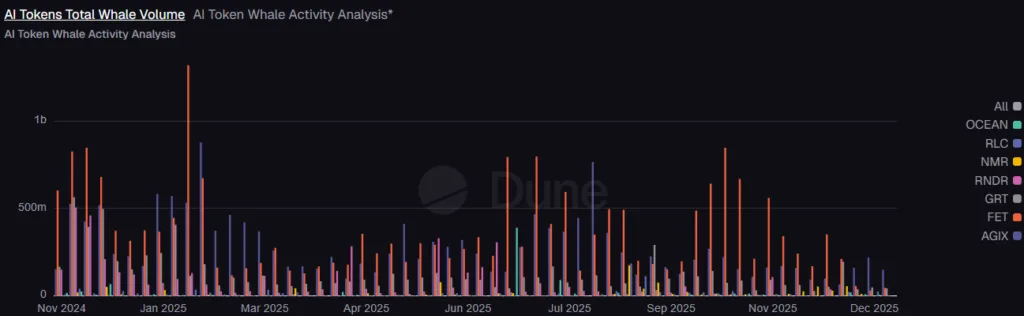
Speaking of AGIX, it is the native token of SingularityNET, another decentralized AI ecosystem that allows users to gain exposure to AI’s upside. The project’s infrastructure arm, in partnership with Swedish data center operator Conapto, launched an Nvidia GPU Cluster in Sweden last month.
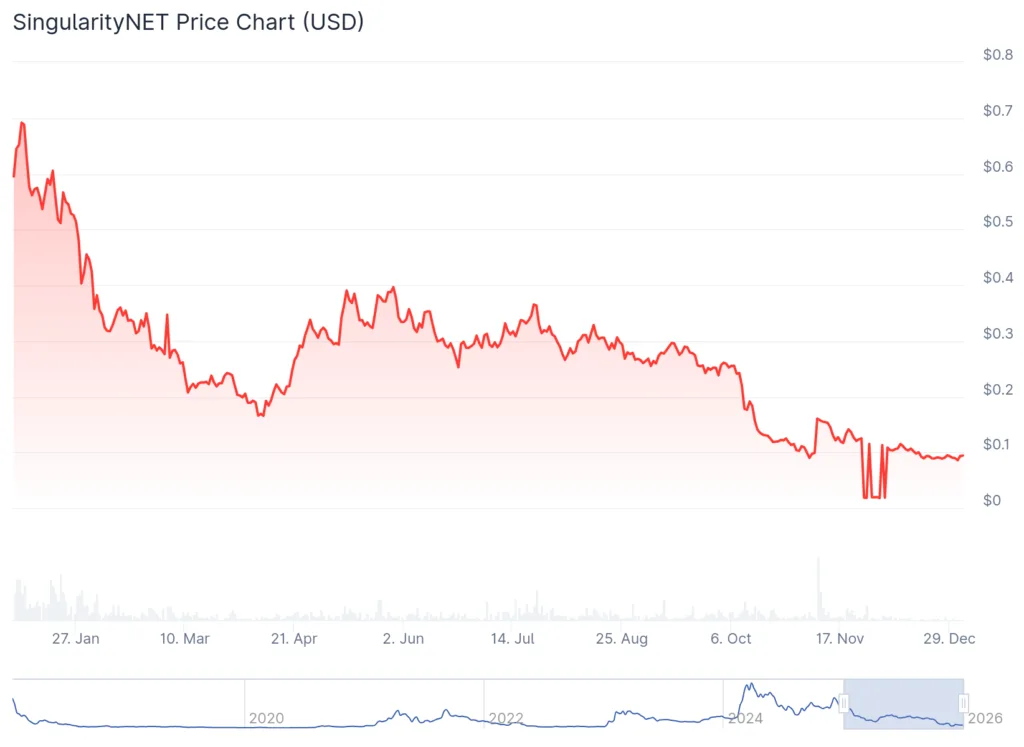
Its price action bears a lot of resemblance to the wider crypto market price action for most of 2025. The following chart from Coingecko shows that AGIX’s price has tumbled from $0.69 in January 2025 to $0.09 at the time of writing.
The third and final project to keep a close eye on is Ocean Protocol. Though it is primarily a data marketplace, Ocean’s AI agent layer is seeing rapid adoption. It enables data-driven agents to execute verifiable inference without compromising on data security.
As is the case with FET and AGIX, OCEAN is down more than 72% over the past year. The token has crashed from $0.71 in January 2025 to as low as $0.16 at the time of writing.
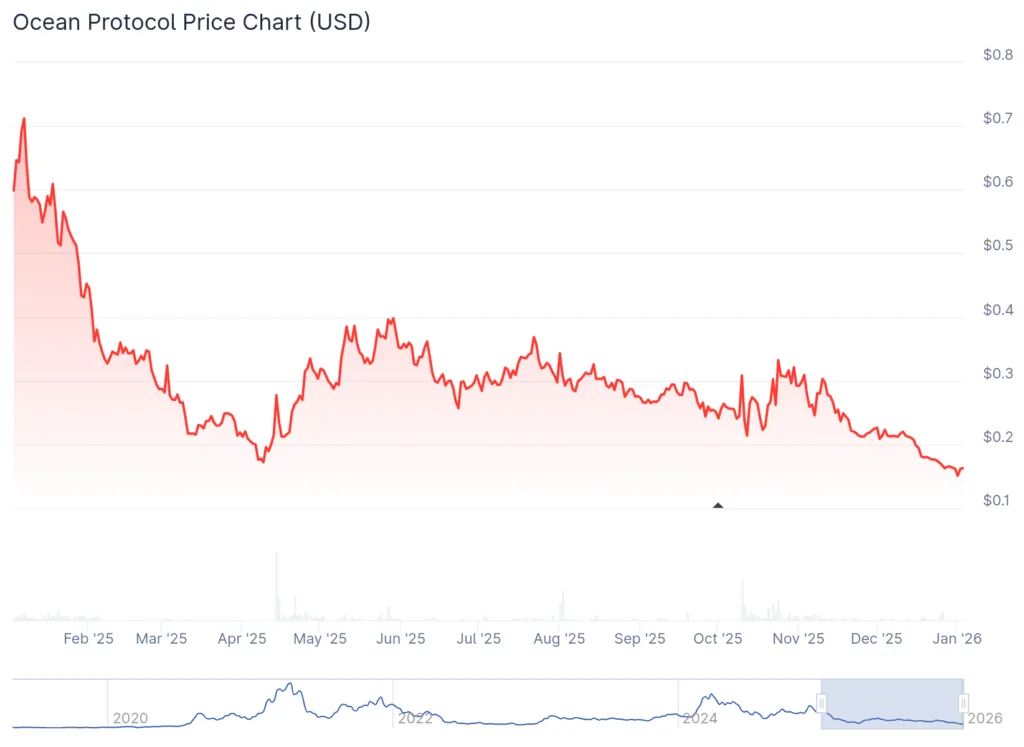
However, it won’t take long to turn its price trajectory, given that Phase 2 of Ocean Nodes is ready to roll out in 2026, enabling GPU-accelerated decentralized compute for complex AI workloads and performance-based rewards.
Position for the upside
Warren Buffett’s advice about buying when there’s fear in the market applies perfectly to the current market psyche. The extraordinary run in precious metals such as gold and silver has spooked investors around the world, and crypto might be the last asset class they’d want to invest in, giving an almost perfect opportunity for maximum potential upside if AI agent tokens rally in 2026.
Focus on projects with high usage and real, verifiable adoption metrics. According to Dr. Fan, AI is likely to be used first by critical sectors, such as defense, healthcare, oil and gas, and others. Monitor projects that indicate a pivot toward these industries in 2026.
Adoption will begin in niche, high-value industries that benefit most from, and can actually afford, the cost of verifiable AI. Sectors such as oil and gas, medical diagnostics, and military defence care about compliance, traceability, and auditability, making them likely early adopters of verifiable inference.
Dr. Leo Fan, co-founder, Cysic
Another important facet to keep track of is AI infrastructure. As mentioned by Dr. Fan earlier, the workload that verifiable AI will require is going to be greater than Ethereum, opening opportunities for high-throughput, low latency blockchain networks such as Solana, Polygon, and Ethereum layer-2 solutions like Optimism, Arbitrum, and others.