

As the year 2025 draws to a close, the cryptocurrency industry continues its steady growth. Besides the flashy institutional adoption, which opened the floodgates for record capital into the space, the digital assets ecosystem witnessed important technological milestones as several smart contract platforms underwent major upgrades.
In 2025, instead of new chains like Ethereum-based Layer-2 networks such as Arbitrum, Optimism, or Coinbase’s Base network being launched, the focus was on significant upgrades to existing protocols that improved scalability, speed, compatibility, security, and user experience. These upgrades put the foundation for broader blockchain adoption in 2026 and beyond.
Ethereum’s Pectra and Fusaka upgrades
No conversation about protocol upgrades can be considered complete without mentioning Ethereum, the largest smart-contract platform in terms of users and market capitalization. The second largest cryptocurrency by market cap rolled out two major upgrades this year.
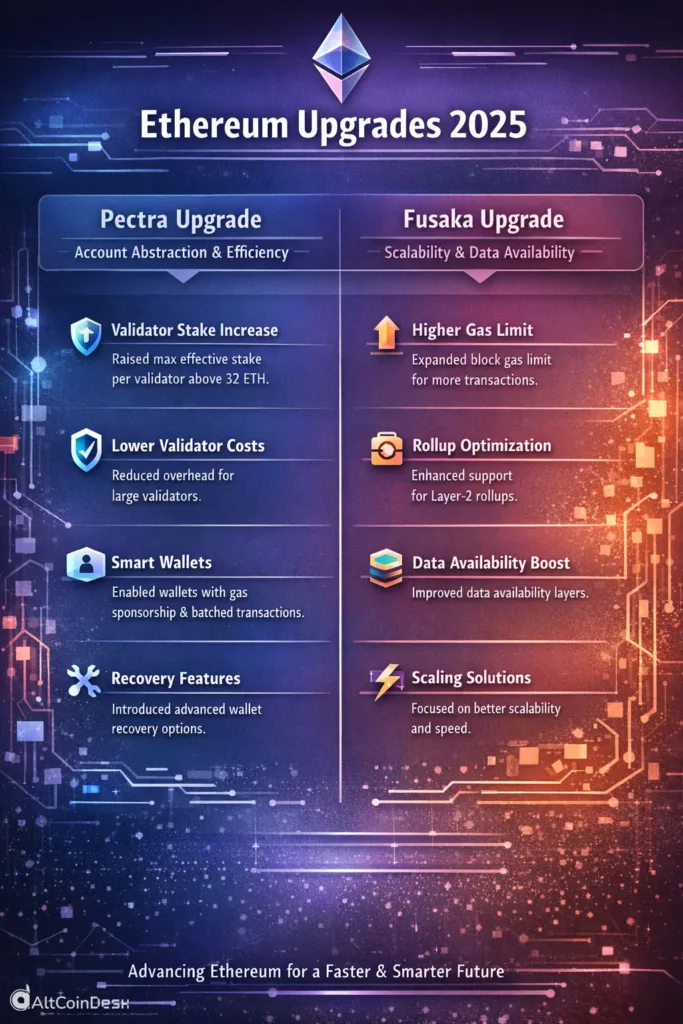
First, the Pectra upgrade focused on account abstraction and validator efficiency. The upgrade increased the maximum effective stake per validator above the 32 ETH mark, lowering operational overhead for large validators. Notably, the extension in maximum effective stake did not compromise on Ethereum’s decentralization.
In addition, account abstraction improvements meant wallets could function similarly to smart contracts. As a result, they could offer features like gas sponsorship, batched transactions, and innovative recovery mechanisms.
Towards the end of the year, Ethereum underwent another major protocol upgrade called the Fusaka upgrade. The upgrade was planned meticulously, as it involved tackling one of Ethereum’s most long-standing challenges – scaling.
In short, the Fusaka upgrade expanded Ethereum’s block gas limit and rolled out data-availability enhancements that enabled support for Layer-2 rollups more efficiently. To learn more about the Fusaka upgrade, check out AltCoinDesk’s detailed article on the upgrade.
BNB Chain undergoes three major forks
Besides Ethereum, Binance’s BNB Chain underwent its own major upgrades this year. Specifically, the smart contract platform underwent three major forks in 2025 – Pascal, Lorenz, and Maxwell.
The Pascal hardfork was executed earlier this year in March 2025. The fork was geared toward increasing BNB’s compatibility with Ethereum. The fork introduced smart contract wallets, versatile account recovery options, multi-sig support, batch transactions, and spending limits.
In addition, BNB Chain saw the rollout of the Lorenz fork in April, while the Maxwell fork went live in June. Both the forks were designed to reduce block processing times and improve the network’s throughput. Notably, the Maxwell fork reduced block times from 1.5 seconds to 0.75 seconds.
Solana continues to make strides
Solana carried the positive momentum it witnessed in 2024 at the peak of the memecoin frenzy led by pump.fun. In 2025, the fast-settlement, low-latency blockchain underwent numerous significant upgrades that cemented its place among the top smart contract platforms both in terms of market cap and user traffic.
For instance, the Alpenglow protocol upgrade was geared toward one of Solana’s major challenges – transaction finality time. The upgrade dramatically cut the blockchain’s finality time to 100 ms – 150 ms. In addition, it increased the smart contract platform’s throughput to 10,000 transactions per second (tps).
The blockchain has an ambitious target of increasing the throughput to 1 million tps in the future. The Alpenglow protocol upgrade elevated Solana to a level that not only outcompetes other Layer-1 blockchains but also rivals several traditional finance payment networks, such as Visa.
Besides the Alpenglow protocol upgrade, Solana saw the launch of Jump Capital’s Firedancer validator, improving client diversity and bolstering the blockchain’s security. In addition, the recently concluded Solana Breakpoint 2025 event in Abu Dhabi unveiled several more exciting developments brewing in the wider Solana ecosystem.
What to expect in 2026?
Going into 2026, the rate of adoption and technological advancements in leading smart contract protocols is expected to continue at the same pace, if not greater.
Ethereum will see the implementation of the Glamsterdam Fork in mid-2026. The upgrade will introduce parallel transaction processing, increase gas limit, and enhance blockchain throughput to 10,000 tps.
For BNB Chain, the Fermi hard fork – expected to go live in January 2026 – promises to reduce block time to 250-450 milliseconds for lower latency and faster transaction confirmations. The fork is expected to go live in January 2026.
As far as Solana is concerned, the Firedancer validator client will see its full mainnet deployment by Q2 2026. In addition, the Alpenglow Consensus Upgrade will introduce the Votor lightweight voting protocol, which will slash the finality time to as low as 150 ms.