


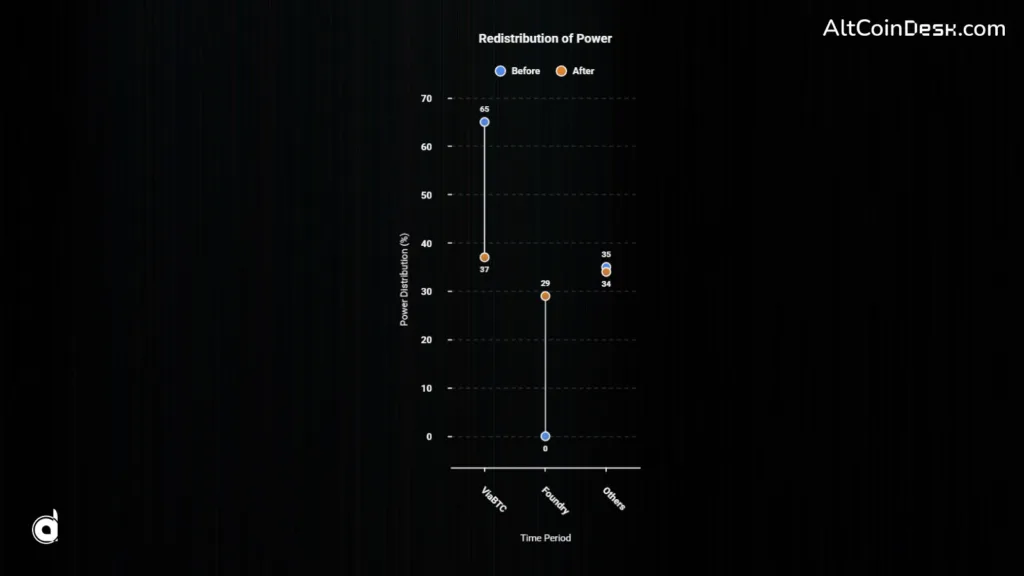
The Foundry’s launch of a Zcash mining pool did not just add another option for miners. It rewrote the balance of power in a network that had quietly drifted into dangerous territory. Within a single month, Foundry moved from zero to roughly 29% of total hashrate, instantly becoming a dominant force. At the same time, ViaBTC’s grip slipped from around 65% to nearly 37%.
This seems unusual in crypto, and it did not come with fireworks. No memecoin frenzy. No dramatic token pump. No influencer countdown thread. Instead, it came quietly, almost mechanically, like infrastructure tends to do when it is about to change everything.
On the surface, this looks like competition. Underneath, it is something more structural. This is about who controls block production, who secures privacy networks, and how institutional capital is beginning to reshape even the corners of crypto that once resisted it. And if you think this is just a mining story, you are already missing the signal.
Zcash mining pool: Foundry enters to shake the map
The Foundry’s launch into the Zcash mining pool ecosystem is not just another expansion move. It is a precision entry into a structurally weak system.
Before this move, Zcash mining had a visible imbalance. One dominant pool controlled a majority of the network’s computational power. That kind of setup does not fail loudly. It fails silently, through risk accumulation.
Then the Foundry launch happened. Within weeks, miners migrated at scale. Not gradually. Not cautiously. Decisively. This is the part that matters: miners do not move unless there is a strong reason. Switching pools involves operational risk, payout changes, and trust decisions. Yet the Zcash mining pool landscape shifted faster than most expected. That tells you everything you need to know. This was not just a new entrant. It was a magnet.

What actually happened (latest news snapshot)
Let’s strip it down to the raw movement:
- The Foundry launch introduced a new Zcash mining pool
- Within roughly 30 days:
- Captured ~29% of network hashrate
- Became a top-tier pool immediately
- ViaBTC’s dominance:
- Dropped from ~65% to ~37%
This is not normal market drift. This is a structural reallocation. The keyword here is speed. Crypto has seen slow migrations before. This was different. This was rapid compression of dominance into a more distributed structure. And importantly, this was not triggered by a crisis. It was triggered by opportunity.
Background you need to understand
1. What is Foundry Digital?
Foundry Digital is not new to dominance. It already operates one of the largest Bitcoin mining pools globally. More importantly, it finances miners, supplies infrastructure, and connects capital with hardware.
So when the Foundry launch entered the Zcash mining pool, it did not arrive empty-handed. It arrived with relationships, and relationships move hashrate faster than marketing ever could.
2. What is Zcash and why does it matter?
Zcash has always occupied a different corner of crypto. It focuses on privacy through advanced cryptography. Not optional branding privacy, but actual shielded transaction capability. That makes infrastructure more important, not less. Because when privacy networks weaken at the mining level, the entire premise starts to crack.
3. The pre-launch problem: Centralization risk
Before the Foundry launch, the Zcash mining pool structure had a clear issue. One pool controlled a majority share. That creates three risks:
- Transaction censorship
- Block manipulation
- Network trust erosion
None of these need to happen to become a problem. The possibility alone is enough. So the system was stable, but fragile.
What changed after foundry entered
The Foundry launch did something simple but powerful. It redistributed trust. Now, instead of a single dominant Zcash mining pool, the network has multiple meaningful players. That reduces attack vectors. It increases resilience. It improves perception. And perception matters more than most admit.
Why this happened so fast
This is where the story gets interesting. The speed of the Foundry launch impact tells us the shift was pre-loaded.
1. Existing miner relationships
Foundry already works with large miners; migration was frictionless.
2. Institutional trust layer
A regulated entity entering the zcash mining pool space signals stability.
3. Incentive structures
Better payouts, lower uncertainty, stronger uptime.
4. Timing
The network was ready for redistribution. Foundry simply triggered it.
Broader industry context
A. Mining centralization has always been a problem
Every pow network drifts toward concentration over time. The foundry launch is not solving a new problem; it is interrupting an old one. But interruption is not the same as resolution.
b. Privacy coins have been under pressure
Zcash has faced:
- Exchange delistings
- Regulatory friction
- Reduced narrative strength
So a strong zcash mining pool environment becomes even more critical.
c. Foundry’s expansion strategy
The foundry launch signals something bigger than Zcash; it signals expansion into multi-chain dominance. Bitcoin was phase one. Zcash might be phase two, and there will likely be a phase three.

The deeper implications
1. Zcash just became structurally safer
The zcash mining pool distribution is now healthier, not perfect, but significantly improved.
2. Institutionalization of privacy mining
This is the real shift; the Foundry launch brings institutional presence into a space that was once largely independent. That changes:
- governance influence
- miner behavior
- long-term perception
3. Foundry’s strategic positioning
This is not expansion. it is positioning. Control enough pools, and you influence enough networks.
4. Competitive pressure begins
Other pools now have to respond. The zcash mining pool market just became competitive again.
Risks still exist
- Two-pool dominance risk: even after the foundry launch, concentration still exists.
- Institutional influence risk: Large players introduce new forms of control.
- Regulatory exposure risk: Privacy coins plus institutional capital equals attention.
Market & token impact (indirect but important)
The price did not explode after the foundry launch; that is normal. Infrastructure changes move slower than narratives. But over time, a stronger zcash mining pool structure can:
- improve investor confidence
- reduce perceived risk
- support long-term valuation
This is not a catalyst. it is a foundation.
What comes next?
1. More hashrate migration: The foundry launch may not be done yet.
2. Institutional competition expands: Others may enter the zcash mining pool space.
3. Narrative reset for Zcash: From fragile to structurally improving.
4. Quiet infrastructure war: Not visible, but highly consequential.
The real insight
The Foundry launch is not loud enough to trend. But it is important enough to matter. Because in crypto, price follows structure more often than hype. And right now, the structure of the Zcash mining pool ecosystem has changed. Not completely. Not permanently. But meaningfully. And sometimes, that is how the biggest shifts begin.