



The blockchain sees anonymity as its central element- a protective layer that safeguards the identity, location, and individual freedom. Recent research reveals that the role of social media platforms is increasing in crypto-based fraud.
While major aspects of the blockchain technology focus on transparency, tradability, and independence; for many builders, traders, and community participants, concealing their real-world identity is not about secrecy for its own sake, but rather to protect themselves from fraudsters, attackers, and regulatory uncertainty. Some experts call the anonymity on blockchain as “pseudonymity.”
However, the same advantage has led to an increase in illegal activities and criminal behaviors on the blockchain. Established projects or crypto holders often fear being victims of robbery, attacks, and harm.
Blockchain also benefits a lot from community building. Social platforms act as the pivotal hub for information, discussions, and debate for the cryptocurrency industry.
Privacy, Security, and more
Crypto communities can be intense. Individuals are often compelled to reveal their identities against their will, facing cyber harassment and threats, particularly during a project failure or a bearish market. Crypto Twitter (CT), or crypto-community X accounts, serve as the primary source, affecting how people plan their trades and even change market trends.
What happens if your anonymity is compromised?
Recently, X launched a new feature that shows the country or region where the account is based. The platform claimed that the feature adds to their integrity, acting as a safety mechanism against scams and pretenders.
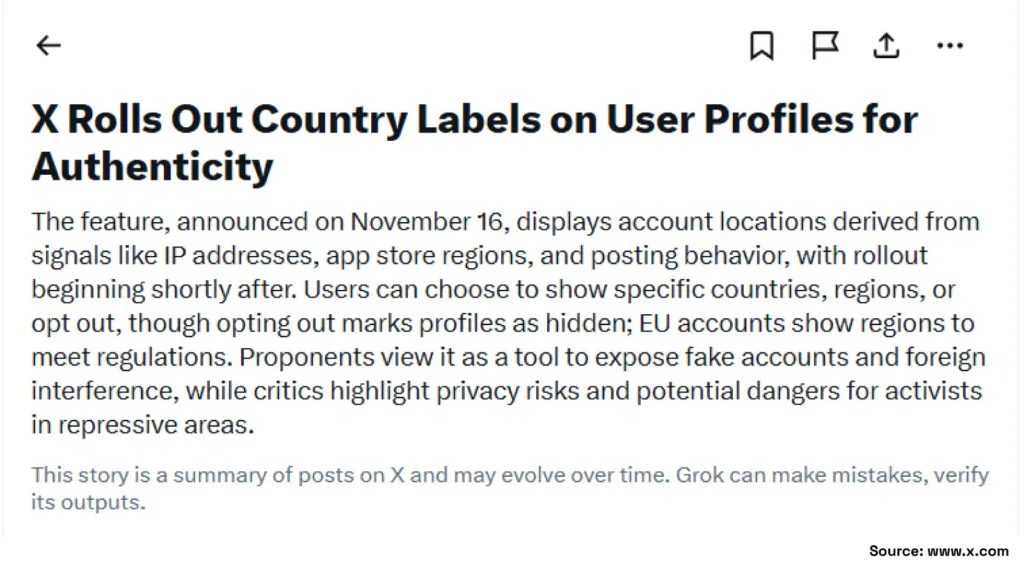
Debates took over the platform about how it could impact the privacy of CT participants.
Co-founder of Ethereum, Vitalik Buterin, also added his perspective on the following, pointing towards the positive and negative impacts of the new feature.
According to Vitalik, this feature may play against its actual role in the medium-term, with people learning to bypass the feature update by renting passports or IP addresses, with a potential money model built around it to fake their accounts’ origin.
However, he also shared his view on how he sees the feature could benefit in terms of sharing authentic community thoughts.
Expert perspectives on how far transparency should go
Vitalik predicts the short-term and long-term impacts of the feature, alongside which he addresses the privacy concerns associated with forcing ‘country reveal’ without a choice to opt-out.
Andrei David, Chief Technology Officer at Summer.fi, a decentralized finance platform, added that the concern is not the visibility of account origin, but the lack of choice in opting in and out.
Empowering Privacy
Blockchain can empower users to have greater control over their identity online by utilizing blockchain-based virtual IDs. These are identities built to enhance security while also making it easier for users to protect their privacy. One such platform is Ethereum Name Service (ENS).
The ENS domain is considered a major shift in how identity works on the web, which defines ownership to its greater extent, including programmability and unification of the domain name.
The founder of Network School, Balaji Srinivisan, said that “if cryptocurrencies are programmable money, then crypto domains are programmable names.”
Users on CT say that the true sense of decentralization is blending anonymity with transparency. In short, selective disclosure is what makes “privacy practical to everyone”. As the industry evolves, privacy is expected to be redefined.
Recent statistics published by the news platform, CoinLaw, suggest that 53% of crypto fraud schemes in 2024 were linked to social media platforms such as Instagram, Telegram, and X, where personal information of users was leaked.
As the industry evolves and technology upgrades, the users await a shift in privacy and anonymity that comes with responsibility.