


Picture a situation where someone could instantly break your password, get into your cryptocurrency wallet, and change the blockchain’s financial history. That sounds crazy right now. But as quantum computing gets better, we are slowly getting closer to a time when the math that keeps our digital money safe could be broken.
What blockchains really are
A blockchain is basically a digital ledger, like a notebook that thousands of people around the world are always adding to. Instead of one person having the notebook and making changes, everyone gets a copy and changes are only made if most people agree they are valid. This builds trust without the need for a bank or central authority.
There are transactions on every page of the notebook. When a block is full, it is sealed and linked to the one before it, making a chain. It is almost impossible to change the past because each block relies on the block before it. That’s why people often say that blockchains can’t be changed.
Blockchains are useful for Bitcoin, Ethereum, and many other things because they let people keep track of things without having to trust banks or governments.
Secret glue to the system: Cryptography
Blockchains use a lot of math to keep secrets safe, which is what cryptography is all about. The system is held up by three pillars:
Hash functions
A hash is like a digital fingerprint. A hash function takes any data you give it and turns it into a string of numbers and letters that is always the same length. The output changes completely with even the smallest change in the input. This means that hashes are great for keeping blockchain blocks safe.
Blockchains use public key cryptography to make transactions. RSA and elliptic curve cryptography (ECC) are two important systems to know about.
RSA encryption
RSA uses very big prime numbers to do its job. You have a private key that only you know and a public key that everyone can see. It is almost impossible to figure out the private key by reverse engineering the public key because factoring very large numbers would take a long time.
Elliptic curve cryptography (ECC)
Using math on elliptic curves is what elliptic curve cryptography does. It doesn’t factor primes; instead, it depends on how hard it is to solve the discrete logarithm problem. To put it another way, it’s easy to multiply points on a curve, but it’s very hard to do the opposite. ECC is the standard in blockchain because it offers the same level of security as RSA but with much smaller keys.
It would take a very long time to break these systems on regular computers, longer than the life of the universe. That’s why they were thought to be safe until quantum computing came along.
Classical vs quantum computers
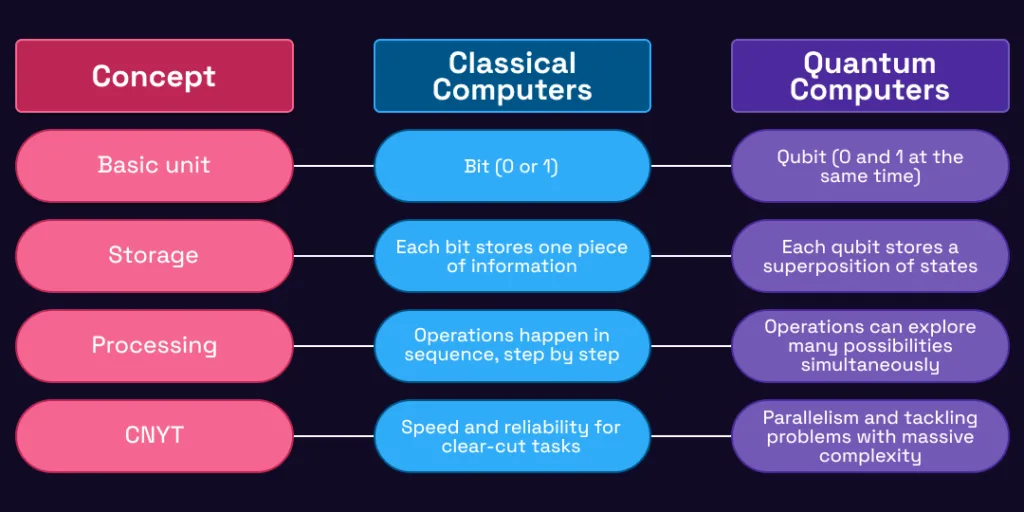
Let’s look at how normal computers and quantum computers work to see the difference.
In classical computing, everything comes down to zeros and ones, which are tiny switches that can be on or off. Superposition allows a qubit, the basic unit of quantum computing, to be both zero and one at the same time.
When you connect qubits, they can also become entangled, which means that the state of one qubit affects the state of another qubit, no matter how far apart they are. This means that quantum machines can solve some problems much faster than classical ones.
The state of quantum computers
Even though there is a lot of talk about them, quantum computers are still very new. IBM, Google, and new companies like Rigetti and IonQ are making prototypes with tens or hundreds of qubits. But these machines make a lot of noise, are not very stable, and make mistakes a lot. To run a useful algorithm, you often need thousands or even millions of stable “logical qubits,” which we don’t have right now.
That being said, research is moving forward quickly. IBM has a plan for a million-qubit system to be built in the next ten to twenty years. Not just for cryptography, but also for chemistry, optimization, and artificial intelligence, governments and businesses are spending billions on the field. Quantum computers of today can’t break blockchain cryptography, but maybe tomorrow they will.
The threat to cryptography
The fear comes from certain quantum algorithms that attack the very basis of cryptography.
- Shor’s Algorithm: This is the most well-known. It can break down big numbers and solve the discrete logarithm problem quickly. That means that if a quantum computer runs Shor’s algorithm, both RSA and elliptic curve cryptography could be broken.
- Grover’s Algorithm: This algorithm makes it faster to look through options. It effectively cuts the power of hash functions in half. SHA-256 (used in Bitcoin) is very safe right now, but Grover’s algorithm could make brute-force attacks twice as fast on a quantum computer. It wouldn’t destroy the blockchain by itself, but it would make it less safe.
These aren’t just ideas. They are working algorithms that have been tested in labs on a small scale. The only problem is making a quantum machine big enough to run them.
Building quantum-resistant blockchains
The good news is that the crypto community isn’t standing still. Scientists are working on cryptographic systems that are resistant to quantum computers, also known as “post-quantum” systems. Many of these depend on math problems that even quantum computers have trouble with, like hash-based signatures, multivariate equations, or lattice-based cryptography.
There are already some experimental blockchains, such as the Quantum Resistant Ledger. Bitcoin and Ethereum, two of the biggest networks, are starting to talk about moving. The United States’ standards body, NIST, has already chosen CRYSTALS-Dilithium and Falcon as recommended post-quantum schemes.
Ethereum becoming quantum-resistant
Ethereum depends a lot on elliptic curve signatures, especially ECDSA and BLS signatures for validators. Ethereum would need to replace these with post-quantum options in order to be quantum-resistant. That sounds easy, but there are a lot of big problems that come with it.
Every Ethereum wallet would have to work with new ways to sign things. Validators would have to get new software and hardware to handle new cryptography, which might use bigger keys and take longer to work. Changes to transaction formats would be needed for the protocol itself. Also, millions of users, developers, and validators need to work together to make sure the switch doesn’t break the network.
Vitalik Buterin, one of the founders of Ethereum, recently pointed to the forecasting platform Metaculus, where the most common guess for when a quantum computer will first break modern cryptography is the year 2040. Quantum breakthroughs could still be decades away, but it’s dangerous for blockchains to wait until the last minute to adopt quantum-resistant measures because they could happen sooner.
So is the future of blockchain security looking bleak?
It will be years before quantum computers are a direct threat. But it will also take years to protect blockchains from them, which is why the conversation has already begun.
Blockchain has always been about trusting people without having to go through middlemen. In the quantum age, the foundations of that promise must change to keep it. This story is about technology pushing technology, whether you’re a developer, an investor, or just curious.