



The Tether bid for Juventus football club was widely framed as a bold takeover attempt. In reality, it unfolded more like a carefully structured approach play. Before any offer was made, the stablecoin issuer had already built a roughly 11.5 percent stake, quietly embedding itself within one of European football’s most closely held institutions.
That context shaped everything that followed. When Tether submitted a €1.1 billion all-cash proposal for control, it did not arrive as a sudden challenge but as the logical extension of a longer strategy. And when Exor, the Agnelli family’s holding company, unanimously rejected the bid over the weekend, the decision underscored a deeper truth. Juventus ownership remains governed by legacy and control, not valuation alone, even when the capital on the table is real, liquid, and fully deployable.
Tether bid for Juventus football club: A calculated display of financial firepower
Juventus is football royalty. Founded in 1897 and controlled by the Agnelli family since 1923, the club represents continuity, influence, and identity. Ownership here is closer to stewardship than trading. You do not approach Juventus unless you understand that history runs deeper than recent results.
Tether did not arrive at the negotiation table empty-handed. Its bid was a masterclass in signaling. The offer of €2.66 per share represented a premium of over 20% above the club’s market price. More strikingly, Tether pledged to pour an additional €1 billion into the club’s development for players, infrastructure, and technology. This was not the language of a speculative asset bubble; it was the confident tone of deep, patient capital.
The source of that capital is the story. Tether is the issuer of USDT, a digital dollar “stablecoin” used by hundreds of millions of users across exchanges and wallets worldwide. The company has reported multi-billion-dollar profits in recent years. Its reserves hold over $130 billion in U.S. Treasury bills, a sum that, if held by a nation, would rank it as one of the largest private holders of U.S. Treasury bills globally. This is the war chest that funded its Tether bid for Juventus football club.
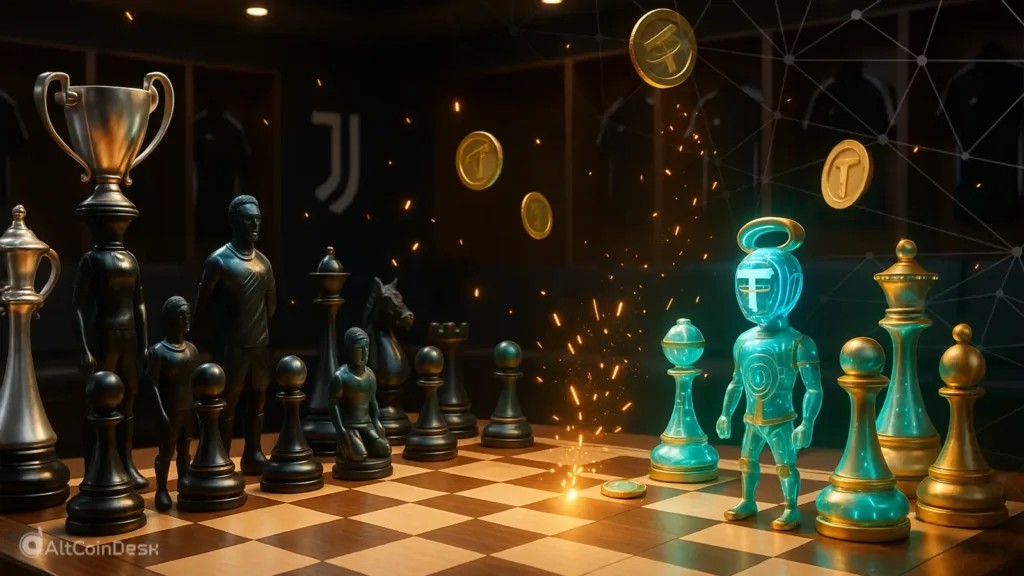
Unbreachable wall of legacy: The midfield battle nobody expected
For all its financial might, Tether ran headlong into a force more powerful than money: tradition. John Elkann, the Agnelli heir, responded from a place of legacy, not ledger books. His message was simple: some things, like a century of family history, are not for sale.
This is the core tension. Cryptocurrency operates on principles of disruption, transparency, and global accessibility. Legacy European football clubs are built on heritage, local identity, and dynastic stewardship. This Tether bid for Juventus football club exposed a fundamental cultural rift. While crypto firms have successfully sponsored stadiums and jersey sleeves, the idea of one taking full control of an institution like Juventus proved a bridge too far for its guardians.
Tether had been preparing its position quietly, like a savvy midfielder building possession. It first disclosed a stake in Juventus in February and steadily grew it to over 10%, gaining influence as a major shareholder. CEO Paolo Ardoino, a lifelong Juventus fan, framed the bid as a “long-term investment” and a personal dream. But even this emotional appeal could not sway a century of tradition.
The red card that changed nothing
Exor’s response was decisive. The holding company rejected the offer unanimously and stated clearly that Juventus was not for sale. Full stop. No counter. No negotiation. Just a firm line drawn by legacy ownership.
For casual observers, the story ended there. Bid rejected. Crypto rebuffed. Tradition prevails.
But that reading misses what actually happened on the pitch.
This was never just about acquiring a football club. It was a public audition for institutional legitimacy. By publicly proposing to deploy billions of liquid cash, derived from its crypto operations, into a mainstream, regulated, and culturally significant asset, Tether performed a critical demonstration. It showed global markets, regulators, and skeptics that its capital is not only real but is also deployable at a scale that commands attention from the most entrenched institutions.
The Tether bid for Juventus football club forced one of Europe’s most powerful football dynasties to publicly respond to crypto capital at full strength. This was not a sponsor knocking on the door. This was a balance sheet capable of buying the stadium keys.

The match result markets care about
In football terms, this was not a missed sitter. It was a statement performance away from home. Tether showed it can play 90 minutes with sovereign-sized money, discipline, and patience. It demonstrated that crypto firms now operate in the same financial league as industrial holding companies and global investment houses.
Exor’s rejection did not weaken Tether. It validated it.
Legacy ownership still answers to history, control, and identity before price. That reality remains intact. But so does another truth. Crypto capital is no longer speculative noise. It is structured, deployable, and capable of testing the strongest defenses.
That is why the Tether bid for Juventus football club mattered, even without a trophy lift.
Full-time whistle, bigger scoreline
Tether walked away without Juventus. Yet it left global markets with something arguably more valuable: proof. Proof that crypto balance sheets now command attention at the highest level. Proof that digital finance can sit across the table from century-old institutions without being dismissed.
Every football fan knows the feeling. Your team loses the cup final, but they played with such guts and style that you feel prouder than in some easy wins. That’s what Tether just did. Their takeover bid for Juventus failed, but in the process, they showed the financial world they have the capital and the courage to play in the biggest leagues. Sometimes, making the final is the victory.
In the end, the Tether bid for Juventus football club was never meant to win the club. It was meant to announce the arrival. And on that scoreline, Tether walked off the pitch, having already changed the game.