
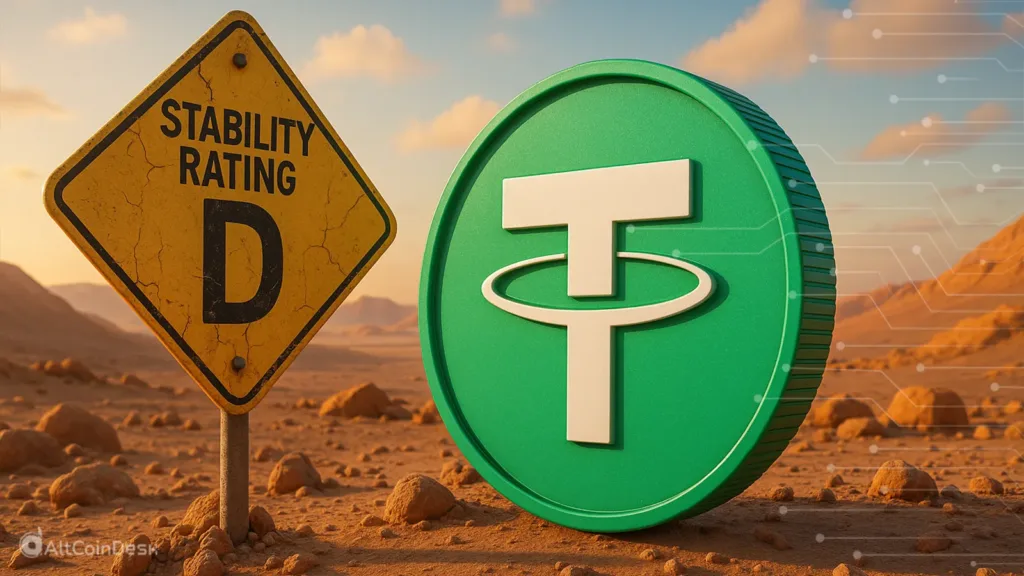

When one of the world’s most influential credit-rating divisions, S&P Global Ratings or Standard & Poor’s, downgraded Tether’s stablecoin USDT, the stablecoin issuer could not remain calm. It expressed outrage and responded, saying S&P has used legacy rating models used for traditional finance, which is inappropriate for digital assets like USDT.
S&P demoted USDT, which has a $184 billion market cap, to the lowest scale, from 4 (constrained) to 5 (weak), on its stability scale for stablecoins. This has triggered Tether CEO Paolo Ardoino, and he noted that his company has solid financial status and the traditional financial system is broken.
LATEST: ⚡ Tether fired back after S&P downgraded USDt to the lowest rating on its stablecoin stability scale, with CEO Paolo Ardoino calling the traditional financial system broken and emphasizing the company's strong financial status. pic.twitter.com/stOrdfC5T6
— CoinMarketCap (@CoinMarketCap) November 27, 2025
Why did the S&P mark low grades for USDT?
S&P cited that Tether’s stablecoin reserve is backed by higher-risk assets, including Bitcoin, precious metals like gold, corporate bonds, loans, and other investments. These assets, according to the credit-rating company, pose foreign-exchange risk, credit risk, market risk, and more.
Another reason that S&P pointed out is that Tether has continuous gaps in disclosure or less information on who holds what reserve assets. There is also an absence of a strong regulatory framework for the stablecoin, as noted by S&P.
Tether, “The Stable Company” just saw S&P cut its assessment rating from 4 to 5 – the lowest rating possible – citing persistent gaps in disclosure and high risk assets being held in its reserves.
— Novacula Occami (@OccamiCrypto) November 26, 2025
Only in crypto would the bedrock stablecoin of crypto trading be viewed as so… pic.twitter.com/fYIplOCMS6
An official statement from S&P Global reads that its Stablecoin Stability Assessment is designed “to provide market stakeholders with transparency into the stability of various stablecoins and specific insight into their depegging risks.”
Before S&P’s dramatic move, Tether bought more gold, becoming the largest independent holder of the precious metal at the moment. However, for some market watchers, Tether is showing a defensive behavior by buying gold, which is not a strength.
TETHER GOES ALL IN ON GOLD
— Front Runners (@frontrunnersx) November 27, 2025
Tether is now the largest independent holder of gold on the planet, buying more last quarter than every central bank combined.
S&P then cut Tether’s rating to its lowest tier, calling out the same structural risks the market has whispered about for… pic.twitter.com/psE1t45crJ
According to idelogist Shanaka Anslem, the S&P’s push down of Tether reminds one thing that skeptics have warned years ago — “the world’s largest stablecoin is one bitcoin crash away from insolvency”.
In simple terms, if the price of Bitcoin nosedives in a major crash, USDT’s reserve value also dips, putting Tether at a critical stage of not having sufficient assets to back the stablecoin.
BREAKING: S&P Just Declared the $184 Billion Foundation of Crypto “Weak”
— Shanaka Anslem Perera ⚡ (@shanaka86) November 27, 2025
Tether holds more US debt than South Korea.
500 million people use it as their dollar.
And a major rating agency just confirmed it cannot survive a bitcoin crash.
The arithmetic is simple:
Tether’s… pic.twitter.com/CXeQg2Clht
Stablecoins are typically pegged 1:1 to native currencies like the dollar, and their value is always stable. This makes them less volatile and risky compared to other cryptocurrencies. However, when S&P marks it to the lowest point, it is not questioning the stability of USDT; rather, it focuses on how stable and sufficient the reserve assets supporting the coin are.