
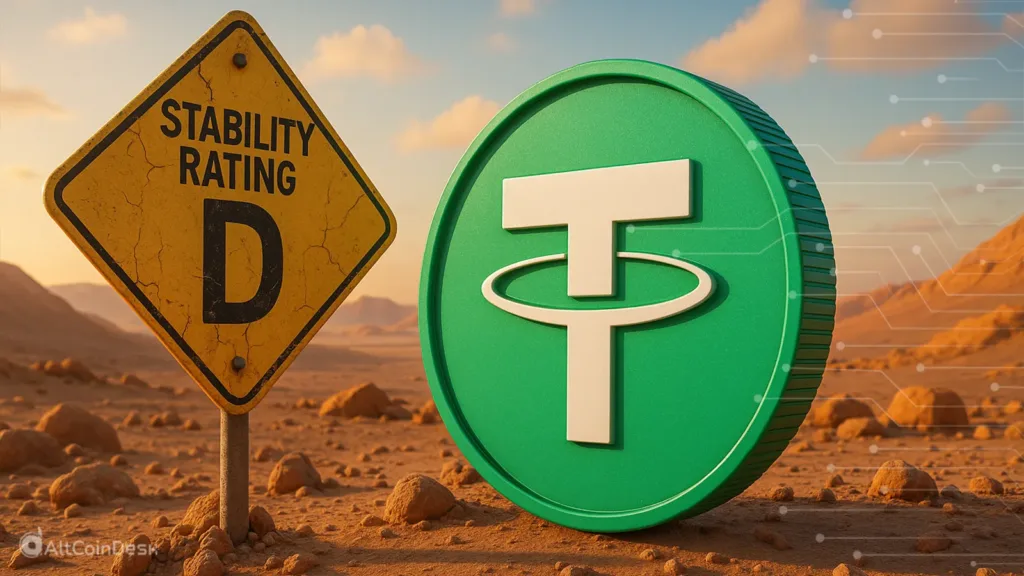

When one of the world’s most influential credit-rating divisions, S&P Global Ratings or Standard & Poor’s, downgraded Tether’s stablecoin USDT, the stablecoin issuer could not remain calm. It expressed outrage and responded, saying S&P has used legacy rating models used for traditional finance, which is inappropriate for digital assets like USDT.
S&P demoted USDT, which has a $184 billion market cap, to the lowest scale, from 4 (constrained) to 5 (weak), on its stability scale for stablecoins. This has triggered Tether CEO Paolo Ardoino, and he noted that his company has solid financial status and the traditional financial system is broken.
Why did the S&P mark low grades for USDT?
S&P cited that Tether’s stablecoin reserve is backed by higher-risk assets, including Bitcoin, precious metals like gold, corporate bonds, loans, and other investments. These assets, according to the credit-rating company, pose foreign-exchange risk, credit risk, market risk, and more.
Another reason that S&P pointed out is that Tether has continuous gaps in disclosure or less information on who holds what reserve assets. There is also an absence of a strong regulatory framework for the stablecoin, as noted by S&P.
An official statement from S&P Global reads that its Stablecoin Stability Assessment is designed “to provide market stakeholders with transparency into the stability of various stablecoins and specific insight into their depegging risks.”
Before S&P’s dramatic move, Tether bought more gold, becoming the largest independent holder of the precious metal at the moment. However, for some market watchers, Tether is showing a defensive behavior by buying gold, which is not a strength.
According to idelogist Shanaka Anslem, the S&P’s push down of Tether reminds one thing that skeptics have warned years ago — “the world’s largest stablecoin is one bitcoin crash away from insolvency”.
In simple terms, if the price of Bitcoin nosedives in a major crash, USDT’s reserve value also dips, putting Tether at a critical stage of not having sufficient assets to back the stablecoin.
Stablecoins are typically pegged 1:1 to native currencies like the dollar, and their value is always stable. This makes them less volatile and risky compared to other cryptocurrencies. However, when S&P marks it to the lowest point, it is not questioning the stability of USDT; rather, it focuses on how stable and sufficient the reserve assets supporting the coin are.