

The single most important question in crypto today is not “What does this token do?” It’s “Why do people want it?”
Why do tokens have value? Forget roadmaps and utility. The uncomfortable, hilarious truth is that we’ve become masters of wanting nothing. We cheer for digital receipts with billion-dollar price tags that don’t secure a network, power an app, or solve a single real-world problem. Crypto didn’t invent this magic trick. It simply strapped a rocket to an ancient human instinct: our incredible talent for collectively deciding that something has worth.
The psychology of the price tag: Why cheap feels like winning
Let’s start with a simple fact proven by research: a token priced at $0.003 doesn’t just look cheap, it feels like a psychological victory. Academics call this the “small price bias.” Our brains don’t see a useless asset; they see a lottery ticket with room to soar. This bias triggers stronger emotional reactions than any rational analysis could, overriding logic with the siren song of a “small cost, big dream” bet.
This is the first accelerant in the speculation engine. People weren’t just buying tulips or Beanie Babies; they were buying a story of transformation. A token with no fundamentals can surge 40% in a day because someone with a blue checkmark tweets a rocket emoji. That volatility isn’t a bug; it’s a feature. It screams, “Anything can happen here!” And in a world of student debt and stagnant wages, “anything can happen” is a powerful drug.
Scarcity and story: Programming belief
Next, we add the oldest magic trick in economics: artificial scarcity. A token may be digital vapor, but if the supply is capped at one million coins, our ancient brains perk up. Diamonds are artificially scarce. Gold’s supply is finite. We are wired to believe “rare” equals “valuable.”
But scarcity alone is meaningless. You can create a token with a supply of ten, and no one will care. The magic happens when scarcity meets a compelling narrative. Crypto has perfected this alchemy. The stories are irresistible: “This is the next Bitcoin.” “The whales are secretly accumulating.” “A major exchange listing is next week.” As Nobel laureate economist Robert Shiller might describe it, these stories create a “psychological contagion,” an epidemic of belief that spreads from person to person. The promise of future utility becomes the utility itself. The story is the value.

The social contract of worth: When vibes become currency
This brings us to the core of the mystery: value is not about utility; it’s about agreement. A dollar bill is just fancy linen. Gold is a shiny, useless metal. Their worth exists because we all agree to believe in it at the same time.
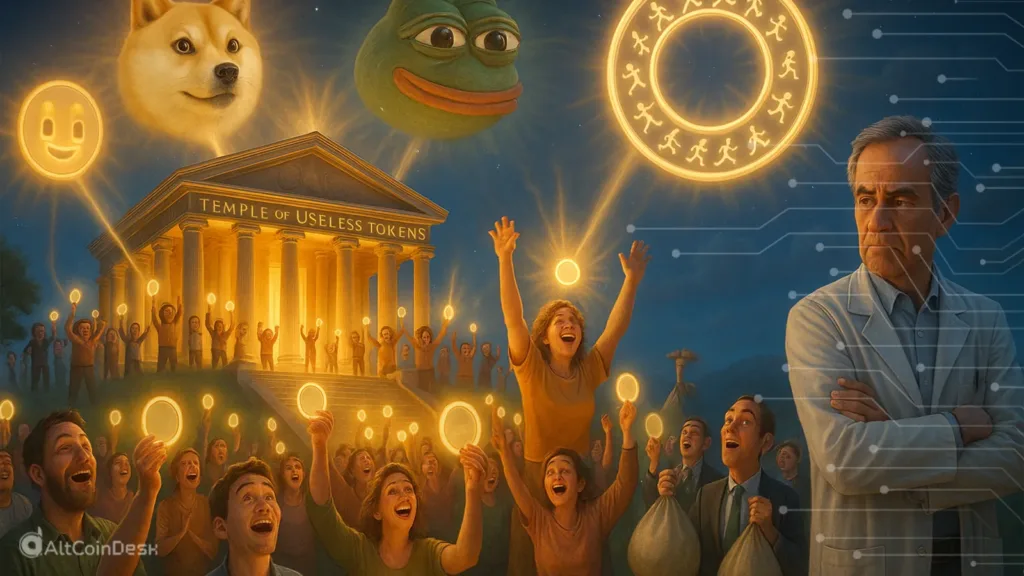
Cryptocurrencies have digitized this collective hallucination. A vibrant community can turn a joke about a dog into a multi-billion-dollar asset. Look at DOGE, SHIB, or PEPE. They started with “vibes,” a meme, a shared joke, and a sense of belonging. They created what Shiller identifies in speculative markets: a feedback loop where price increases spur enthusiasm, which justifies more price increases. This is the social belief loop in action:
- A group decides a token has value.
- They buy and hold it.
- The price rises.
- New people see the rising price as proof of value and join.
- The belief hardens into reality.
In this world, a charismatic founder, a viral tweet, or a passionate Discord server isn’t just marketing; it’s the fundamental infrastructure of a new micro-economy. Social capital transforms directly into monetary capital.
The crypto reversal: How value creates utility
Here’s the most ironic twist of all, and the one that flips traditional finance on its head. In the world of startups, you build a useful product, attract users, and hopefully create value. In crypto, the sequence often reverses.
Many tokens only become useful after they are valuable. A soaring market cap acts like a gravitational force. It attracts developers who want to build on a hot platform. It lures partnerships from companies chasing hype. It draws the attention of exchanges and media. The “utility” promised in “Phase 3” of the roadmap is often funded by the speculative frenzy of Phase 1.
Belief precedes functionality. The narrative builds the reality. It’s absurd, but it’s a pattern we’ve seen play out repeatedly.
The final, unsettling truth: We are all believers
So, why do tokens have value when they do nothing? The same reason a signed baseball, a Picasso painting, or a Rolex watch has value. Humans are meaning-making machines. We project our hopes, our identities, and our tribal affiliations onto objects. Crypto has simply given us a new, hyper-efficient canvas for this ancient behavior.
The value emerges because people believe it exists, because the supply is limited, because the price movements tell a story of opportunity, and because the community tirelessly reinforces the myth.
Calling it an “illusion” misses the point. As the research into market psychology shows, all value is a shared illusion. Money itself is a collective fantasy we agree to treat as real. Crypto, with its memecoins and speculative manias, doesn’t create value from thin air. It holds a mirror up to the very nature of value itself, revealing it to be what it has always been: a compelling story that enough people choose to believe.
And in our connected, digital world, the best stories, not the most useful products, often win. That’s the real magic trick, and we are all the magicians.