



A White House meeting exposed a deeper clash over money, power, and who controls returns in a high-rate economy.
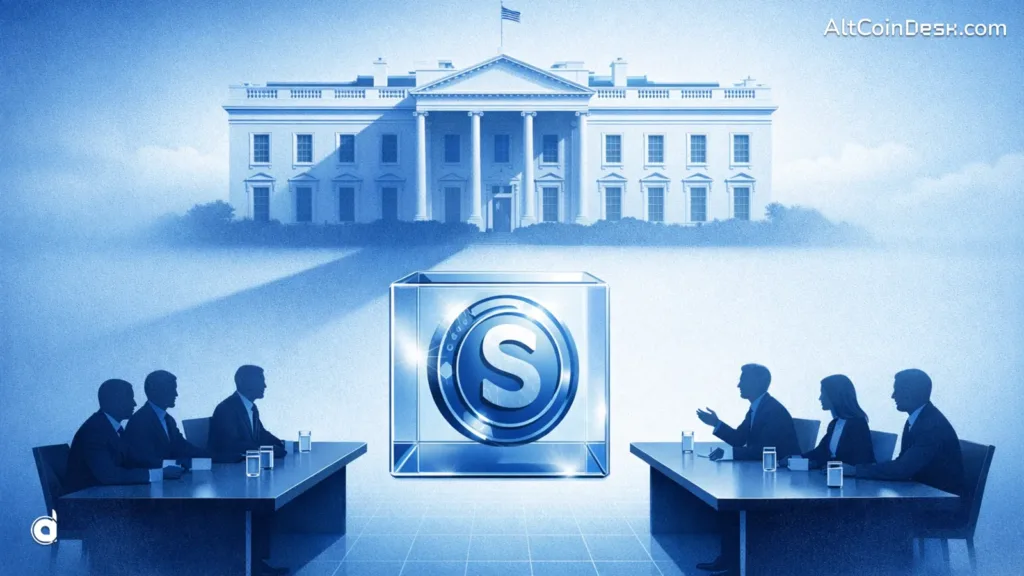
The White House brought banks and crypto leaders into the same room this month to solve what sounded like a narrow problem. Could stablecoins legally offer yield to users? The meeting ended with no deal. That outcome tells us something important. This fight is not really about crypto. It is about who gets to pay interest in America.
At the center of the dispute is stablecoin yield, the idea that people holding digital dollars could earn returns, either directly or through apps and platforms. Banks see this as a direct threat to deposits that fund loans and local lending. Crypto firms see it as basic product parity with money market funds and fintech rewards that already exist across the financial system. The meeting hosted by the White House was meant to bridge that gap. Instead, it showed how far apart the sides still are.
A high-stakes meeting with no compromise
The talks came after weeks of reporting that crypto legislation was stuck in Congress. One issue kept blocking progress. Whether stablecoins could be linked to yield without being treated like bank deposits. Banking groups warned that allowing stablecoin yield would pull money out of insured accounts and weaken the traditional system. Crypto groups argued that banning it would freeze innovation and push activity offshore.
Both sides walked away calling the meeting constructive. That is Washington code for unresolved. This matters because interest rates are high. People care deeply about where their money earns something. When banks pay low rates on savings, frustration builds quietly. That frustration is part of why the idea of stablecoin yield resonates far beyond crypto circles.
What banks are really worried about
Banks are not wrong to worry about deposit flight. Analysts estimate hundreds of billions of dollars could move if digital dollars become more attractive than checking accounts. Deposit loss affects lending, mortgages, and small business credit.
Trade groups like the American Bankers Association and the Bank Policy Institute have been clear. If stablecoins act like deposits, they should follow bank rules. From their view, allowing stablecoin yield through third-party platforms creates a look-alike deposit without the same safeguards. This argument carries weight with regulators who still see the world through the lens of past crises.
Why crypto firms refuse to back down
Crypto companies counter with a simple point. Yield already exists everywhere. Money market funds pay interest. Fintech apps offer rewards. Brokerage accounts sweep cash into interest-bearing products. Blocking stablecoin yield does not protect consumers. It just limits choice.
From the crypto side, the concern is that lawmakers are regulating yesterday’s system while money has already moved on. Digital wallets are global. Capital is mobile. If rules are too tight in the United States, innovation does not stop. It relocates. That is why companies like Coinbase have pushed hard for clarity instead of outright bans.
The political backdrop shaping the debate
Politics adds another layer. Former President Donald Trump has been portrayed as supportive of advancing crypto legislation, framing it as pro-growth and pro-innovation. That stance puts pressure on agencies to find compromise, even as banks push back. At the same time, regulators are trying to avoid another shadow banking problem. They remember what happens when financial products grow faster than oversight.
What happens if there is no compromise?
If lawmakers block stablecoin yield outright, demand does not disappear. It simply finds workarounds. Platforms will design new wrappers. Offshore products will grow. The system becomes harder to see and harder to supervise. If regulators allow stablecoin yield with clear rules, they may keep activity onshore and visible. That is the quiet trade-off at the heart of this debate.
The bigger question hiding in plain sight
This story keeps getting framed as crypto versus banks. That misses the point. The real question is who gets to pay interest in a digital economy. For decades, banks held that privilege. Technology is challenging it.
The White House meeting did not fail because the issue was complex. It failed because the stakes are high. Control over yield means control over where money lives.
Until Washington answers that question honestly, the stablecoin yield fight will remain unresolved. And for everyday Americans watching their savings earn little, that answer matters more than any label attached to crypto.