

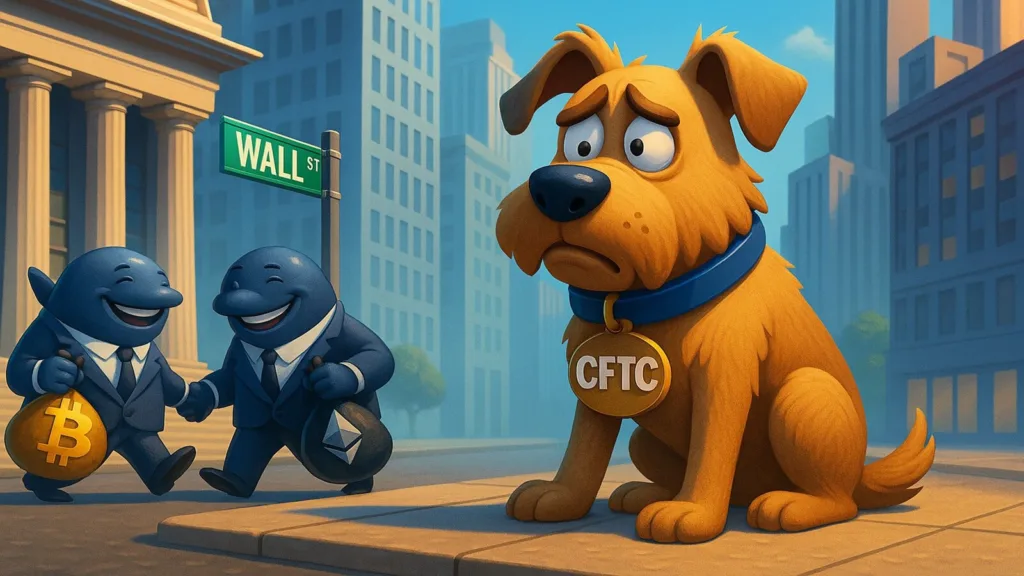

The Commodity Futures Trading Commission (CFTC) was built to police some of the most important markets in the world: oil, interest rates, and, more recently, cryptocurrency. Today, that same watchdog is stumbling through a leadership crisis that, according to the Financial Times, has left the watchdog operating with a single acting commissioner. That’s unprecedented, and it couldn’t come at a more critical time: crypto regulation is hanging in the balance, the industry is left asking: who’s really in charge?
One Commissioner, too much power
Normally, the Commodity Futures Trading Commission (CFTC) is run by a five-member panel. Right now, it is down to just one: acting chair Caroline Pham. The recent reports alleged that in her short tenure, Pham has fired and reshuffled key enforcement staff, including lawyers who worked on high-profile crypto cases.
Current and former employees told the paper that staff morale has plummeted, enforcement has slowed, and companies that once feared the agency now openly question its bite. Dennis Kelleher, head of Better Markets, summed it up bluntly to the Financial Times: “There’s nobody today that’s fearing the CFTC.”

Trump, the Winklevoss Twins, and a stalled nomination
At the center of the turmoil is President Donald Trump’s nominee for permanent chair: Brian Quintenz. His confirmation has been stuck for months. According to reports, Quintenz has suggested that crypto entrepreneurs Tyler and Cameron Winklevoss may have sought to undermine his nomination.
The twins, best known for their early legal battle with Mark Zuckerberg over Facebook, have become prominent figures in crypto. Their Gemini exchange settled a $5 million case with the CFTC in 2022. The Financial Times reports that the Winklevoss brothers argue the case represented regulatory overreach under the Biden administration.
Quintenz, who leads policy for Andreessen Horowitz’s crypto arm, released screenshots earlier this month that allegedly appear to show Tyler Winklevoss pressing him about the Gemini case. Quintenz implied this pressure may have affected his nomination, though both he and the brothers declined to comment further when asked by reporters.
The Commodity Futures Trading Commission at Crossroads
The irony is striking. The Commodity Futures Trading Commission (CFTC), once feared as an overzealous cop, is now accused of being paralyzed. While U.S. regulators fight, the crypto industry sees an opening. Companies that long complained about heavy-handed enforcement now spot a chance to expand in the world’s largest economy with little pushback.
Meanwhile, prediction markets, platforms that let people bet on events, are growing fast. The FT highlights Kalshi and Polymarket, two platforms linked to figures close to the Trump family. Kalshi hired Donald Trump Jr. as an adviser in January, while he also sits on Polymarket’s advisory board. Both platforms fall under the CFTC’s oversight, raising new questions about conflicts of interest.

Why this matters beyond Washington
For global markets, the leadership crisis at the Commodity Futures Trading Commission (CFTC) is more than Beltway drama. The agency oversees multi-trillion-dollar derivatives markets. If it struggles to regulate prediction markets and crypto derivatives, ripple effects could spread far beyond the U.S.
In the UAE, where regulators have built a reputation for clarity and innovation, the contrast is stark. While Dubai and Abu Dhabi move to attract capital with clear frameworks, America’s main market cop is tied up in political infighting. That divergence could reshape where money flows next.
Closing thoughts
The Commodity Futures Trading Commission (CFTC) was meant to be the aggressive cop on the beat. Today, it looks more like a referee stuck in its own rulebook. For crypto companies, that might feel like an opportunity. For investors, it’s uncertainty.
In markets where confidence is everything, the question posed by the FT report remains simple: if the watchdog is distracted, who’s really guarding the future of finance?