

The AAVE Decentralized Autonomous Organization (DAO) passed a grant fund for the protocol’s growth. The approved $25 million investment in stablecoins with an asset allocation of 75,000 AAVE tokens shall be utilized under the “Aave Will Win” framework. The approval of the fund comes at a very strategic time and occurs at the same price level of AAVE as of August 2024.
AAVE eliminates the involvement of middlemen
AAVE refers to the coin of the Aave platform, which is a widely used DeFi protocol that eliminates the need for an intermediary during transactions. This platform allows individuals to conduct lending and borrowing activities without the need for intermediaries who would charge users fees.
By using Aave, individuals are able to deposit tokens to earn interest or borrow funds by securing the same tokens against a collateralized position through the use of smart contracts.
The AAVE token serves an important role in the protocol’s ecosystem by facilitating the governance of the network, where users will be able to vote on major protocol changes, and by participating in the staking of the Aave safety module to support the security of the platform and earn rewards.
Thanks to features such as flash loans and flexible interest rates, the Aave platform has emerged as one of the primary layers of liquidity within the DeFi industry. As such, the price action of AAVE tokens is intrinsically linked to that of the entire DeFi sector.
AAVE DAO passes $25 million stablecoin and 75,000 AAVE
The AAVE DAO approved a fund of $25 million in stablecoins and token allocation of 75,000 AAVE. And approved amount will be used for the “Aave Will Win” framework, a proposal that would scale and enhance the protocol’s growth.
The vote passed Saturday hands down, with nearly 75% voting in favor. As such, the approved stablecoin allocation will be paid in installments over 12 months, while the 75,000 AAVE tokens will vest linearly over four years, according to the governance dashboard.
The founder and CEO of AAVE stated that the ecosystem will be centered around the AAVE token. The protocol will be moving toward a structure where all core value, incentives, and governance revolve around a single token ($AAVE).
AAVE endeavors to consolidate its system to the token
Instead of spreading utility across multiple tokens or fragmented systems, Aave is consolidating everything—staking, governance power, and value capture—into $AAVE. For investors, this is important because it creates a clearer link between protocol success and token value, reducing dilution and aligning incentives across the ecosystem.
Under its governance framework (AIP-1), the protocol has generated around $140 million in revenue in 2025, which has been accumulated by the Aave DAO treasury. What’s more significant is that 2026 is on route to match that figure even during a weaker market, and this revenue is coming purely from protocol activity (lending, borrowing fees, etc.), not external incentives or token emissions. In simple terms, Aave is proving it can function like a self-sustaining financial system, generating consistent income regardless of market hype cycles.
However, the AWW proposal introduces a new revenue stream: application and product revenue generated outside the Aave Protocol, now directed to the DAO as additive revenue. As such, revenue from Aave Pro, Aave App, Horizon (RWAs), and Aave Kit will all flow back to the DAO treasury.
Furthermore, the proposal also seeks to enhance the product layer and distribution, engineering and tech, marketing, risk management, governance, and growth. The passage of the funds could not have come at a better time than this, as AAVE struggles at the 2024 August levels.
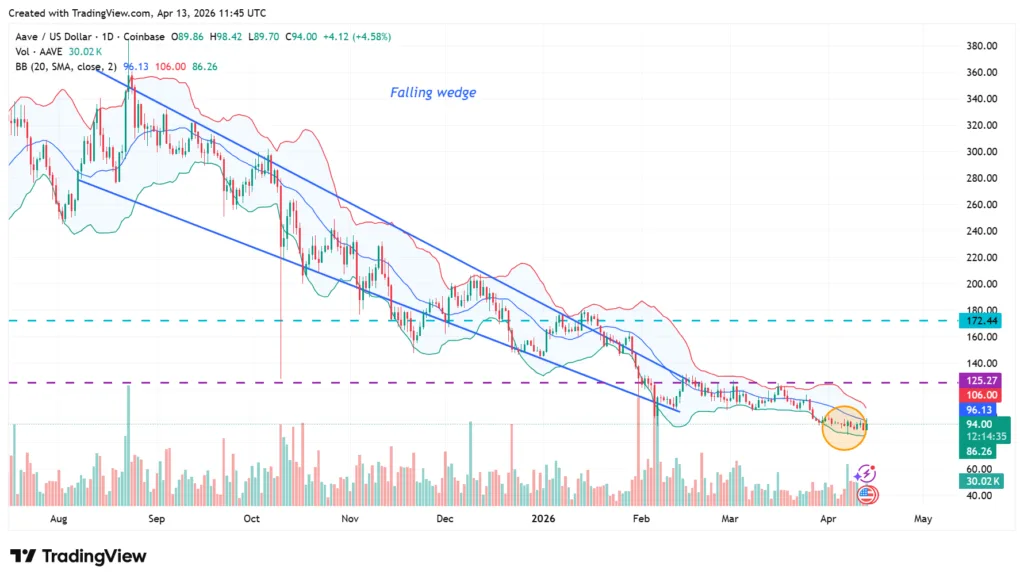
The daily chart above shows how AAVE prices started to consolidate after completing the falling wedge. The falling wedge is a bullish chart pattern where the price declines between two converging lines in such a way that the range becomes smaller and smaller because of reduced selling interest.
Even though the overall movement of the price action is bearish inside the falling wedge, the lower levels of decline become weaker, which indicates that the sellers are beginning to lose their power while buyers begin to enter the market.
However, unlike a conventional falling wedge, which breaks out and the prices appreciate, AAVE kept consolidating despite completing this pattern. One primary cause is the inherent unreliability of chart patterns themselves; even well-formed falling wedges have failure rates, often turning into bull traps where an initial upside break lacks sufficient follow-through momentum, causing price to drift sideways as buyer conviction remains weak.
A major contributing factor here would be the lack of volume verification, as a proper breakout must be preceded by contraction in the volume inside the wedge and a sudden explosion upwards in the breakout, without which the entire pattern will just fail to materialize into anything meaningful.
Other factors that may come into play here include heavy overhead resistance from swing high zones, round number levels, and invisible sell walls from large shareholders.
Bearish double top forms on weekly chart
Additionally, the higher-timeframe context often overshadows the lower-timeframe pattern. As such, by looking at the higher time frames, traders can recognize if AAVE remains trapped in a larger downtrend or broad trading range on weekly or monthly charts. This helps resolve the fact of whether the falling wedge on daily or intraday timeframes is likely to break neutrally rather than bullishly.
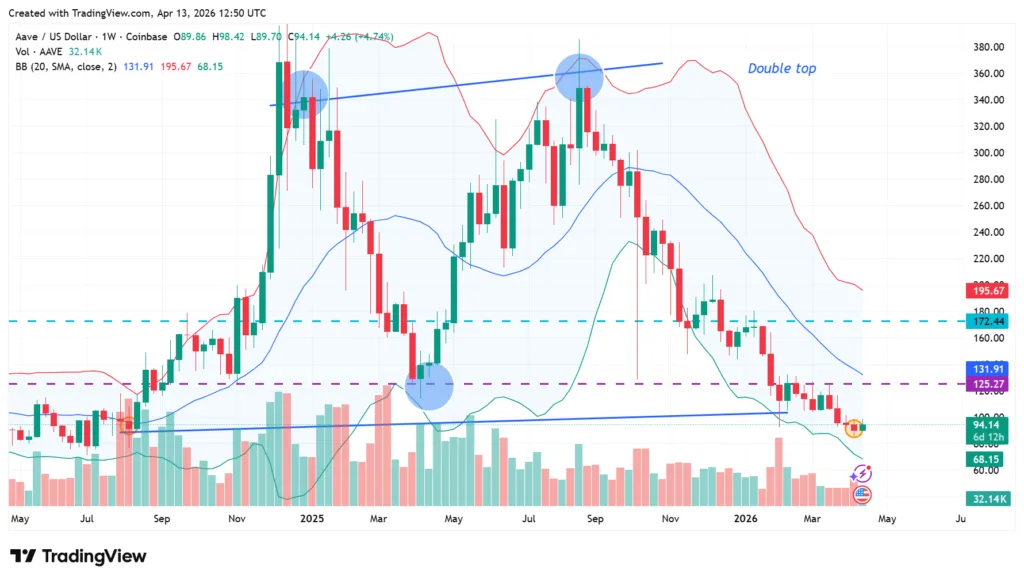
AAVE has formed a double top pattern on the weekly chart. When a double top pattern forms, it signals a bearish formation that indicates a possibility of trend reversal, where the uptrend changes into a downtrend. It consists of two tops in an asset’s price action. In other words, after rising towards a certain resistance point, the price will fall before rising towards that resistance point again without breaking above it.
The main indicator that confirms the formation is when the price moves below the support level (neckline) between those two tops. This means that sellers have started taking control over the market and that it might start moving downwards. In brief, the double top indicates exhaustion of buyers and dominance of sellers. And this is exactly what has happened to AAVE.