

Near protocol is severely undervalued with the present market conditions, and there is a high chance that the token could break above $3-$4. Comparing NEAR unlocks, the revenue generated, and how well the price is doing compared to these two parameters, analyst Michael van de Poppe stated that the coin is underpriced.
NEAR Protocol positions itself as a blockchain built for the AI era—a high-performance platform designed to support the next wave of decentralized applications and intelligent agents. The main activity of NEAR is to provide the infrastructure needed for AI systems to transact, operate, and interact seamlessly across both Web2 and Web3 environments.
The network is built around three key pillars. The first is user-owned AI, this ensures that intelligent agents act and aligns with the best interests of the user rather than centralized entities.
Second is intents and chain abstraction, which simplify the user experience. It removes blockchain complexity and enables goal-based transactions across multiple chains. Finally, NEAR’s sharded architecture provides the scalability, speed, and low-cost execution needed for real-world use. Together, these elements position NEAR as a foundation for building secure, scalable, and user-centric AI-native applications capable of operating at internet scale.
Analyst Michael van de Poppe pointed out that based on the prevailing market conditions and NEAR’s supply of tokens, it is extremely underpriced.
Rewards for validators slashed by 50%
For instance, the analyst considered the amount of new tokens entering the market. The NEAR network releases tokens each year in the form of rewards for validators and stakers, and this has been cut by 50%. Usually there are 32 million tokens issued at 2.5% inflation into the open market.
However, this amount of tokens released into the market has been cut down by 50% after the 2025 update. The update plays a major role because lower inflation reduces the constant selling pressure from newly issued tokens.
Venture capitals dont have enough supply to upset the price
Another major point the analyst revealed was that there was not enough hidden supply that could crash the prices. To reveal this, he looked into the venture capital holdings and stated that all VCs’ tokens are unlocked and 99% of the supply is circulating. So what does this mean?
This shows the supply left to enter the market is minimum, and even in the event they enter the market, there is no sudden sell-off risk from early investors. Despite many projects suffering with ongoing unlocks, NEAR’s risk is already behind, and it makes the supply structure more transparent, robust, and mature.
Nearly 50% staked on the protocol—supply crunch
In addition, 45.5% of tokens are staked, and that means nearly half of the circulating supply is locked up in securing the network, earning staking rewards. This reduces the amount of tokens actively available for trading, which can tighten supply in the market and support price during periods of demand.
$50-$60 million annual revenue generated
It not just about the supply of the tokens, which made the analyst bet big on the token, but also its platform, which generates about $50–60M in annual revenue based on a 90-day run rate. This means the network is currently producing that level of income from transaction fees and usage.
In layman terms, NEAR is no longer just a speculative asset; it’s behaving more like a revenue-generating platform, and that revenue reflects actual demand for blockspace.
70-30 gas split
NEAR also follows a 70/30 gas fee split. 70% of base-layer fees are burned, and those tokens are permanently removed from circulation, while the remaining portion goes to validators. This introduces a deflationary pressure, as increased network usage leads to more tokens being destroyed over time.
NEAR token buybacks
And then comes the more aggressive approach where NEAR buys back its tokens from the market. NEAR Intents fees are used to buy back $NEAR from the market. Instead of just burning fees, the protocol actively creates buy pressure, since it has to purchase tokens from the open market to execute this mechanism.
NEAR doesn’t just reduce future supply—it also creates ongoing market-side absorption of circulating tokens, which strengthens the relationship between protocol revenue and token value capture over time.
However, NEAR is currently trading at $1.4 as it tries to establish a new uptrend rising from the October 2023 levels. As shown in the chart below, NEAR is producing higher lows while it has a flat top.
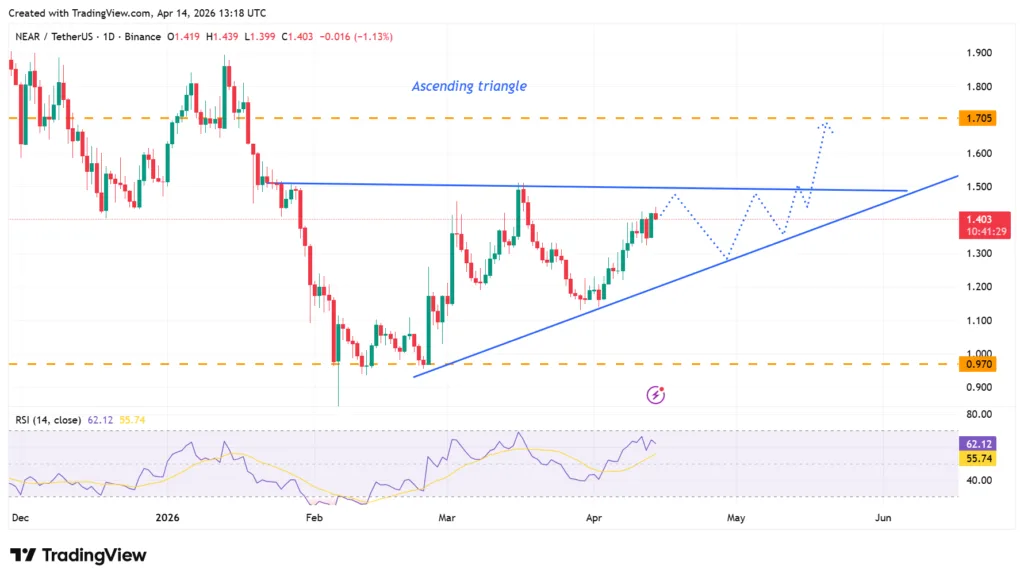
This pattern is called an ascending triangle pattern. An ascending triangle is a bullish continuation pattern. The price moves inside a triangle in a zigzag pattern as the range of motion tightens. It has a flat resistance level on top and rising higher lows underneath. It shows that buyers are becoming more aggressive while sellers are repeatedly defending the same price ceiling, creating a buildup of pressure inside the range.
However, once the strength of the sellers at the flat top fades away eventually as the bulls put on more strength with each higher low. And there will come a moment when the power of the bulls will overshadow the bears, and NEAR prices will push past the resistance level at $1.4.