


The short- and medium-term price charts of Solana show that it is bearish, while the longer-term trend shows that the coin’s bullish trend is still intact and that it could appreciate in the coming days.
Solana was born to kill Ethereum
Solana is a blockchain platform that was specifically developed to facilitate decentralized applications with very high speed, reduced costs, and scalability. Aka, the Ethereum killer was introduced in 2020 by Anatoly Yakovenko.
Solana was designed to tackle a key challenge in the world of cryptocurrency: scalability, by processing hundreds of thousands of transactions at a time while maintaining minimal costs.
Solana makes use of special techniques that include Proof of History (PoH) to efficiently order transaction blocks along with its proof of stake system.
Solana thus offers an ideal blockchain infrastructure for decentralized finance (DeFi) projects and NFTs that developers can implement without having to worry about higher costs. The blockchain platform is among the few major layer-1 blockchains today.
SOL-short timeframe chart shows a bearish outlook
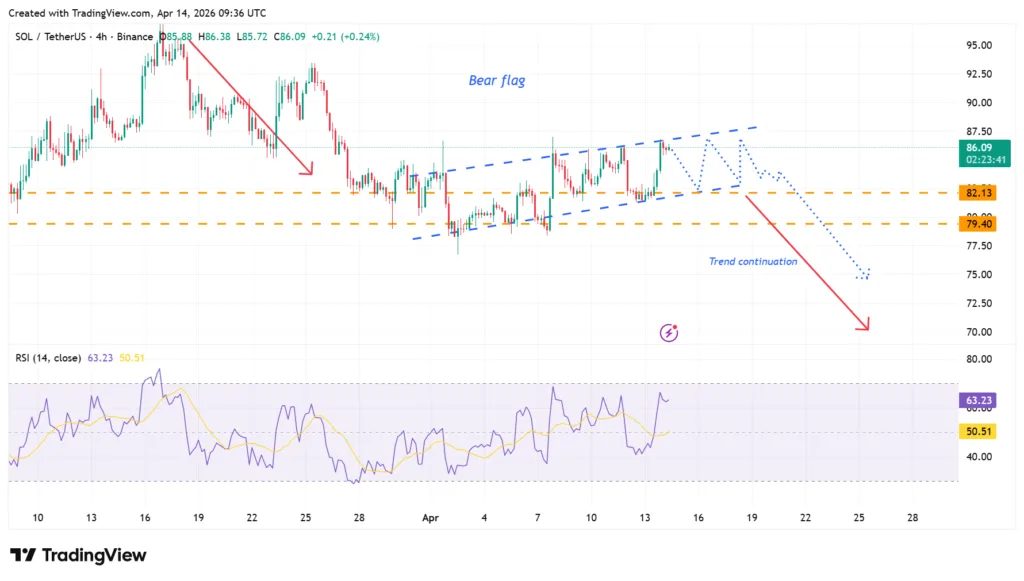
Solana has been exhibiting a bearish trend on the short-term price chart. For instance, the 4-hour chart below shows the coin trading inside a bear flag. After hitting values above $95, the SOL price is currently priced at $86, as it struggles to get some momentum. However, as it is trading inside a bear flag, it cannot.
SOL bears dominate the market
A bear flag is a short-term bearish continuation pattern that forms during a downtrend when price pauses and briefly moves upward or sideways before continuing lower. More often than not, it appears after a strong sell-off (which represents the “flagpole”).
After a massive selloff, the sellers take a breather, and during this period buyers attempt a temporary recovery. The efforts of the buyers only materialize. in a small upward-sloping or sideways consolidation channel, known as the “flag.” Although it may look like the price seems to be stabilizing, it is actually just cooling off after heavy downside momentum.
The pattern forms after a sharp decline. Since the market hits the threshold and becomes temporarily oversold, it recovers, and this leads to a bounce driven by short-covering and bargain buying.
When price fluctuates inside the flag, traders behave differently depending on positioning: early shorts often lock in profits, while new buyers enter expecting a reversal, and aggressive traders may even fade the downtrend.
Whatever the stance of the traders, the overall structure still favors sellers, as every bounce tends to attract fresh short positions or distribution from larger players. Volume dips during the flag phase, showing that bullish momentum is weak and not strongly supported. As such it cannot sustain.
The bullish momentum weakens to an extreme level, so even the breakdown occurs when the price fails to hold the upper boundary of the flag and breaks below support, continuing the original downtrend. This happens because the bounce is not backed by strong demand – it’s more of a pause than a reversal.
Once sellers take back control, stop-losses from long positions get triggered. This adds selling pressure and makes the price drop even faster.
In terms of a bear flag, it keeps moving downward. It is a short pause in a strong bearish trend. The upward move is a small correction, not a real change, in market direction. The bear flag represents this consolidation. The dominant bearish trend remains.
Given this scenario, SOL prices will further crash after fluctuating inside the bear flag for some time. When a price crashes from a bear flag, it usually follows a phenomenon of crashing by the height of the flagpole. Given that SOL follows a conventional breakout, the coin could crash as low as $80.
Sometimes the smaller time frames could produce some noise, and it could blur the long-term trajectory of the coin. Hence, it’s important to observe the higher time frame chart. For instance, the daily chart also shows that the coin is currently trading inside a bear flag.
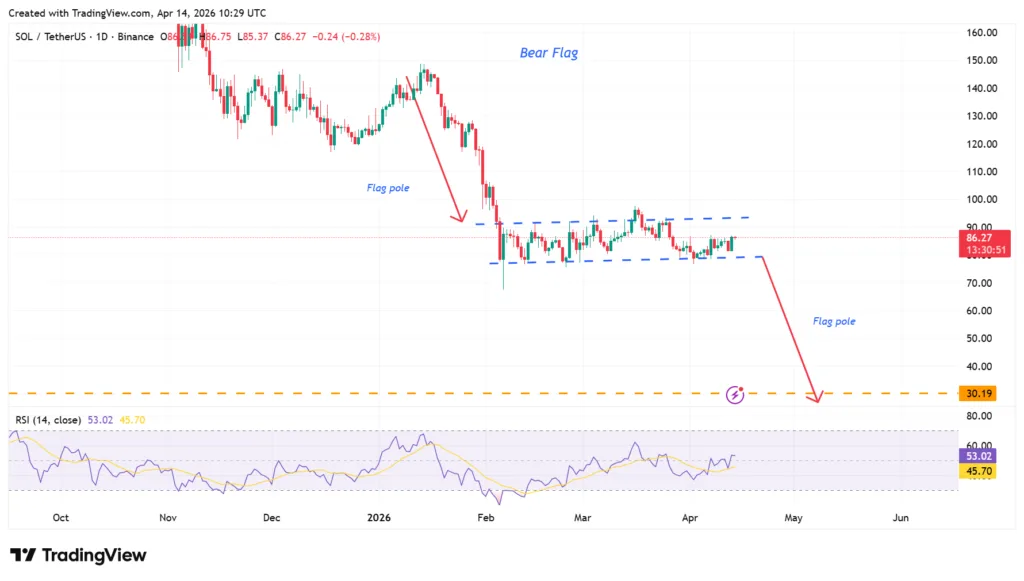
If the Solana is forming a bear flag on both the four-hour and daily charts, it is showing a sign of bearish continuation pressure across multiple timeframes.
If the Solana bear flag structure is visible on the 4-hour chart, it shows that short-term sellers of the Solana are still in control, and any upward move of the Solana is likely a pause rather than a reversal of the Solana.
SOL’s daily and weekly charts paint a bearish outlook
However, when the four-hour, daily, and weekly charts of Solana also show the bear flag structure, it significantly strengthens the signal for Solana, suggesting that the bearish trend is not just short-term noise but part of a larger higher-timeframe downtrend.
This alignment across timeframes of the Solana indicates that buying pressure for the Solana is weak during recovery phases of the Solana, and rallies of the Solana are being used more for distribution or shorting of the Solana rather than accumulation of the Solana.
It also shows that market participants are not confident enough to reverse the trend of the Solana, so the price of the Solana continues to coil within a biased structure of the Solana.
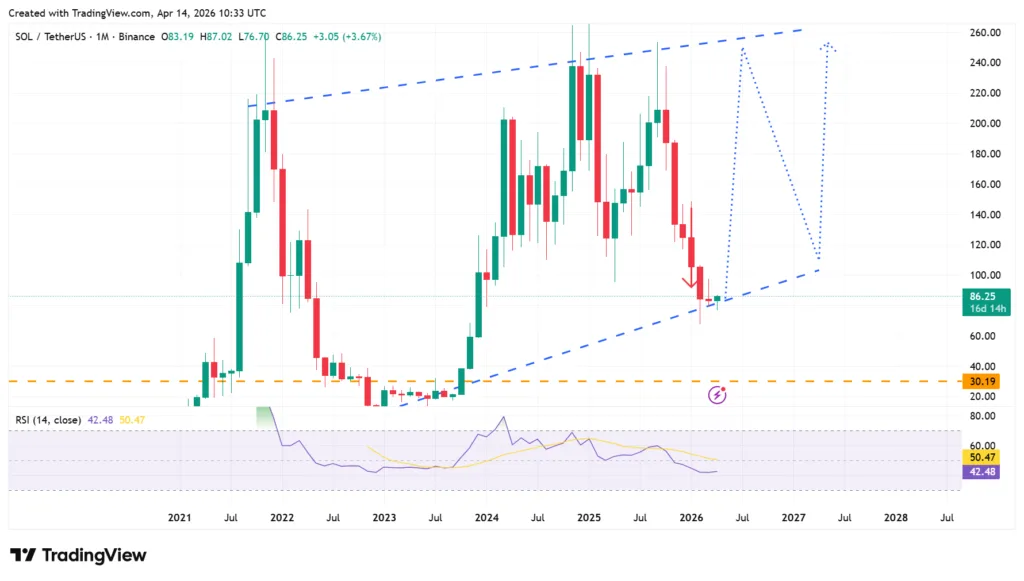
Solana’s monthly chart follows an uptrend
However, the monthly chart on Solana presents a different and more structural narrative. For instance, the chart shows how SOL has rebounded off a major lower trendline, suggesting that longer-term buyers are still defending key macro support levels.
When the broader timeframe is put into context, SOL’s current price can be seen as a higher low. This goes on to show that no matter what happens in the short time frames, the overall long-term uptrend is still intact.
The budding green monthly candlestick reflects early signs of accumulation at higher timeframes. Long-term investors utilize this candlestick as a signal to enter the market, as it shows that the sell pressure is over and the trend is about to change.
This is classical behavior often seen near major support zones, where value-oriented buyers see discounted prices as an opportunity to build positions ahead of the next expansion phase.
When the multiple timeframes are considered together, it creates a confusing scenario. The four-hour, one-day, and weekly charts show a bear flag and short-term bearish continuation risk, while the monthly chart suggests that the broader macro uptrend has not been broken.
Usually, this kind of divergence often extends into consolidation, where the bulls and bears fight tooth and nail to conquer the market in the short term.
If the higher-timeframe support continues to hold and buying pressure keeps on building, there is every chance that SOL could eventually shift back into an expansion phase. During this expansion or rally, SOL could target previous resistance zones such as the $200 region and beyond.
However, this process is usually gradual, as it requires confirmation through sustained higher lows, increasing volume on upswings, and a clear break of lower-timeframe bearish structures before a full trend continuation can resume.