



There’s been a lot of talk about yield compression in DeFi lately, and it’s not wrong. Returns across the board have come down, especially compared to the outsized yields seen in previous cycles. But if lower yields alone were enough to break the space, you’d expect to see capital leaving in a more obvious way. That’s not really happening.
Not all DeFi protocols are feeling the same
Looking at total value locked (TVL), the drawdowns from peak levels are still meaningful – but they’re uneven. Aave v3, for example, is down roughly 43.8% from its peak. Sky Lending has dropped about 23.7%, while Ethena’s USDe stands out as one of the weaker performers, down around 60.7%.
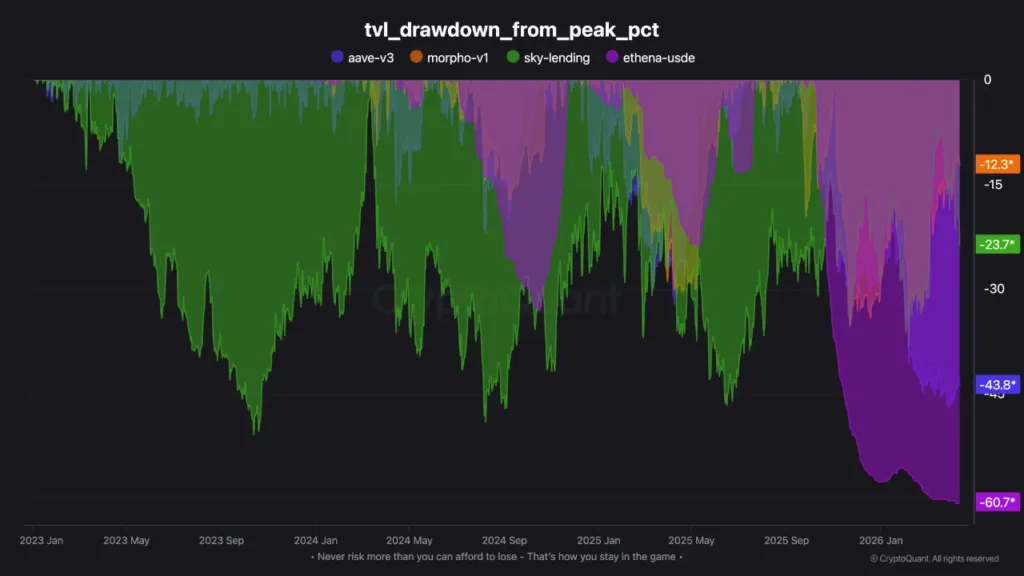
Then there’s Morpho, which tells a slightly different story. Its drawdown is closer to 12.3%, suggesting capital hasn’t pulled back nearly as aggressively there.
That kind of spread matters. It shows this isn’t a broad, uniform exit from DeFi – it’s more selective than that.
The short-term trend is more mixed
If you zoom in on the past week, the picture gets even more nuanced. Aave has actually ticked up around 5.7%, and Morpho is up about 4.6%. On the other hand, Sky Lending is down roughly 3.2%, and Ethena is still slightly in the red, hovering around -0.9%.
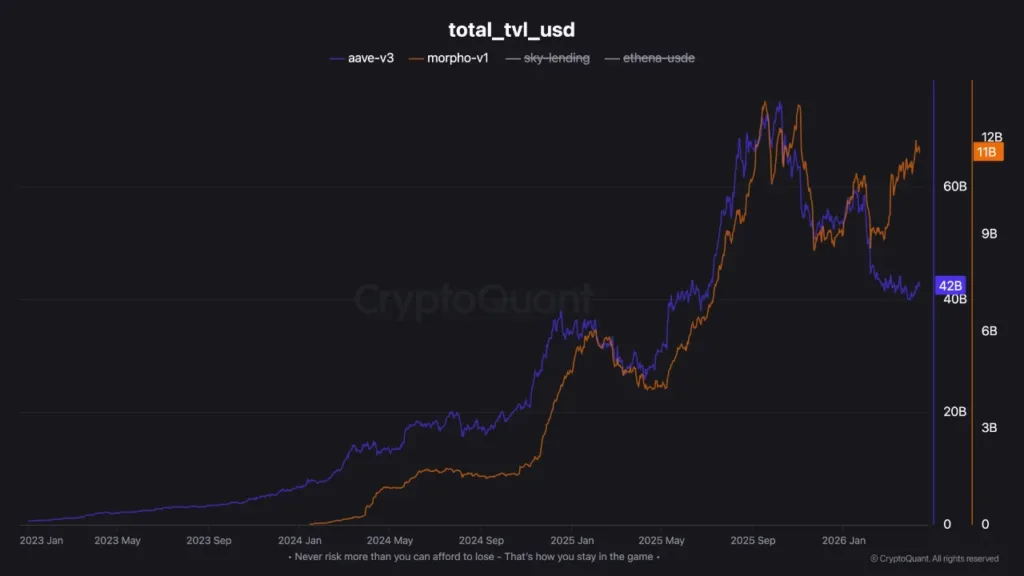
So while yields may be compressing, capital isn’t just flowing out. It’s rotating.
That rotation tends to happen when the easy opportunities start to fade. Instead of chasing high yields across the board, investors become more selective about where they park their capital.
A shift in how capital is positioned
The bigger takeaway here is that the “yield premium” that once led rapid inflows into DeFi is starting to fade. That doesn’t mean the space is losing relevance, rather, it just means the bar is getting higher now.
Protocols that can offer more stable returns, better risk management, or stronger fundamentals are holding up better. Others are seeing sharper drawdowns as capital looks for safer or more efficient alternatives.