



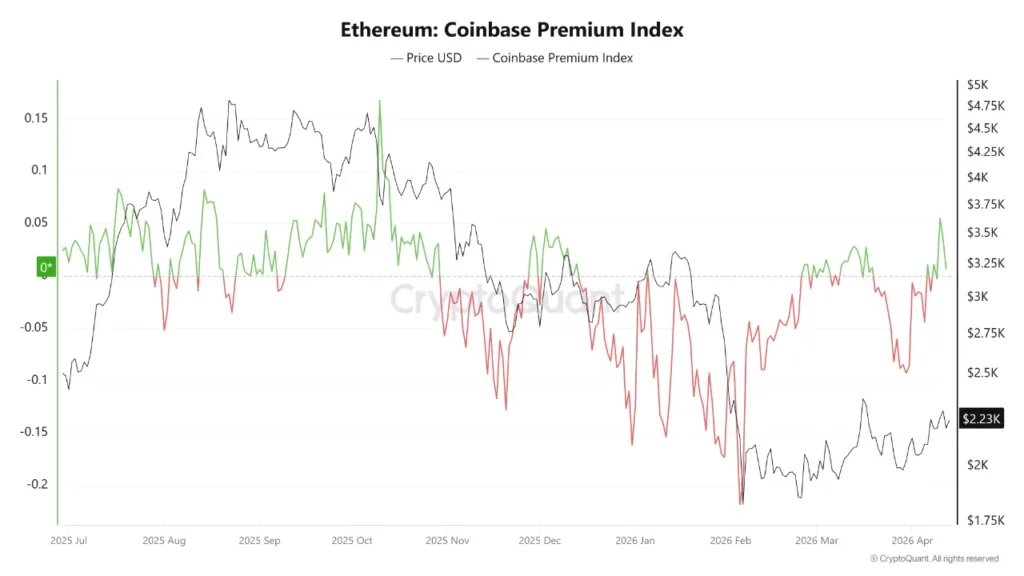
Ethereum had a short burst of strong demand recently, but it didn’t really stick. A key institutional signal – the Coinbase Premium Index – spiked to its highest level since October 2025 before quickly cooling back down to almost flat again.
A quick wave of heavy ETH buying
For the uninitiated, the Coinbase Premium Index compares where Ethereum is trading on Coinbase versus Binance. When Coinbase trades higher, it usually means US buyers – often institutions – are stepping in more aggressively.
This time, the premium jumped to around 0.055. That’s a pretty strong move, and it basically meant people were willing to pay more for ETH on Coinbase just to get filled. That’s usually not retail behavior – it tends to point to larger, more price-insensitive buyers.
For a brief moment, it looked like real momentum was building.
But the move didn’t last for long
The interesting part is what happened next. After hitting that peak, the premium dropped right back down to around 0.006.
So whatever buying pressure showed up, it didn’t continue at the same pace. The gap between Coinbase and Binance disappeared again, which suggests that the urgency we saw earlier faded pretty quickly.
That kind of move often happens when large buyers come in, take down available liquidity, and then step back once the immediate demand is satisfied.
What this usually means for price
People watch the Coinbase Premium because it gives a rough read on institutional appetite in the US. When it’s high, it usually means demand is stronger on that side of the market. When it flattens out, things are more balanced again – or just quieter.
In this case, it was very much a spike-and-reverse situation. Not a slow trend, not a steady build – just a burst of activity that came and went.
And that’s kind of important in itself. It tells you institutions are still active, but they’re not consistently leaning into the market right now.
More ‘bursts’ than a trend
What stands out here is how uneven the flow is. Instead of a steady wave of buying, we’re seeing short, sharp moves where demand shows up, moves price, and then disappears again.
That doesn’t necessarily mean anything bearish on its own. It just means the market is still a bit reactive – waiting for clearer direction before committing harder.